
For most sellers, MarketplaceAnywhere is the strongest starting point: local pickup, verified seller ratings, and zero shipping headaches for bulky items. If you need a national audience, eBay covers high-value collectibles and niche electronics. Poshmark owns fashion resale. Depop reaches younger buyers hunting vintage. Mercari handles small-to-medium goods with simple shipping. Facebook Marketplace moves everyday household items fast with no listing fees. Whatnot is the go-to for live collectible auctions.
Quick pick scenarios:
- Fast local sale (furniture, appliances, baby gear): MarketplaceAnywhere or Facebook Marketplace
- High-value collectible (trading cards, sneakers, watches): eBay or Whatnot
- Bulk electronics or media: Decluttr for instant cash, Mercari for national resale
| App | Best For | Seller Fees | Shipping vs. Pickup | Ease of Listing | Buyer Traffic | Payout Speed | Seller Protections |
|---|---|---|---|---|---|---|---|
| MarketplaceAnywhere | Local sellers, bulky items | Transaction fee on sale | Local pickup first | Simple, mobile-friendly | Growing local network | Fast, in-app payment | Verified profiles, secure payments |
| eBay | Collectibles, niche electronics | ~13.25% final value fee | National shipping | Moderate | Massive national | 1–3 business days | eBay Money Back Guarantee |
| Facebook Marketplace | Furniture, household items | Free for local pickup | Local pickup | Very easy | Huge local audience | Buyer pays at meetup | Limited; buyer/seller arrange |
| Mercari | Small–medium goods | 10% + payment fee | National shipping | Very easy | Large national | Instant Pay or direct deposit | Buyer Protection, ratings |
| OfferUp | Quick local meetups | Free; optional paid boosts | Local pickup | Very easy | Large local | Cash at meetup | Reputation/safety features |
| Poshmark | Fashion, closet cleanouts | 20% over $15; flat $2.95 under | Prepaid USPS label | Easy | 80M+ community | After buyer confirms | Poshmark Buyer Protection |
| Depop | Vintage, streetwear | 10% Depop fee | Seller arranges | Easy | Youth-skewed | PayPal or Depop Payments | Dispute resolution |
| Etsy | Handmade, vintage, crafts | $0.20 listing + 6.5% transaction | Seller arranges | Moderate | Specialty buyers | Weekly deposits | Seller Protection program |
| Whatnot | Live collectible auctions | ~8% seller fee | Seller ships | Moderate | Niche enthusiasts | Weekly payouts | Platform dispute process |
| Craigslist | Large local items, services | Free (some paid categories) | Local only | Minimal | Wide local reach | Cash at meetup | None; self-managed |
| Decluttr | Books, CDs, DVDs, tech | Direct buy (no listing fee) | Free prepaid label | Instant quote | Platform buys direct | Next-day after receipt | Direct-buy guarantee |
| PangoBooks | Books, textbooks | 15% commission | Prepaid label | Very easy | Book-specific | After delivery | Buyer/seller protections |
| Nextdoor | Hyper-local neighborhood sales | Free | Local pickup | Very easy | Neighborhood only | Cash at meetup | Community trust signals |
Table of Contents
- Which selling app is right for your item?
- How to choose the right selling app for your situation
- How these apps were selected and compared
- Seller-tested tips to sell faster and for more money
- Key Takeaways
- The case for local-first selling (and where sellers go wrong)
- Start selling locally with MarketplaceAnywhere
- Sources and further reading
Which selling app is right for your item?
Every app on this list has a lane. Knowing which lane matches your item saves time and usually means more money in your pocket.

MarketplaceAnywhere
MarketplaceAnywhere is built for the seller who wants to skip the post office entirely. Location-based search connects you with nearby buyers, verified seller ratings build trust before anyone messages you, and secure in-app payments mean you are not chasing Venmo requests after a meetup. It handles everything from used electronics and gaming consoles to furniture, vehicles, and baby gear.
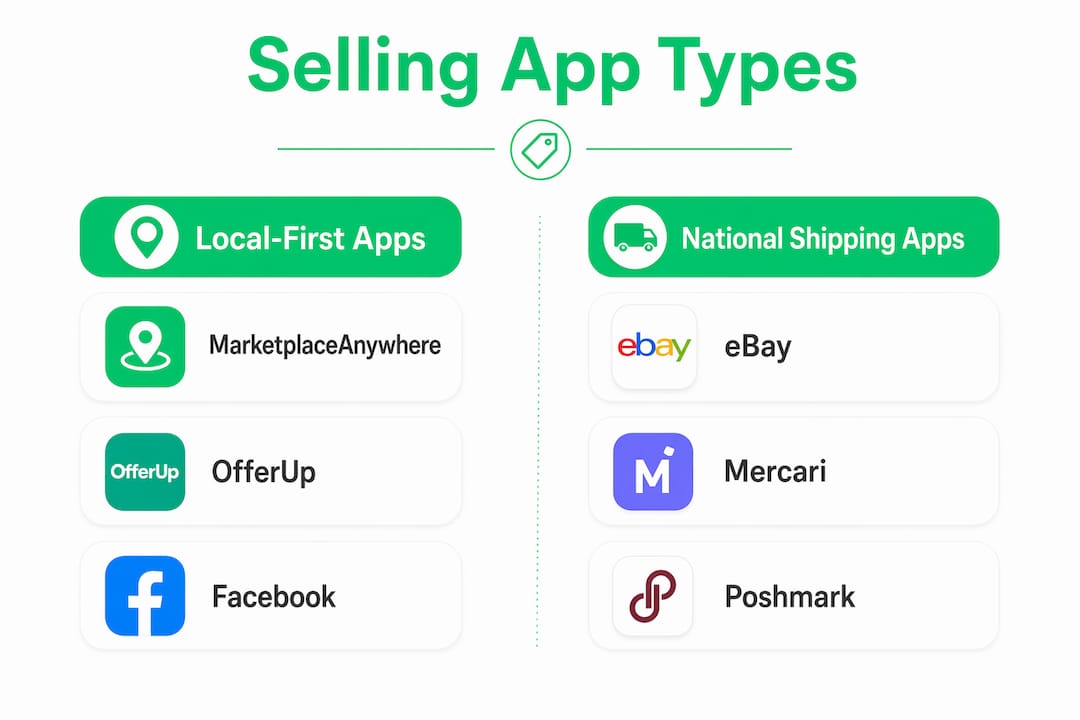
Pros: No shipping logistics; verified profiles reduce scam risk; location search surfaces your listing to nearby buyers; push notifications keep deals moving. Cons: Buyer pool is local, so rare or niche items may take longer to sell than on a national platform.
eBay
eBay's national reach is unmatched for anything rare, collectible, or high-value enough to justify shipping. The eBay Money Back Guarantee covers buyers on most transactions, which actually helps sellers too: buyers bid more confidently. AI-assisted listing tools can auto-generate descriptions from a photo, which cuts setup time considerably.
Pros: Massive buyer pool; auction format drives competitive prices on collectibles; strong authenticity verification for sneakers, watches, and trading cards. Cons: Final value fees around 13.25% add up fast on lower-priced items; shipping coordination falls on the seller.
Facebook Marketplace
No listing fees for local pickup sales makes Facebook Marketplace the default choice for anyone moving furniture, appliances, or everyday household goods. The audience is already there — you are posting inside a platform people check daily. The trade-off is thin buyer protection: transactions are largely self-managed, so cash at meetup is the norm.
Pros: Zero listing fees; enormous local audience; familiar interface. Cons: Minimal dispute resolution; scam messages are common; no in-app payment protection for local deals.
Mercari
Mercari is the easiest national shipping app for casual sellers. List in seconds, print a prepaid label, and get paid via Instant Pay or direct deposit once the buyer confirms receipt. The 10% seller fee plus a payment processing fee is competitive for the category. Buyer Protection and seller ratings keep both sides accountable.
Pros: Simple listing flow; prepaid labels with UPS, FedEx, and USPS; Instant Pay option. Cons: 10% fee eats into margins on cheap items; national shipping means you need to pack and drop off.
OfferUp
OfferUp merged with Letgo to become one of the biggest mobile marketplaces for local buyers and sellers in the U.S. Listings go live in under 30 seconds. Seller reputation scores and in-app messaging let you vet buyers before agreeing to meet. Optional paid boosts (Promote Plus at $19.99/month) push your listings higher in search.
Pros: Fast listing; strong local search; reputation system reduces bad actors. Cons: Paid boosts required for consistent visibility in competitive markets; local-only limits reach for niche items.
Poshmark
Poshmark's large community is fashion-obsessed. Every sale comes with a prepaid, pre-addressed USPS label — you print, pack, and drop it off. The fee structure is simple: $2.95 flat on sales under $15, and 20% on anything above. That 20% stings on mid-priced items, but the built-in social sharing features (followers, shares, Posh Parties) drive organic discovery that other platforms cannot match.
Pros: Massive fashion-specific audience; simple shipping; social discovery tools. Cons: 20% fee is steep; almost exclusively clothing and accessories.
Depop
Depop skews young and visual. If you are selling vintage Levi's, Y2K pieces, or streetwear, this is where the buyers are. Listings live or die by photography — a well-lit flat lay outperforms a hanger shot every time. The 10% Depop fee applies to the item price plus shipping.
Pros: Strong community discovery for fashion; youth demographic pays premium for the right pieces. Cons: Niche audience; photography quality matters more here than anywhere else.
Etsy
Forbes Advisor notes that specialized apps like Etsy are a better fit for handmade and vintage inventory than general marketplaces. The $0.20 listing fee per item plus a 6.5% transaction fee is reasonable for the access it buys: a buyer base actively searching for unique, handcrafted, or vintage goods. Etsy's search algorithm rewards complete listings with strong keywords and multiple photos.
Pros: Devoted specialty buyer base; strong SEO for handmade and vintage searches. Cons: Listing fees add up for large inventories; competitive in popular categories.
Whatnot
Whatnot runs live auctions, which changes the selling dynamic entirely. You go live, show your items, and buyers bid in real time. Trading cards, toys, and sports memorabilia move fast in this format. The roughly 8% seller fee is competitive for the engagement level it generates.
Pros: Live format drives urgency and competitive bids; strong niche communities. Cons: Requires comfort on camera; niche audience limits general-item sales.
Craigslist
Craigslist is free, blunt, and still widely used for large items like furniture, appliances, and local services. There is no app-based payment protection, no dispute resolution, and no seller ratings. You handle everything yourself. For a couch or a riding mower, that trade-off often makes sense.
Pros: Free listings; wide local adoption; no fees. Cons: No buyer or seller protections; scam risk is higher than on any other platform here.
Decluttr
Decluttr skips the listing process entirely. Scan a barcode, get an instant quote, ship for free with a prepaid label, and receive payment the next day after Decluttr receives your items. It is the fastest path to cash for books, CDs, DVDs, and older tech. The trade-off: Decluttr sets the price, so you will not get top dollar the way you might on eBay.
Pros: No listing, no waiting; next-day payment; free shipping. Cons: Decluttr's buy prices are below market; not suitable for items without barcodes.
PangoBooks
PangoBooks does one thing: books. If you have a shelf of novels, textbooks, or academic titles, the category-specific pricing and buyback workflows here beat listing each book individually on a general platform. The 15% commission is the cost of reaching buyers who are specifically looking for books.
Pros: Book-specific audience; simple listing for large collections; prepaid shipping. Cons: Books only; 15% commission on each sale.
Nextdoor
Nextdoor's neighborhood trust signals make it genuinely useful for hyper-local sales where you want to know your buyer is literally down the street. No fees, no shipping, and the community reputation layer reduces the stranger-danger factor. The audience is small by design, so it works best for items with purely local appeal.
Pros: Neighborhood-level trust; free; no shipping. Cons: Very limited reach; not suitable for anything with national demand.
Pro Tip: If you are just starting out, Debutify's seller guidance recommends a three-app stack: one local-first app (MarketplaceAnywhere or Facebook Marketplace), one national marketplace (eBay or Mercari), and one niche app for specialty inventory. That combination covers most seller goals without spreading you too thin.
How to choose the right selling app for your situation
The decision comes down to four variables: what you are selling, how fast you need the money, how much effort you want to put in, and whether shipping is realistic.
Start with the item. NerdWallet recommends local marketplaces for oversized items specifically to avoid shipping and handling costs that can erase your margin. A sofa, a treadmill, or a car part belongs on MarketplaceAnywhere, OfferUp, or Facebook Marketplace. A rare trading card or a designer handbag belongs on eBay or Whatnot, where national buyers compete for it. Clothing goes to Poshmark or Depop. Handmade goods go to Etsy.
Then weigh fees against traffic. High-traffic platforms charge more because they deliver more buyers. Poshmark's 20% fee is painful, but 80 million fashion shoppers is a real asset. Craigslist charges nothing and delivers a local audience with zero protections. The right answer depends on your item's value and your risk tolerance.
Ask yourself these questions before listing:
- Is this item too heavy or fragile to ship safely?
- Does it need authentication (sneakers, watches, luxury goods)?
- How long can you wait for a sale?
- Is the buyer pool local or national for this item type?
Red flags to watch for. Opaque fee structures that only appear at checkout are a problem on any platform. Poor or nonexistent dispute resolution (Craigslist, basic Facebook Marketplace) means you are on your own if something goes wrong. Avoid any buyer who asks to move the conversation off the app before payment is confirmed. CNBC Select's review criteria specifically weighted fee transparency and dispute processes when ranking platforms, and those two factors are the ones most sellers overlook until they get burned.
For high-value items specifically, check each platform's seller protection policy before listing. Platform policies differ significantly on what qualifies for dispute coverage and how quickly claims are resolved.
How these apps were selected and compared
The shortlist was built using a consistent set of criteria applied to every platform, with no app getting a pass for brand recognition alone.
- Fee transparency: Does the platform disclose all fees before a listing goes live? Hidden fees that appear only at payout were a disqualifier.
- Buyer traffic and market size: Active buyer pools drive faster sales. Platforms with demonstrably large or highly engaged audiences ranked higher on speed-to-sale potential.
- Ease of listing: How many steps does it take to go from item to live listing? Mobile UX, photo upload flow, and auto-fill tools all factored in.
- Seller protections and dispute resolution: Platforms with clear, documented dispute processes and buyer/seller protection programs ranked above those with none.
- Shipping support: Prepaid label availability, shipping insurance, and carrier options were evaluated for national-shipping platforms.
- Local reach: For local-first platforms, location-based search quality, verified profile systems, and in-app messaging were assessed.
- Payout speed and methods: How quickly does a seller receive funds after a completed sale, and through what channels?
Exclusion rules: Platforms not available to U.S. sellers were excluded. Platforms with documented patterns of unresolved seller fraud were excluded regardless of traffic size. Industry reviews from CNBC Select and Forbes Advisor were used alongside seller forum feedback and platform help pages. MarketplaceAnywhere's local-first feature set was weighted to reflect the publisher context, but every app was evaluated against the same seven criteria above.
Seller-tested tips to sell faster and for more money
Photos are the single biggest lever you control. Shoot in natural light, use a clean background, and capture at least four angles: front, back, sides, and any defects. A listing with honest condition photos gets fewer lowball offers and fewer post-sale disputes. For electronics, photograph the screen powered on and include any accessories in the frame.
Title strategy matters more than most sellers realize. Lead with the brand name, model, and condition: "Apple iPhone 13 Pro Max — Graphite, 85% Battery, Unlocked" beats "iPhone for sale" in search results on every platform. Include the size for clothing, the year for vehicles, and the edition for books.
Price with data, not gut feel. Search your item on the platform you plan to use, filter by "sold" listings, and price within 10% of the median completed sale. Overpricing stalls listings; underpricing leaves money on the table. For high-value items like watches, a guide to selling watches online can help you understand authentication requirements and realistic price ranges before you list.
Category-specific fits:
- Clothing: Poshmark or Depop; share listings actively on Poshmark to trigger the social algorithm.
- Furniture and appliances: MarketplaceAnywhere or Facebook Marketplace; local marketplaces minimize shipping costs on heavy items.
- Electronics: MarketplaceAnywhere for local pickup, Mercari for national shipping on smaller devices.
- Books and textbooks: PangoBooks or Decluttr for speed; eBay for rare or out-of-print titles.
- Collectibles: eBay for fixed-price or auction; Whatnot for live-auction engagement.
Safety at meetups. Meet in a public place with foot traffic — a coffee shop, a bank lobby, or a police department's designated safe exchange zone. Use in-app messaging until the sale is confirmed; never share your phone number or email before payment is agreed. Forbes Advisor's safety guidance consistently emphasizes verified profiles and in-app communication as the two practices that reduce transaction risk most.
MarketplaceAnywhere's verified seller ratings and location-based search are specifically designed around these safety practices. Buyers can see your rating history before messaging, and the secure in-app payment option means cash does not need to change hands at the meetup.
Pro Tip: Complete profiles and clear photos raise conversion rates and buyer ratings across every platform. Fill out every profile field, add a profile photo, and respond to messages within a few hours. Sellers who respond quickly close deals faster.
Key Takeaways
The best selling app depends on your item type and goals: local-first platforms win for bulky goods, niche platforms win for specialty categories, and national marketplaces win for high-value items with broad demand.
| Point | Details |
|---|---|
| Local-first for bulky items | Use MarketplaceAnywhere, OfferUp, or Facebook Marketplace to avoid shipping costs on furniture and appliances. |
| Match niche items to niche platforms | Clothing sells faster on Poshmark or Depop; handmade goods belong on Etsy; collectibles move best on eBay or Whatnot. |
| Fees erode margins on cheap items | Factor in platform fees and shipping before listing; local pickup often nets more on lower-priced goods. |
| Cross-posting speeds sales | Listing the same item on two platforms (e.g., MarketplaceAnywhere and Facebook Marketplace) doubles exposure with minimal extra effort. |
| MarketplaceAnywhere for local selling | MarketplaceAnywhere's verified profiles, secure payments, and location search make it the recommended starting point for local sellers. |
The case for local-first selling (and where sellers go wrong)
The conventional wisdom says list everywhere and let the algorithms sort it out. That advice sounds efficient, but it creates a specific problem: sellers who list a heavy item on a national shipping platform either absorb brutal shipping costs or lose the sale when the buyer sees the freight quote. The item that should have sold locally in two days sits for three weeks.
Local-first is not a consolation prize for sellers who cannot figure out shipping. It is the correct strategy for a specific and very common category of goods: anything large, fragile, or low-margin relative to its shipping cost. A $60 lamp is not worth $25 in shipping plus platform fees. A $60 lamp sold locally nets $55 after a small transaction fee and zero packaging time.
The other mistake worth naming: sellers who treat photos as an afterthought. Every platform's algorithm surfaces listings with more photos and higher engagement. A listing with one blurry image competes against listings with eight clear shots. The camera on your phone is good enough. The lighting in your living room probably is not — take it outside or near a window.
Cross-posting makes sense when an item has both local and national demand. A gaming console, for example, could sell locally on MarketplaceAnywhere or nationally on Mercari. List both, respond to whoever moves first, and pull the other listing immediately. What does not make sense is cross-posting a sectional sofa to eBay. Know what your item is before you decide where it belongs.
Start selling locally with MarketplaceAnywhere
If you have items sitting in your garage or closet, the fastest path to cash is usually a local sale. MarketplaceAnywhere is built specifically for that: no shipping coordination, no packaging runs, and no waiting a week for a buyer across the country to confirm delivery.
Here is what you get on MarketplaceAnywhere: verified seller ratings that build buyer trust before the first message, location-based search that puts your listing in front of nearby buyers, secure in-app payment options, and push notifications so you never miss an offer. Getting started takes three steps: create your listing on the platform, set your price and pickup preference, and meet your buyer locally or arrange delivery. The platform covers electronics, fashion, vehicles, home goods, and more. If you are ready to turn unused items into cash without the hassle of shipping, start selling locally on MarketplaceAnywhere today.
Sources and further reading
The recommendations in this article draw on the following publications and platform resources. Check each platform's help center for the latest fee and payout details before listing, as these change periodically.
- Best Selling Apps and Websites for 2026 — CNBC Select
- Best Apps To Sell Your Stuff — Forbes Advisor
- Where to Sell Stuff Online: 12 Ideas — NerdWallet
- Top Seller Apps in 2026 — Debutify
- OfferUp Buy & Sell Marketplace — App Store
- Poshmark Sell Page
- eBay App — App Store
- Mercari — Google Play
- MarketplaceAnywhere — Buy & Sell Locally