
The fastest way to negotiate a lower price is to prepare your walk-away number, open with a precise anchor, and trade every concession conditionally. Research from the Program on Negotiation at Harvard Law School confirms that precise numeric anchors produce smaller counteroffers and narrow the final settlement in the buyer's favor. And consumer data shows that 89% of people who actually try to haggle walk away with a better deal than the sticker price.
TL;DR: Prepare a real alternative (BATNA), open with a specific number, and never give a concession without asking for something back.
- Prepare your BATNA first. Without a genuine walk-away option, you can only accept, not negotiate.
- Anchor with a precise number. "$2,347" signals research; "$2,300" signals a guess.
- Trade concessions, never gift them. Every discount you offer should come attached to a condition.
Table of Contents
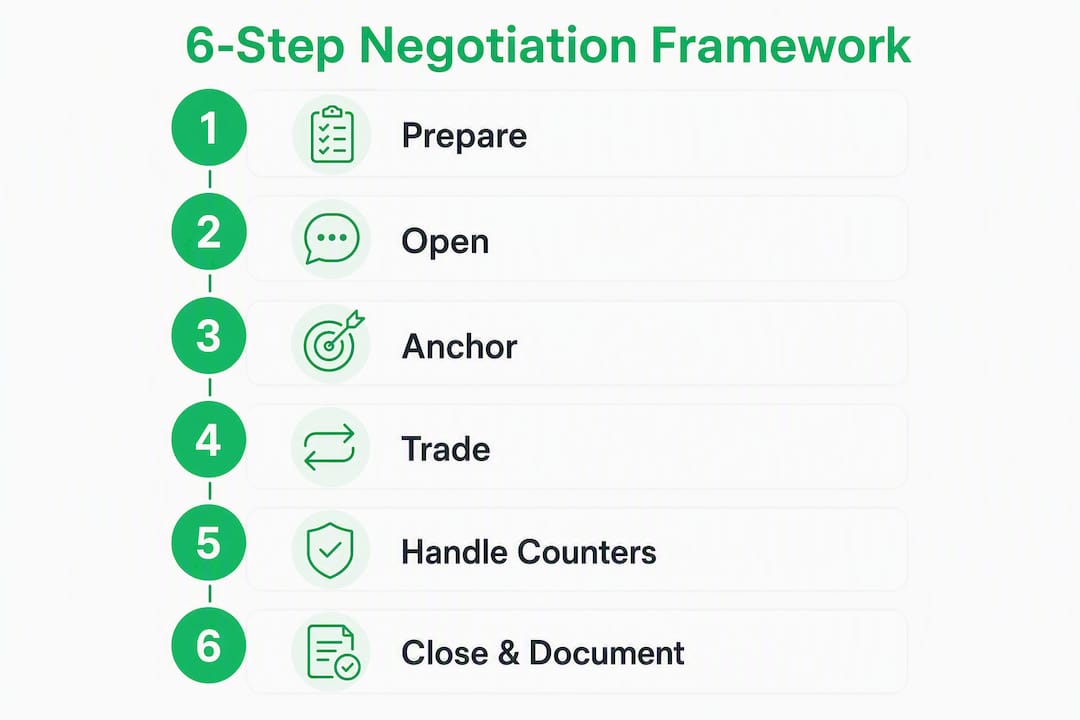
- How to negotiate on price: the 6-step framework
- What to say: exact phrases for every negotiating moment
- How much should you offer? Rules of thumb by scenario
- How to handle objections and firm "no" answers
- Common mistakes that cost you money
- Three realistic examples that show the framework in action
- Why these tactics work: the research behind the scripts
- Key Takeaways
- The negotiation advice most guides skip
- Find your next deal on Marketplaceapp
- Useful sources
How to negotiate on price: the 6-step framework
Run this sequence before any call, chat, or in-person ask. It works for a used couch on a local listing, a software contract, and everything in between.
Step 1: Prepare
Research the market price before you say a word. Check comparable listings, published retail prices, and recent sale data. Then set two numbers: your target price (what you actually want to pay) and your reservation price (the absolute most you will pay before walking). The gap between them is your negotiating room.
Your reservation price is your BATNA in dollar form. The Harvard Program on Negotiation is clear on this: without a real alternative, you have no leverage. Know your walk-away before you open your mouth.
Also pre-price your tradeables. List the non-monetary things you can offer: faster payment, larger order, flexible pickup, a public review, or a referral. These cost you little but can be worth real money to the seller.
Pre-call checklist:
- Market price range (3+ comparable sources)
- Your target price and walk-away price
- List of 2–3 tradeables you can offer
- Timing advantage (end of month, end of season, slow hours)
Step 2: Open
Start with a short rapport line, then state a value-aligned reason for negotiating. Do not apologize for asking. Sellers expect negotiation; apologizing signals weakness before you have even started.
Timing matters here. Consumer guides consistently show that end-of-month, end-of-season, and quiet store hours increase the likelihood of a discount or an added extra. A floor manager near a sales quota is a different conversation than one at 11 AM on a Tuesday in peak season.
Step 3: Anchor
Make the first offer whenever you have done your research. The first number on the table becomes a psychological anchor that shapes every counteroffer that follows. Use a precise figure, not a round one. "$1,847" reads as calculated; "$1,800" reads as a guess.

Pair your anchor with a brief justification: a comparable sale, a published price, or a condition note. That one sentence transforms your number from a wish into a data point.
Step 4: Trade
When the seller counters, do not simply split the difference. Attach a condition to every move you make. "If you can hold that price, I can pay in full today" is a trade. "Okay, $1,900" is a gift. Gifts train sellers to wait you out.

Pre-loaded tradeables from Step 1 pay off here. You already know what you can offer, so you are not improvising under pressure.
Step 5: Handle counters
When a seller pushes back, pause before responding. Silence is a legitimate tactic: after stating your position, stop talking. The Harvard Program on Negotiation notes that silence often pressures the other side into filling the gap with a concession or a justification you can use.
If the counter is still too high, re-anchor with data rather than emotion. "Based on the three comparable sales I found, $1,847 is in line with market" is harder to dismiss than "that still feels too high."
Step 6: Close and document
Once you reach an agreement, confirm the out-the-door total immediately, in writing. Gangly's margin research shows that delaying written capture of an agreed price by even a day opens the door to scope creep and changed conditions. A quick email or chat message that restates the agreed price, any extras, and the payment terms takes 90 seconds and protects everything you just earned.
Pro Tip: Ask "Is there anything else you can include at that price?" right before you close. Sellers who cannot move further on price often have room to add an accessory, an extended warranty, or free delivery. You only find out by asking.
What to say: exact phrases for every negotiating moment
Knowing the tactic is half the job. Knowing the exact words is the other half. These scripts are ready to use on a call, in a chat window, or in an email.
Opening lines
Phone/in-person: Chat/email: For a recurring service: Keep the tone warm but direct. You are not asking for a favor; you are opening a conversation.
Precise anchor scripts
Precise numbers signal research and reduce the seller's willingness to push back hard. Compare:
- Round anchor: "I was thinking around $500."
- Precise anchor: "Based on recent comparable sales, I'd like to offer $487."
The second version invites a smaller counteroffer. Pair it with one line of justification: a comparable listing, a published price, or a condition note.
Conditional concession scripts
Never move on price without attaching a condition. These phrases do that automatically:
- "If you can come down to $[X], I can pay in full by [date]."
- "If you include [extra], I'm ready to sign today."
- "I can go up to $[X] if you can throw in [accessory/delivery/warranty]."
The structure is always: if you do X, I can do Y. That framing keeps every concession tied to a trade.
Responding to "the price is firm"
If they hold firm on everything:
Then actually pause. Walking away, or credibly signaling you might, is often what moves a stuck negotiation.
Responding to "I don't have authority to discount"
For a subscription or recurring bill, ask specifically for the retention team. Consumer guides note that retention agents typically have more discount authority than front-line reps.
Closing line
How much should you offer? Rules of thumb by scenario
There is no universal "offer 20% less" rule that works everywhere. The right opening offer depends on the category, the seller's flexibility, and the signals you pick up during prep.
General principles
Start below your target price, not at it. You need room to move toward your actual goal without overshooting your walk-away. Always negotiate the out-the-door total, not a monthly payment. Monthly framing hides the real cost and is a common trap in car dealerships and subscription services.
Safe ranges by scenario
Used goods (local listings, secondhand items): Opening 15–25% below the asking price is generally defensible, especially when you can point to comparable listings. Sellers on peer-to-peer platforms often price with negotiation in mind.
Retail (electronics, appliances, furniture): Aim for 5–15% off, or shift to non-price asks: free delivery, an extended warranty, or an open-box discount. Retail margins on electronics are thin; services and accessories have more room.
Services (contractors, freelancers, agencies): 10–20% is a reasonable opening, but the more effective move is often to trade scope. "Can you hold that rate if I commit to a 6-month contract?" gives the seller a reason to move.
B2B purchases: Pre-load your tradeables before the first call. Gangly's margin framework recommends anchoring 14–21 days before procurement deadlines, when sellers are most motivated to close. Volume, payment terms, and reference rights are the most tradeable variables.
When price won't move, shift to extras
If a seller is genuinely at their floor, pivot to a trade list: faster payment, a larger order, a public review, or a referral. These cost you little and often unlock value the seller cannot express as a discount.
A note on category sensitivity: Electronics and commodity goods have publicly visible price floors. Pushing past 15% off retail on a new iPhone will likely end the conversation. Services and used goods have far more room. Read the market before you anchor.
How to handle objections and firm "no" answers
Resistance is normal. A seller who says "no" on the first ask is not necessarily done negotiating; they are often testing whether you are serious.
Common objections and short responses
"That's the lowest I can go." Pause. Then: "I hear you. If the price stays at $[X], could you include [extra] to help me get there?"
"I don't discount." "Totally fair. Is there anything you could add at that price, like [delivery / setup / accessory]?"
"I don't have authority to change the price." "Who does? I'd love to speak with them directly."
"We're already below market." "I've seen a few comparables at $[lower price]. Can you help me understand what's different here?"
A three-turn example
Buyer: "I'd like to offer $340 for the laptop. I found two similar models locally at that price." Seller: "Best I can do is $390." Buyer: "I can go to $355 if you include the charger and we close today."
That last line is a conditional concession: a small price move attached to two tradeables (an accessory and a fast close). It gives the seller a reason to say yes without simply caving.
What not to do
- Never reveal your maximum budget. Once a seller knows your ceiling, that becomes the floor.
- Never apologize for asking. It signals that you expect to be refused.
- Never negotiate monthly payments without locking the total first. Monthly framing inflates the real cost.
- Never react emotionally to a high counter. Surprise or frustration hands the seller information they can use.
When to escalate
If a front-line rep is stuck, ask for a manager or a retention specialist. Frame it politely: "Is there someone else I could speak with who might have more flexibility on pricing?" That question alone often prompts the rep to check with a supervisor rather than lose the sale.
Pro Tip: For subscription services, the phrase "I'm considering canceling" almost always routes you to a retention team with real discount authority. Use it only if you mean it.
Common mistakes that cost you money
Speed through this list before any negotiation. Each item here has cost real buyers real money.
Mistakes to avoid:
- Revealing your maximum budget before the seller has anchored
- Negotiating the monthly payment instead of the total price
- Over-explaining your offer with personal reasons (why you need a discount is irrelevant to the seller)
- Accepting the first counteroffer without a conditional trade
- Making a round-number anchor that signals you are guessing
- Letting the conversation end without written confirmation of the agreed terms
Red flags from sellers:
- Scripted, identical responses to every question (signals no real flexibility)
- Refusal to discuss any non-price terms (extras, timing, delivery)
- Pressure to decide immediately without time to compare
- Pushing monthly payment framing while avoiding the total price
If a negotiation is going poorly:
- Pause and restate your anchor with a data point.
- Shift to a non-price trade: "If the price can't move, what can you add?"
- Signal willingness to walk: "Let me think about it and come back to you."
- Actually walk if your reservation price has been crossed. A deal above your walk-away is not a win.
The Academy of Negotiation puts it plainly: never accept the first offer, use silence after stating your price, and be genuinely willing to walk away. The willingness to leave is what makes every other tactic credible.
Three realistic examples that show the framework in action
Example 1: Used item on a local listing
You find a used espresso machine listed at $280. Comparable machines in similar condition are selling for $210–230 locally.
Opening chat: "Hey, still available? I'm ready to pick up today. Would you take $215?"
The seller counters at $255.
Conditional concession: "I can do $230 cash if we can meet this afternoon."
The seller agrees. You saved $50, closed fast, and gave the seller a same-day pickup they probably wanted anyway.
Example 2: Dealer-style purchase (car or large appliance)
You are buying a floor-model refrigerator listed at $1,499. The salesperson says it is already marked down.
Anchor: "I can see it's been on the floor a while. Based on the open-box condition, I'd like to offer $1,247."
The rep counters at $1,350.
Trade: "If you can include delivery and haul away the old unit, I'll do $1,350 today."
The rep agrees. You did not get the price you anchored, but you added $150–200 in services. Watch the monthly payment trap here: always confirm the total before signing anything.
Example 3: Small B2B purchase (software or agency service)
A freelance designer quotes $3,800 for a brand identity project. Your budget is $3,200, and your walk-away is $3,500.
Pre-loaded tradeables: faster payment (net-7 instead of net-30), a testimonial, and a referral to a colleague.
Opening: "Your work is exactly what we need. Our budget for this scope is $3,347. If we can land there, I can pay net-7 and write a detailed testimonial for your portfolio."
The designer counters at $3,600.
Counter: "I can go to $3,450 net-7 with the testimonial and a referral introduction. That's my best number."
They settle at $3,500. You stayed inside your walk-away, paid fast (which the designer values), and gave them two marketing assets that cost you nothing.
Why these tactics work: the research behind the scripts
The techniques in this guide are not intuition. They are grounded in negotiation research that has been replicated across consumer, commercial, and academic settings.
Anchoring
The Harvard Program on Negotiation has documented the anchoring effect extensively: the first number on the table disproportionately shapes the final settlement. Precise anchors outperform round numbers because they signal that the buyer has done real research, which reduces the seller's confidence in their own position and narrows the range of counteroffers.
Asking works
Consumer research puts the success rate for people who actually try to negotiate at 89%. The single biggest barrier is not seller resistance; it is buyer reluctance to ask. Most people assume the price is fixed when it is not.
Conditional concessions
The trade-not-gift principle is a cornerstone of professional negotiation. Every unconditional concession you make trains the other side to wait for the next one. Conditional language ("if you do X, I can do Y") stops that cycle and keeps every move tied to a reciprocal gain.
Timing and documentation
Gangly's B2B margin research shows that anchoring 14–21 days before procurement deadlines and locking terms in writing immediately after agreement are the two highest-leverage process moves available to a buyer. The same logic applies to consumer purchases: shop near quota deadlines and confirm in writing before you leave.
| Tactic | What the research shows | Source |
|---|---|---|
| Precise numeric anchor | Produces smaller counteroffers; signals expertise | Harvard PON |
| Asking / haggling | 89% success rate for buyers who try | DontPayFull |
| Conditional concessions | Preserves margin; prevents unilateral discount cycles | Academy of Negotiation |
| Early anchoring (B2B) | 14–21 days before deadline maximizes leverage | Gangly |
| Rapid documentation | Delays of more than a day erode negotiated value | Gangly |
Stat to remember: 89% of buyers who ask for a better price get one. The negotiation usually fails before it starts because the buyer never asks.
Key Takeaways
Effective price negotiation comes down to four moves: set a real walk-away number, anchor with a precise figure, trade every concession conditionally, and lock the agreement in writing immediately.
| Point | Details |
|---|---|
| Set your BATNA first | Know your walk-away price before you open; without it, you can only accept. |
| Anchor with a precise number | A specific figure like $1,847 signals research and narrows counteroffers more than a round number. |
| Trade, never gift | Attach a condition to every concession: "If you can do X, I can do Y." |
| Document immediately | Confirm the out-the-door total in writing the same day to prevent scope creep. |
| Use Marketplaceapp to practice | Browse local, negotiable listings on Marketplaceapp to apply these scripts in real, low-stakes transactions. |
The negotiation advice most guides skip
Most negotiation content focuses on tactics as if the other party is an obstacle to overcome. That framing is both wrong and counterproductive, especially in local and repeat-purchase contexts.
The buyers who consistently get the best deals are not the most aggressive ones. They are the most prepared. They know their number, they know their tradeables, and they make it easy for the seller to say yes by attaching a clear benefit to every ask. That is not manipulation; it is clarity.
There is also a reputational dimension that rarely gets mentioned. On local marketplaces, sellers remember buyers. A buyer who negotiates respectfully, closes when they say they will, and pays promptly gets better deals on future listings from the same sellers. A buyer who low-balls rudely, ghosts after agreeing, or haggles past the point of reason gets blocked. The short-term win from aggressive tactics often costs more in closed doors than it saves on a single transaction.
The Business Insider guide on haggling frames it well: be friendly but firm, and stay perceptive rather than presumptuous. Read the seller's signals. If they are clearly at their floor, pivot to extras rather than pushing on price. If they have room to move, a well-placed silence after your anchor will often do more work than another round of back-and-forth.
One more thing most guides understate: the value of walking away cleanly. A polite "I appreciate your time, let me think about it" is not a failure. It is often what prompts a seller to follow up with a better offer within 24 hours, because they would rather close than reopen the listing.
Find your next deal on Marketplaceapp
The best way to get comfortable negotiating is to do it in real transactions, with real stakes that are low enough to learn from. Marketplaceapp is built for exactly that: a peer-to-peer local marketplace where buyers and sellers connect directly, prices are frequently negotiable, and the messaging thread is already there for you to open with a precise anchor.
Listings across electronics, furniture, vehicles, and home goods give you dozens of live opportunities to practice the scripts in this guide. Verified seller ratings tell you who is responsive and who has a track record of fair deals. Secure payments mean you are protected when you close. And because transactions are local, you can negotiate pickup timing, condition inspection, and bundled extras in the same conversation where you discuss price.
Browse local listings on Marketplaceapp and put your first precise anchor to work today.
Useful sources
The research and scripts in this guide draw from the following sources:
- Price Negotiation Advice for Consumers — Program on Negotiation at Harvard Law School: foundational consumer negotiation tactics, BATNA framework, and anchoring research.
- Price Anchoring 101 — Program on Negotiation at Harvard Law School: detailed coverage of how first offers shape final settlements and when to use bolstering ranges.
- In a Price Negotiation, Should You Make the First Offer? — PON: guidance on when to anchor first and how to frame the opening offer.
- The Dos and Don'ts of Haggling — Business Insider: etiquette-based guidance on tone, perceptiveness, and relationship preservation in price talks.