
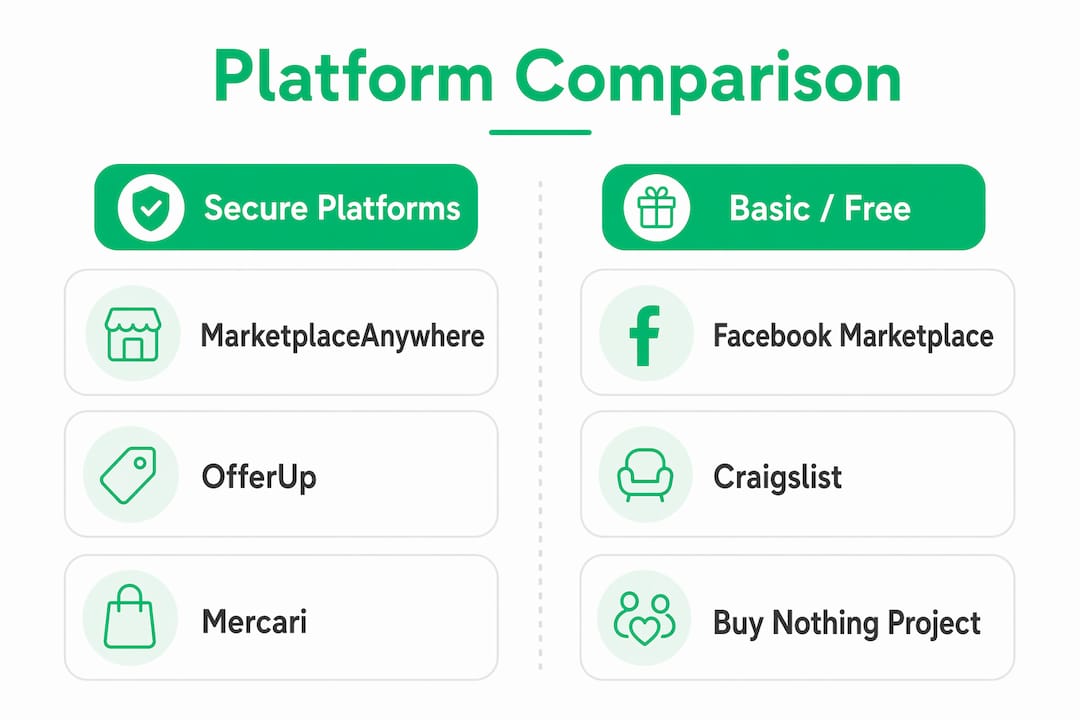
For local buying and selling, Marketplaceapp (MarketplaceAnywhere) is the top pick: it combines verified seller ratings, secure in-app payments, and location-based search in one purpose-built marketplace. If you want more options, OfferUp is the runner-up for fast local cash deals, Facebook Marketplace wins on raw buyer volume, and the Buy Nothing Project is the go-to for free gifting. Craigslist and Mercari round out the list for specific use cases. Safety, fees, and how many active buyers are in your ZIP code are the factors that actually separate these platforms, and each one is covered in detail below.
- MarketplaceAnywhere — best for secure local sales with verified ratings and in-app payments
- OfferUp — best for quick local cash transactions and a clean mobile experience
- Facebook Marketplace — best for sheer buyer volume and zero listing fees
- Craigslist — best for no-frills, free classified listings across most U.S. cities
- Mercari — best for shipping small items nationwide when local buyers are scarce
- Buy Nothing Project — best for free, community-based gifting with no money involved
Safety, fees, and buyer volume are the deciding factors. Each platform handles all three differently, and the right choice depends on what you're selling and where you live.
Table of Contents
- Which Nextdoor alternatives are best for buying and selling?
- How do these platforms actually compare for local sellers?
- How do you choose the right platform for your item?
- What are the safest ways to complete a local transaction?
- Which platform fits your specific item or situation?
- Key Takeaways
- Why most sellers are using the wrong platform
- Marketplaceapp makes local selling faster and safer
- Sources and further reading
Which Nextdoor alternatives are best for buying and selling?
| Platform | Best for | Fees / Payment | Local Pickup | Shipping | Verification & Safety | Listing Ease | Buyer Volume |
|---|---|---|---|---|---|---|---|
| MarketplaceAnywhere | Secure local sales | Transaction fee; in-app secure payments | Yes | Yes | Verified seller ratings, secure payments | Mobile app, push notifications | Growing U.S. local reach |
| Facebook Marketplace | Maximum buyer reach | Free to list; payment via Marketplace Checkout or cash | Yes | Yes (select items) | Basic ID; buyer/seller ratings | Very easy; integrates with FB account | Massive — hundreds of millions of U.S. users |
| Craigslist | Free no-frills classifieds | Free (most categories); cash typical | Yes | Rarely | Minimal; no built-in escrow | Simple web form | High in urban areas; thin in rural |
| OfferUp | Fast local cash deals | Free to list; optional shipping; TruYou ID verification fee | Yes | Yes | TruYou ID verification; seller ratings | Excellent mobile app | Strong in most U.S. metros |
| Mercari | Nationwide shipping sales | 10% seller fee + 2.9% + $0.50 payment fee | Limited | Yes — primary model | Ratings system; buyer/seller protection | Easy mobile listing | Large national audience |
| Buy Nothing Project | Free community gifting | Free; no payments | Yes — local only | No | Facebook group moderation; community vouching | Moderate (Facebook-based) | Hyperlocal; varies by neighborhood |
MarketplaceAnywhere stands out for sellers who want the full package: secure payments, verified ratings, and local pickup support without having to manage payment risk on their own. Industry analysis from early 2026 confirms a clear shift toward purpose-built platforms that support concrete actions like exchanging goods, rather than general neighborhood apps cluttered with ads and civic noise.
How do these platforms actually compare for local sellers?
MarketplaceAnywhere
Pros: Verified seller ratings build trust before a buyer ever messages you. Secure in-app payments mean you're not chasing Venmo requests or handling cash at a parking lot. Location-based search and push notifications keep your listing in front of nearby buyers actively looking.

Cons: Smaller current user base than Facebook Marketplace; buyer volume in very rural areas may be limited while the platform grows.
Facebook Marketplace
Pros: The buyer pool is enormous. If you list a couch on a Tuesday morning, you can have five inquiries by noon. Zero listing fees, and most Americans already have an account.
Cons: Payment protection is inconsistent — many transactions still happen in cash with no recourse. Scam attempts are frequent, and the feed mixes your listing with ads and unrelated content. Users commonly leave broader neighborhood apps precisely because of ad-heavy, algorithmically manipulated feeds.
Craigslist
Pros: Free to list in almost every category. No account required for buyers. Huge reach in major U.S. cities for furniture, vehicles, and appliances.
Cons: Zero built-in buyer or seller protection. No escrow, no ratings, no in-app payments. Cash-only culture means you're on your own if a deal goes sideways. Thin activity outside metro areas.
OfferUp
Pros: TruYou identity verification gives sellers a meaningful trust signal. Clean mobile app makes listing fast. Strong in most U.S. metros for furniture, electronics, and clothing.
Cons: Promoted listings cost extra. Shipping fees add up for heavier items. Buyer volume drops noticeably in smaller cities.
Mercari
Pros: Nationwide audience means you're not limited to local buyers. Buyer and seller protection is built in. Good for small, shippable items like clothing, collectibles, and electronics.
Cons: The 10% seller fee plus a 2.9% + $0.50 payment processing fee cuts into margins. Local pickup is possible but not the platform's strength. Bulky items are impractical to ship.
Buy Nothing Project
Pros: Zero cost, zero friction for gifting. Hyperlocal by design — your neighbors are the audience. Closed community models with neighbor vouching reduce spam and bad actors.
Cons: No money changes hands, so it's useless if you need to sell. Runs through Facebook Groups, which limits reach to people still on that platform.
Reputation-based systems with verified badges consistently reduce antisocial behavior and increase completed transactions, which is why platforms that invest in verification outperform open, anonymous classifieds for higher-value items.
How do you choose the right platform for your item?
Start with three questions: What am I selling? How fast do I need the money? And how much do I trust the buyer pool?
Item type drives the first cut. Bulky furniture and appliances need local pickup support and a large nearby buyer pool. Facebook Marketplace and MarketplaceAnywhere both deliver on that. Small electronics and clothing can ship, which opens Mercari's national audience. Free items go to Buy Nothing. Vehicles and tools do well on Craigslist in urban markets, but only if you're comfortable with cash transactions and no platform protection.
Urgency shapes your fee tolerance. If you need a fast sale, a platform with a large local buyer base beats a lower-fee platform with thin traffic. Paying a transaction fee on MarketplaceAnywhere or OfferUp is worth it when the alternative is a listing that sits for three weeks on a free site with no traction.
Buyer vetting matters more than most sellers realize. Platforms that combine reputation signals with platform-mediated payments enable faster dispute resolution and more completed transactions. Before listing anything over $50, check whether the platform offers in-app payments, a ratings system, and a clear dispute process.
Typical time-to-sale ranges widely: high-demand items like iPhones or name-brand sneakers can sell within hours on a high-volume platform. Furniture in a mid-size city averages a few days to a week. Niche items can take two to four weeks regardless of platform.
Pro Tip: List below expected resale value and include pickup details (floor, elevator access, disassembly) for bulky items. Sellers who do this consistently close deals faster than those who price at retail and leave logistics vague.
Watch for these red flags before accepting a deal: a buyer who insists on paying via wire transfer or gift card, an offer that arrives within minutes at full asking price from an account with no history, or a request to move the conversation off-platform before any payment is discussed.
What are the safest ways to complete a local transaction?
The safest default is platform-mediated payment plus a public daytime meetup. That combination eliminates the two biggest risks: payment fraud and physical safety.
Before you list:
- Photograph items from multiple angles in good natural light
- Write an honest condition description — note scratches, missing parts, or wear
- Record serial numbers for electronics before handing them over
- Never include your home address in the listing itself
Getting paid safely:
- Use in-app payment tools whenever the platform offers them
- Accept cash only in person, counted before you hand over the item
- Avoid Zelle for marketplace transactions — it offers no buyer or seller protection and reversals are nearly impossible
- Never accept overpayment with a request to refund the difference; that's a check fraud setup
Where to meet:
- Police station parking lots are the gold standard — many U.S. departments designate "safe exchange zones"
- Large retail parking lots with active surveillance cameras work well
- Bring a friend for anything over $100 or any item that requires a test (electronics, vehicles)
- Daytime only; if a buyer pushes for late evening, that's a signal
Pro Tip: Prioritize platforms with verified profiles and a public ratings history. A seller or buyer with 20+ completed transactions and a 4.8-star rating is a meaningfully different risk profile than an anonymous account created last week.
Common scams to recognize: fake payment confirmation screenshots, "I'll send a mover to pick it up" schemes where payment never clears, and phishing links disguised as platform notifications. If something feels off, it usually is.
Which platform fits your specific item or situation?
Selling a couch or large appliance: Prioritize local pickup support and buyer volume. MarketplaceAnywhere and Facebook Marketplace are the strongest options. Include exact dimensions and note whether you can help disassemble.
Selling a smartphone or laptop: In-app payments and a ratings system matter most here, since electronics attract the most scam attempts. MarketplaceAnywhere and OfferUp both handle this well. Mercari works if you're open to shipping.
Quick flip on a trending item: Facebook Marketplace for volume, or OfferUp for a cleaner transaction experience. List within an hour of acquiring the item while demand is fresh.
Giving away items you don't want to deal with: Buy Nothing Project. No pricing, no negotiation, no payment logistics. Post it, pick a neighbor, done.
Selling in a rural area with thin local traffic: Mercari's national shipping model is your best bet. Local platforms will underperform when there simply aren't enough nearby buyers.
Segmented, purpose-built platforms that separate commerce from civic chatter keep listings visible to buyers who are actually shopping, rather than burying them under neighborhood news and political threads.
Key Takeaways
For local buying and selling, the platform you choose should match your item type, urgency, and need for payment protection — not just whichever app has the most users.
| Point | Details |
|---|---|
| Top pick for secure local sales | MarketplaceAnywhere offers verified ratings, in-app payments, and location-based search in one platform. |
| Best for raw buyer volume | Facebook Marketplace reaches the most U.S. buyers but offers weaker payment protection and more scam exposure. |
| Fee awareness matters | Mercari charges a 10% seller fee plus a 2.9% + $0.50 payment fee; factor that in before listing small-value items. |
| Safety non-negotiable | Use platform-mediated payments and public daytime meetups for every local transaction, regardless of platform. |
| Marketplaceapp recommendation | Start your listing on MarketplaceAnywhere for secure local sales with verified seller ratings and built-in payment protection. |
Why most sellers are using the wrong platform
The conventional wisdom says go where the most people are. That usually means Facebook Marketplace. But raw user count is a misleading metric for sellers who care about completing a transaction safely and efficiently.
A platform with 200 million users and no payment protection, no verified profiles, and an ad-saturated feed is not actually better for selling than a purpose-built marketplace with a smaller but more intent-driven audience. The shift toward intent-based platforms in 2026 reflects exactly this: sellers are tired of fielding lowball offers from anonymous accounts and managing payment risk entirely on their own.
The platforms that win for sellers are the ones that treat the transaction as the product, not the social feed. Verified ratings, in-app payments, and clean listing tools are not premium features — they're the baseline for a marketplace that actually works. Choose accordingly.
Marketplaceapp makes local selling faster and safer
Every platform covered in this article solves part of the problem. Marketplaceapp's MarketplaceAnywhere is built to solve all of it in one place: secure payments so you're never chasing cash, verified seller ratings so buyers trust you before they message, and location-based search so your listing reaches the right people in your area.
List electronics, furniture, fashion, vehicles, pets, home goods, and more with a mobile app that sends push notifications the moment a buyer shows interest. No guessing whether your listing is visible. No managing payment risk outside the platform.
Start selling on MarketplaceAnywhere today — create your first listing in minutes and reach local buyers who are actively looking for what you have.
Sources and further reading
The sources below informed this article and offer deeper reading on local marketplace safety, platform design, and neighborhood app trends in the U.S.
| Source | What it covers |
|---|---|
| Closeby Blog — Nextdoor Alternatives 2026 | Platform comparison, intent-based design trends, and seller tips for local marketplaces |
| CityBuzz | Velocity-based feed design, reputation systems, and privacy-first location features |
| Towne | Invite-only and ZIP verification models; segmented community channels for commerce |
| Telegram Messenger | Neutral messaging tools and the limits of unprotected peer-to-peer transactions |
| Fellow | Community-first apps with event planning and subscription micro-communities |
This article is general information for U.S. buyers and sellers. Platform fees, policies, and safety features change frequently — confirm current terms directly with each platform before transacting.