
The fastest reliable way to sell your car locally is to match the right route to your actual goal: get a dealer instant offer if you need cash within a day or two, list privately if you want the most money and can invest a few weeks, or post on a local marketplace if you want reach and control without handing the keys to a dealer. Most sellers should do all three in sequence, starting with the dealer offer.
Here's your three-step starter plan:
- Get at least one dealer instant offer today. It takes a short time online and gives you a no-risk price floor before you list anywhere. You're not obligated to accept it.
- Gather your paperwork and take photos within 48 hours. Title, maintenance records, spare keys, odometer disclosure, and 8–10 clean photos are what separate a listing that sells in days from one that sits for months.
- Post your listing or schedule the dealer visit within the week. If the private offers don't beat the dealer number by enough to justify the effort, take the dealer deal.
A private sale typically takes a few weeks and requires a significant time commitment. A dealer instant offer can close the same day. A local marketplace listing lands somewhere in between.
Table of Contents
- Which route should you take to sell your car locally?
- How to prepare, price, and photograph your car before listing
- How to create a secure listing and screen buyers
- How to meet buyers safely and close the sale
- Why getting a dealer instant offer first is smart strategy
- Key Takeaways
- What experienced sellers get wrong (and how to fix it fast)
- Marketplaceapp makes your local car sale easier
- Useful resources for title transfer, valuation, and payoff
Which route should you take to sell your car locally?
The right route depends on four things: how fast you need the money, what condition the car is in, how much time you're willing to spend, and your comfort with strangers.
| Route | Speed | Typical net proceeds | Time investment | Paperwork burden | Scam risk |
|---|---|---|---|---|---|
| Dealer instant offer | 1–2 days | Lowest (trade-in range) | 1–3 hours | Dealer handles most | Very low |
| Private sale | 2–4 weeks | Highest | 10–30 hours | Seller handles all | Higher |
| Local marketplace listing | 1–3 weeks | Mid-to-high | 5–10 hours | Seller handles most | Moderate |
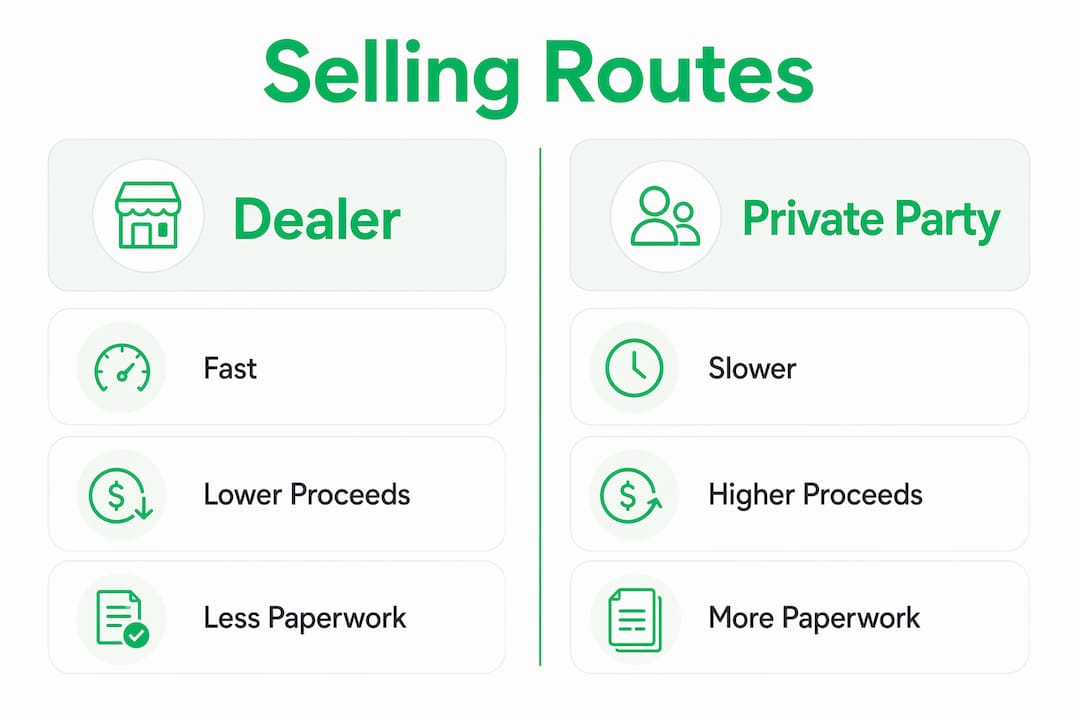
Selling privately often brings the highest payout, but it requires more time and careful safety planning. On many cars, that premium runs several thousand dollars over a dealer offer on a mid-range vehicle. Whether that gap is worth 20+ hours of your time is a personal call.
Quick decision guide:
- Need money today or tomorrow? Go dealer.
- Want the most money and can wait 2–4 weeks? Go private.
- Want wide local reach with less friction than a pure private sale? Post on a local marketplace.
One rule applies to all three: get the dealer offer first. It costs nothing, and it tells you the absolute floor. If a private buyer won't beat it by at least a few hundred dollars, the dealer deal is the smarter move.
How to prepare, price, and photograph your car before listing
Step 1: Assemble your documents
- Clean title (or lender payoff information if you still owe money)
- Maintenance records — even a partial history builds buyer confidence
- Spare keys — missing keys cost buyers money and they'll negotiate you down
- Odometer disclosure statement — required in most states for vehicles under 10 years old
- State-specific inspection or emissions certificate if your state requires one at point of sale
- Bill of sale template — download a free one from your state DMV website
Step 2: Price it correctly
Run a private-party valuation on Kelley Blue Book or a similar tool, then check local listings for comparable year/make/model/mileage combinations. Focus on private-party value, not trade-in value — those are two different numbers, and trade-in is always lower.

Set three prices in your head: your asking price (5–10% above your target), your target price (what you'd genuinely be happy with), and your floor (the dealer instant offer). Never list at your floor.
Step 3: Clean and photograph the car
A clean, well-photographed listing with service records and clear shots of the VIN and odometer attracts more serious buyers and shortens time on market. Professional detailing before listing can recover its cost in negotiating power; if you want a local option, car detailing services can make a real difference in how the car photographs.
Shot list (minimum 8 photos):
- Exterior 3/4 front and rear (both sides)
- Full driver and passenger interior
- Dashboard and odometer (engine running, so mileage shows)
- Trunk or cargo area
- Engine bay
- VIN plate (dashboard, driver's side)
- Any known cosmetic issues — show them honestly
Listing prep schedule:
- Today: Get dealer instant offer, pull title, confirm payoff amount if applicable
- Within 48 hours: Wash and detail the car, take photos, draft listing copy
- Within one week: Post listing across channels, schedule dealer visit if needed
How to create a secure listing and screen buyers
Your listing needs to answer every question a serious buyer has before they contact you. That means: year, make, model, trim, mileage, transmission, condition (honest), known issues, maintenance highlights, asking price, and your general location. Include the VIN. Buyers who want to run a vehicle history report will ask for it anyway, and providing it upfront signals you have nothing to hide.
Disclosing known mechanical issues and maintenance history speeds private sales by preventing wasted showings. A buyer who discovers a problem during the test drive that you already knew about will either walk or hammer your price. Tell them first.
Where to advertise locally
Different listing channels attract different buyer types: general marketplaces pull casual browsers, classifieds attract bargain hunters, and specialized automotive platforms tend to draw more serious shoppers. Post on at least two channels and reuse the same photos and description across all of them. Update or re-post every 3–4 days to stay near the top of search results.
Screening buyers before the test drive
Most no-shows and scam attempts are avoidable with a short pre-screen. When someone messages you, ask:
- Are you paying cash or financing?
- When are you available to meet?
- Have you seen the listing photos and price?
Anyone who skips your questions, pushes to move the conversation off-platform, or offers to send a cashier's check before seeing the car is a red flag. Serious buyers answer directly and want to see the vehicle in person.
Pro Tip: Use a scripted first reply: "Thanks for your interest. The car is [year/make/model], [mileage] miles, asking $[price]. I'm available [days/times] for a test drive at [public location]. Are you paying cash or financing, and does the price work for you?" This one message filters out 80% of time-wasters before you've invested a minute.
How to meet buyers safely and close the sale
Safe meeting rules
Meet in a public place during daylight hours. A busy parking lot, a bank branch, or a police department's designated safe-exchange zone all work. Bring a friend if you can. Before the test drive, photograph the buyer's driver's license and write down their phone number. If they won't share ID, the test drive doesn't happen.
During the test drive, ride along. Never hand over keys and wait in the parking lot.
Payment options, ranked by safety
- Bank wire transfer — traceable and confirmed before you sign anything
- Verified cashier's check — acceptable only after you call the issuing bank directly to confirm the check is real. Verify cashier's checks with the issuing bank before signing over the title; cashier's checks can be forged.
- Cash — fine for smaller amounts; for larger sums, count it at the bank
- Personal check — avoid entirely; funds can be reversed after you've handed over the car
Title transfer and loan payoff
If you own the car outright, sign the back of the title, complete the odometer disclosure, and give the buyer a signed bill of sale. The buyer then takes those documents to their state DMV to register the vehicle in their name.
If a lender holds your title, coordinate payoff with your lender before the sale and consider meeting at the bank to complete the title release. The lender will send the clean title to the buyer (or to you, to forward) once the loan is paid off. Get the payoff amount in writing — it changes daily with interest.
A complete bill of sale should include: buyer and seller names and addresses, vehicle year/make/model/VIN, sale price, odometer reading, date of sale, and both signatures.
Common scams to watch for
- Overpayment scams: buyer sends a check for more than the asking price and asks you to wire back the difference
- Fake escrow services: scammer controls the "escrow" and disappears after you hand over the car
- Out-of-town buyer who can't meet in person but wants to ship the car
If any of these patterns appear, walk away.
Why getting a dealer instant offer first is smart strategy
Industry guidance recommends getting at least one instant cash offer from a dealership before listing privately. The logic is simple: it costs nothing, it takes under 30 minutes, and it gives you a number you can actually use.
That number does two things. First, it sets your floor. If private buyers won't beat the dealer offer by enough to justify the time and hassle, you have a clean exit. Second, it gives you negotiating leverage. When a private buyer tries to lowball you, you can honestly say you have a dealer offer in hand and you're deciding whether the private sale is worth the extra effort. That shifts the dynamic.
How the instant offer process works: you enter your VIN, mileage, and condition details online. The platform generates an offer, usually valid for seven days. You then bring the car to a participating dealer for a physical inspection. If the condition matches what you described, the offer stands and you get paid on the spot, typically by check or electronic transfer. If the inspection reveals issues you didn't disclose, the offer may be adjusted.
The seven-day window matters. It gives you time to run your private listing in parallel. If a private buyer materializes and beats the dealer number by a meaningful margin, take it. If not, you already have a confirmed deal waiting.
Key Takeaways
Selling your car locally comes down to three moves: get a dealer offer first, prepare a clean listing with honest disclosures and strong photos, and close only with verified payment at a safe location.
| Point | Details |
|---|---|
| Get the dealer offer first | A no-obligation instant offer sets your price floor and gives you real negotiating leverage with private buyers. |
| Private sale premium | Selling privately can net $1,500–$3,000 more than a dealer offer on a typical $15,000 car, but it typically takes 2–4 weeks and 10–30 hours of your time. |
| Verify payment before signing | Never release the title until a wire is confirmed or a cashier's check is verified directly with the issuing bank. |
| Disclose issues upfront | Transparency about known problems prevents wasted showings and keeps serious buyers from walking after the test drive. |
| Marketplace app for local reach | Posting on Marketplaceapp gives you location-based visibility, in-app messaging, and secure payment tools in one place. |
What experienced sellers get wrong (and how to fix it fast)
The single most common mistake is overpricing based on trade-in value instead of private-party value. These are different numbers, and listing at the wrong one either drives buyers away or leaves money on the table. Pull the private-party figure, check local comps, and price 5–10% above your target.
The second mistake is skipping the dealer instant offer entirely. Sellers who skip it often accept a low private offer because they have no reference point. Thirty minutes online prevents that.
Poor photos are the third killer. Blurry shots, bad lighting, and missing interior photos tell buyers the seller isn't serious. Buyers scroll past listings that look like the seller couldn't be bothered. A clean car photographed in good natural light on a clear day takes 20 minutes and changes the quality of inquiries immediately.
Weak buyer screening invites no-shows and scam attempts. Anyone who won't answer basic questions about payment method and availability before the test drive is not a serious buyer. The scripted pre-screen message in the listing section above handles this in one reply.
Watch for these red flags in buyer behavior: pressure to move fast, refusal to meet in person, requests to complete the transaction through an unfamiliar payment app, and any story involving a third party sending payment on the buyer's behalf. On the paperwork side, a buyer who wants to delay the title transfer or asks you to sign a blank title is a serious warning sign. Sign the title only in the presence of the buyer, with all fields completed.
Marketplaceapp makes your local car sale easier
Listing your car on Marketplaceapp puts your vehicle in front of local buyers who are already searching nearby, without the noise of national platforms where your listing competes with inventory from across the country.
The platform's location-based search means buyers in your area find your listing first. Verified seller ratings and in-app messaging keep conversations on the record and filter out low-quality inquiries before they reach you. Secure payment tools reduce the risk of the fraud scenarios covered above. Push notifications alert you the moment a buyer responds, so you're not checking email every hour waiting for a lead.
For sellers who want to move a vehicle quickly and safely, Marketplaceapp handles the reach and the communication layer while you stay in control of the price and the closing. List your car locally on Marketplaceapp today and reach verified local buyers in your area.
Useful resources for title transfer, valuation, and payoff
State DMV title transfer and release of liability: Your state DMV website is the authoritative source for title transfer forms, release-of-liability filings, and any state-specific odometer disclosure requirements. Connecticut's DMV, for example, publishes a vehicle sale checklist that covers seller obligations step by step. Search "[your state] DMV sell vehicle" for your state's equivalent page.
Lender payoff procedures: Call your lender's customer service line and ask for the "10-day payoff quote" in writing. This gives you the exact amount needed to clear the loan, including accrued interest through the closing date. Keep the lender's contact information handy for the buyer, since some lenders require direct communication to release the title.
Vehicle valuation: Kelley Blue Book is the standard U.S. reference for private-party value, trade-in value, and instant cash offers. Use the private-party value when pricing for a private sale, not the trade-in figure.
Payment verification: The FTC's consumer guidance at consumer.ftc.gov covers payment fraud and buyer/seller rights. For cashier's check verification, call the phone number on the issuing bank's official website, not the number printed on the check itself.