
A product bundle is two or more related items sold together at one price. Done right, it raises your average order value, clears out slow inventory, and gives buyers a sense of curated value they won't find item by item. Bundling makes sense when you're sitting on excess stock, when two items naturally go together, or when demand for a category spikes seasonally.
- Increases average order value per transaction
- Moves aging or excess inventory faster
- Creates a curated offer that feels like a deal, not a discount dump
TL;DR:
- Bundling is most effective when using percentage-off or tiered discounts to balance margin preservation and sales volume.
- Keep bundles small, with two to four items, to increase the likelihood of conversion and simplify the buying process.
- Testing different pricing strategies and reconfiguring underperforming bundles is essential before scaling operation-wide.
- Selling bundles locally through platforms like MarketplaceAnywhere reduces shipping complexity and offers faster buyer access.
- Focus on bundling items with a clear use case, verified sales history, and a manageable inventory impact to ensure profitability and efficiency.
Table of Contents
- What Product Bundling Is and Why It Works
- What Are the Most Common Bundle Types?
- How Should You Price a Discounted Bundle?
- How Do You Choose Items That Actually Sell Together?
- Worked Pricing Examples You Can Copy
- What Setup Choices Affect Inventory and Shipping?
- How Do You Promote and Test Bundle Listings?
- Selling Bundles Locally: What MarketplaceAnywhere Adds
- The Real Lesson on Bundling Sellers Miss
- List Your Bundle on MarketplaceAnywhere Today
- Key Takeaways
- Documentation and Guides for Deeper Setup
- Sources
What Product Bundling Is and Why It Works
Bundling works because it changes the buyer's decision from "do I want this one thing" to "do I want this whole solution." That's a psychological shift, not just a pricing trick. A camera paired with a memory card and a case sells faster than the camera alone, because the buyer isn't left wondering what else they need to buy.
Sellers lean on bundling for a few concrete reasons:
- Clearance: pairing a slow-moving item with a popular one gets both out the door
- Curated offers: grouping items by use case (a "home office starter set") signals expertise
- Starter kits: bundling a core product with accessories reduces the buyer's research burden
Bundling isn't free, though. If you discount too aggressively or bundle items with thin margins, you can lose money on the transaction even as your order count climbs. Watch your margin per bundle, not just your sales volume.
What Are the Most Common Bundle Types?
Most sellers only need a handful of formats. Try these:
- Starter kits. A primary product plus the accessories a first-time buyer would otherwise have to hunt down separately, like a bike with a lock and lights.
- Cross-sell bundles. Items frequently bought together, based on what you've actually noticed customers pairing.
- Gift or seasonal sets. Grouped around a holiday, occasion, or season, priced to feel like a complete gift rather than loose items.
- Pick-and-mix bundles. The buyer chooses from a set list (say, any three candles from a shelf of ten) at a fixed bundle price.
- Inventory-balancing combos. Pairing overstocked items with fast sellers to move both at once.
Retail sellers building curated sets, like a boxer-and-pant combo sold as one product, often frame the bundle around a single use case rather than just "two things together." That framing does most of the selling for you.
How Should You Price a Discounted Bundle?
You have three basic pricing modes to choose from, and each one carries different accounting consequences:
- Percentage off. Simple to explain ("20% off when bought together") and scales naturally with item price, but it can eat margin fast on high-cost items.
- Fixed amount off. Predictable margin loss per bundle, easier to control than a percentage, but it can look like a weak deal on expensive items.
- Flat bundle price. Cleanest for the buyer to understand, though the total gets distributed proportionally across items for accounting and refund purposes, which complicates partial returns.
Tiered discounts add another lever: some sellers offer steeper breaks at higher quantities, such as 40% off for four or more items and 60% off for ten or more. That structure rewards bulk buyers without discounting your entire catalog.
Before publishing any bundle, run a quick math check: total item cost plus your minimum acceptable margin should never exceed your bundle price. If it does, you're paying the buyer to take inventory off your hands.

How Do You Choose Items That Actually Sell Together?
Not every combination makes a good bundle. Pick items that share a use case, fit your margin targets, and don't strand inventory you'll need elsewhere. Keep the bundle easy to complete, because bundles with two to four items typically convert better than sprawling sets that ask too much of the buyer.
- Choose items a buyer would naturally use together, not just items you want gone
- Check that combined margin still meets your minimum after any discount
- Avoid bundling your last unit of anything you'll need for future single-item sales
Name the bundle by outcome, not just contents ("Weekend Camping Starter Set" beats "Tent + Lantern + Stakes"). Your description should state exactly what's included, the individual value, and the savings.
Pro Tip: Photograph the bundle as one grouped shot and include a second image listing each item separately, so buyers never have to guess what's actually in the box.
Worked Pricing Examples You Can Copy
Here's how the math actually plays out on a real bundle:
- Percentage-off example. Three items priced at $20, $15, and $10 total $45. A 20% bundle discount brings it to $36, a $9 savings you can headline in the listing.
- Flat-price example. The same $45 combined value gets a flat bundle price of $38. That $38 gets distributed proportionally across the three items for refund purposes, so a return of the $20 item refunds roughly 44% of the bundle price, not a flat third.
- Minimum price formula. Add your total item cost to your desired margin (say, 30%) to find the floor. If your combined cost is $25, your minimum bundle price is $32.50.
Test two or three price points over a week and track which one actually clears inventory without cutting into profit you didn't intend to give up.
What Setup Choices Affect Inventory and Shipping?
Your setup decision determines how much reporting headache you'll deal with later. Priced-individually bundles preserve per-item visibility, which matters if you need to track stock and returns precisely across each item in the set. A flat bundle SKU is simpler to list but harder to reconcile against individual inventory counts.
Assembled versus unassembled matters too. Unassembled bundles let you ship each item separately, which helps when items differ wildly in size or weight. Assembled bundles simplify the unboxing experience but complicate stock reconciliation if one item runs out mid-sale.
- Decide priced-individually vs. flat SKU before your first sale, not after
- Document your partial-return policy in the listing itself
- Confirm cart quantities match your intended bundle before going live
How Do You Promote and Test Bundle Listings?
Bundles sell better when they're visible in the right spots and marketed with a clear hook. Feature them on your homepage, inside relevant product pages, and in dedicated category blocks where buyers are already browsing similar items.
- Lead with the savings, either as a flat price headline or a percent-off badge
- Use limited-time framing sparingly, and only when it's genuinely temporary
- A/B test your listing copy and price points, then measure the lift in average order value
- Add clear, mobile-friendly photos and lean on your seller ratings to build trust fast
If a bundle isn't moving after a reasonable test window, don't just deepen the discount. Re-bundle the items or break them apart and try a different combination. For copy that converts browsers into buyers, our listing description guide covers the specific language that gets clicks.
Pro Tip: Screenshot your best-performing bundle listing before you tweak it, so you always have a control version to compare against.
Selling Bundles Locally: What MarketplaceAnywhere Adds
Selling bundles locally removes a layer of complexity that online-only sellers deal with constantly: shipping mismatched items in one box. MarketplaceAnywhere is built around local pickup, so an unassembled bundle (a patio table plus four chairs, say) never needs to be boxed as one unit.
A few platform features that reduce friction specifically for bundle sales:
- Verified seller ratings give buyers confidence before they commit to a multi-item purchase
- Secure payment handling removes the awkwardness of negotiating bundle pricing in cash
- Instant chat lets buyers ask what's included before they show up, cutting down on no-shows
- Push notifications and location-based search put your bundle listing in front of nearby buyers actively searching your category
For the actual wording of your listing, our guide to listing descriptions covers what to include so buyers know exactly what they're getting.
The Real Lesson on Bundling Sellers Miss
Most advice on bundling stops at "combine complementary items and offer a discount," which is true but incomplete. The bigger lever is treating every bundle as a live experiment, not a permanent listing. A bundle that doesn't move in two weeks isn't a pricing problem to fix with a deeper discount. It's usually a signal that the combination itself is wrong.
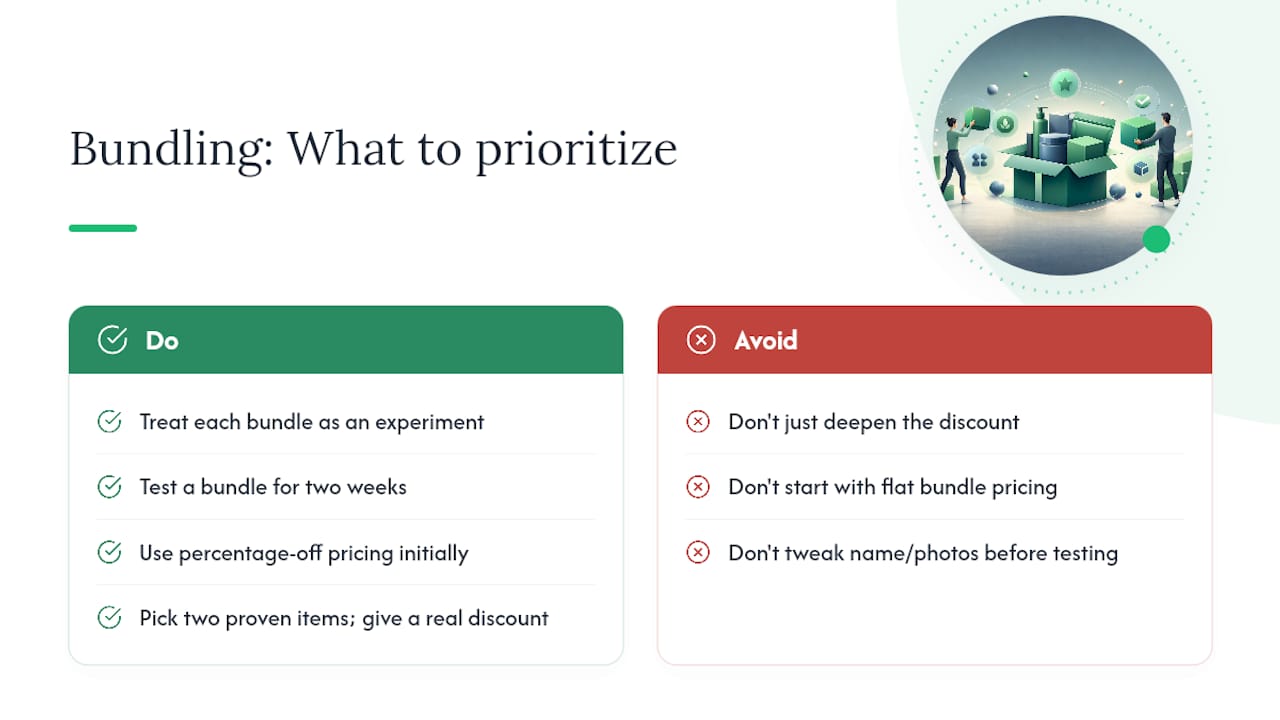
Conventional wisdom also overrates flat bundle pricing for beginners because it looks cleanest on the surface. In practice, the proportional refund math it requires trips up sellers the first time a buyer returns one item from a three-item set. If you're new to bundling, start with percentage-off pricing on priced-individually items. It's more forgiving when something goes wrong, and it gives you cleaner data on which items in the bundle are actually pulling weight.
What should you prioritize first? Pick two items you already know sell well together, price the bundle at a real discount (not a token 5%), and give it two weeks before touching the price again. Everything else, the naming, the photos, the promotion, matters less than getting that first combination right.
— Marketplace
List Your Bundle on MarketplaceAnywhere Today
Selling a bundle locally means skipping the packing headaches that come with shipping a mismatched set of items to a stranger three states away. MarketplaceAnywhere is built for exactly that kind of transaction: you meet nearby, the buyer sees the whole bundle in person, and secure in-app payment handles the money side without cash changing hands awkwardly on a driveway.
Getting started takes two steps. Create your bundle listing with clear photos and a description that states what's included and what it's worth individually, then turn on push notifications so you know the moment a nearby buyer shows interest. For help writing that description, our listing tips guide walks through the specifics that get bundles noticed. When you're ready, start your listing on MarketplaceAnywhere and get your bundle in front of local buyers today.
Key Takeaways
Bundling raises average order value and clears inventory only when the pricing model matches the item mix and the seller tests results instead of guessing.
| Point | Details |
|---|---|
| Bundle definition | Two or more related items sold together to raise order value and move inventory. |
| Keep bundles small | Two to four items typically convert better than large, hard-to-complete sets. |
| Match pricing to goals | Use percentage-off for flexibility, flat price for simplicity, tiered discounts for bulk buyers. |
| Test before scaling | Re-bundle or break apart underperforming sets rather than deepening the discount. |
| Sell locally with MarketplaceAnywhere | Verified ratings, secure payments, and push notifications help bundle listings reach nearby buyers fast. |
Documentation and Guides for Deeper Setup
For technical configuration details, the WooCommerce Product Bundles documentation covers priced-individually settings and unassembled shipping options. The Webstepper bundle discounts guide explains cart-matching rules across all three pricing modes. For curated-set presentation ideas, see Lifted+'s guide to building a homewares edit.
Sources
- WooCommerce product bundles review — WP Mayor
- Product Bundles documentation — WooCommerce
- Bundle Discounts — Webstepper documentation