
For local sellers who want fast pickups without shipping headaches, Marketplace - Buy & Sell Locally is the strongest starting point. For everyone else, the right app depends entirely on what you're selling. Picks are based on fees, audience fit, shipping support, buyer and seller protections, and ease of listing, per the methodology used by CNBC Select and Forbes Advisor.
Quick shortlist by use case:
- Best overall (local): Marketplace - Buy & Sell Locally — verified profiles, location-based search, zero shipping friction
- Best for broad national reach: eBay — massive buyer pool, auction and fixed-price formats, strong seller tools
- Best free local listings: Facebook Marketplace or Craigslist — no selling fees, huge local traffic, cash-in-hand deals
- Best for fashion resale: Poshmark or Depop — fashion-first audiences, built-in social sharing, straightforward flat-fee shipping
- Best for vintage and handmade: Etsy — buyers actively searching for handcrafted and one-of-a-kind items
- Best for musical instruments: Reverb — instrument-specific audience, lower effective fees than general platforms
- Best for quick cash on electronics: Mercari or Decluttr — fast nationwide sales, prepaid shipping labels included
- Best for luxury and authenticated items: Vestiaire Collective, The RealReal, or Worthy — expert authentication, affluent buyers, higher realized prices on premium goods
For books specifically, PangoBooks targets readers directly. thredUP works best if you want to mail a bag of clothes and let the platform handle pricing and listing for you.
Key Takeaways
The single most important decision in resale is matching item category and price band to the platform's audience and fee structure before you list.
| Point | Details |
|---|---|
| Match item to platform | Category-specific platforms (Reverb, Etsy, Vestiaire) deliver higher sell-through for the right items despite smaller audiences. |
| Local pickup saves margin | Skipping shipping on a typical sale can net you noticeably more than a shipped sale after fees and packaging. |
| Calculate all-in fees | Effective rates commonly reach 13–25% once shipping and processing are included — price accordingly before listing. |
| Safety for local deals | Meet in public, daylight, with a friend; use platform-integrated or verified payment methods only. |
| Marketplaceapp for local sales | Marketplace - Buy & Sell Locally offers verified profiles, location-based search, and secure payments for fast, low-friction local transactions. |
Table of Contents
- How do the best marketplace apps compare side by side?
- Which app is right for your specific item?
- How do you pick the right marketplace app for your item?
- What does a sale actually cost you on each platform?
- How do you sell faster and stay safer on any platform?
- The case for going local first
- Marketplaceapp: list locally, sell faster
- Sources and further reading
How do the best marketplace apps compare side by side?
The table below puts each platform's key selling dimensions in one place. Fee shapes vary by item price, category, and whether you use promoted listings — treat the fee column as a starting range, not a ceiling.
| Platform | Best For | Seller Fees | Shipping Support | Buyer/Seller Protections | Audience / Demographics | Ease of Listing |
|---|---|---|---|---|---|---|
| Marketplace - Buy & Sell Locally | Local pickup, all categories | Transaction fee on completed sales | Local pickup first; no shipping required | Verified seller ratings, secure payments, in-app messaging | Local buyers across all demographics | Fast mobile listing; location-based search |
| eBay | National reach, auctions, collectibles | Final value fee varies by category | Full shipping integration, prepaid labels | eBay Money Back Guarantee; seller protections | Large active buyer base globally | Robust but more complex; strong seller tools |
| Facebook Marketplace | Free local listings, furniture, vehicles | Free for local; ~5% for shipped items | Optional shipping; local pickup default | Limited platform protection; buyer/seller messaging | Billions of Facebook users; all ages | Extremely easy; syncs with Facebook profile |
| Poshmark | Women's and men's fashion, accessories | Flat fee or percentage fee depending on sale amount | Prepaid USPS label included | Posh Protect covers non-delivery and misrepresentation | Fashion-focused audience | Simple; social sharing built in |
| Mercari | Electronics, clothing, general goods | ~10% selling fee + 2.9% payment processing | Prepaid shipping labels provided | Buyer and seller ratings; item-not-as-described coverage | Broad US audience; younger adults | Very easy mobile listing |
| OfferUp | Local sales, vehicles, furniture | Free for local; ~13% for shipped | Local pickup or shipping | TruYou ID verification; reputation scores | Local-first; broad US demographics | Simple app; quick photo listing |
| Depop | Vintage, streetwear, Gen Z fashion | ~10% Depop fee + payment processing | Seller arranges shipping | Buyer protection on eligible transactions | Primarily Gen Z and millennials | Instagram-style; easy photo upload |
| Etsy | Handmade, vintage, craft supplies | $0.20 listing + 6.5% transaction + payment processing | Seller arranges; shipping calculator built in | Etsy Purchase Protection | Craft and gift buyers; broad age range | Moderate; shop setup required |
| Reverb | Musical instruments and gear | ~5% selling fee (capped at $500) | Shipping integration; local pickup option | Reverb Safe Shipping; buyer protection | Musicians and gear enthusiasts | Category-optimized listing forms |
| Craigslist | Free local listings, large items | Free for most categories | Local pickup only | No platform protection; cash or Venmo typical | Hyperlocal; all demographics | Minimal; web-based, no app polish |
| Vestiaire Collective | Luxury and designer fashion | ~12–15% seller fee (varies) | Shipping with authentication step | Expert authentication on high-value items | Affluent fashion buyers globally | Moderate; authentication adds time |
| The RealReal | Luxury consignment (clothing, jewelry, watches) | Consignment split (varies by tier and item value) | Ship to RealReal; they handle listing | Expert authentication; buyer guarantee | Luxury buyers; higher income bracket | Easiest for seller — they do the work |
| Decluttr | Electronics, CDs, DVDs, books | Instant offer (they buy direct); no listing fee | Free prepaid shipping label | Instant payment; no buyer disputes | Direct buyer (Decluttr buys from you) | Scan barcode; instant quote |
| PangoBooks | Used books | 3% + $0.25 per sale | Prepaid shipping label included | Buyer and seller ratings | Book lovers; students | Very easy; ISBN scan listing |
| thredUP | Women's and kids' clothing | Consignment; payout varies by item value | Mail-in Clean Out Kit | thredUP handles all buyer interactions | Secondhand clothing shoppers | Easiest — mail a bag, they list it |
| Worthy | Fine jewelry and watches | Commission-based (varies by sale price) | Insured shipping provided | Auction-based; authenticated by Worthy | Jewelry buyers and collectors | Submission-based; Worthy manages auction |
| MarketplaceAnywhere | Local peer-to-peer, all categories | Transaction fee on completed sales | Local pickup; no shipping required | Verified profiles, secure payments, in-app chat | Local community buyers and sellers | Fast mobile listing; push notifications |
MarketplaceAnywhere and Marketplace - Buy & Sell Locally refer to the same platform. Fee shapes across all platforms vary by item price, category, and promotional spend.
Which app is right for your specific item?
Marketplace - Buy & Sell Locally: the local-first pick
For bulky items, furniture, vehicles, electronics, and anything where shipping costs would eat your margin, Marketplace - Buy & Sell Locally removes the friction that kills local deals on other platforms. Verified seller ratings mean buyers arrive with a baseline of trust. Location-based search surfaces your listing to people within driving distance, and in-app messaging keeps the negotiation clean and documented. No shipping label to print, no box to find, no carrier drop-off. The buyer shows up, inspects the item, pays securely, and leaves. That's the whole workflow.
Quick tips for local sellers:
- Set your pickup radius in the app to filter out buyers who won't realistically travel to you
- Use the verified profile badge prominently in your listing photos or description
- Price 10–15% above your floor to leave room for the negotiation most local buyers expect
National auction and fixed-price platforms (eBay)
eBay's buyer pool is the largest of any US marketplace, which matters most for collectibles, rare electronics, and niche items where local demand is thin. The auction format can push prices above what you'd get on a fixed-price listing when two motivated buyers compete. The trade-off is complexity: category-specific final value fees, shipping weight calculations, and a returns process that can favor buyers in disputes.
Quick tips:
- Use auction format only for items with genuine collector demand; fixed-price works better for common goods
- Factor the final value fee (roughly 13.25% in most categories, though it varies) into your starting price
Free local listing platforms (Facebook Marketplace and Craigslist)
Zero platform fees make Facebook Marketplace and Craigslist the default choice for furniture, appliances, and anything too heavy to ship economically. Facebook's integration with user profiles adds a layer of social accountability that Craigslist lacks entirely. Craigslist remains useful for hyperlocal reach and for sellers who prefer anonymity, but it offers no payment protection and no dispute resolution. For decluttering home goods, both platforms move items faster than almost any shipped alternative.
Quick tips:
- On Facebook Marketplace, respond within the first hour of a message — buyer interest drops sharply after that
- On Craigslist, never accept checks or wire transfers; cash or a verified payment app only
Fashion resale platforms (Poshmark, Depop)
Poshmark's flat-fee shipping model ($2.95 under $15, 20% above) is simple to calculate but expensive on lower-priced items. Its social features, shared closets and follower feeds, drive organic discovery in a way that generic platforms don't. Depop skews younger and more streetwear-focused; its Instagram-style feed rewards good photography more than detailed descriptions. For selling clothes locally, a local-first platform can move items faster without the commission hit.
Quick tips:
- On Poshmark, share your listings during peak evening hours (7–9 PM local time) for maximum visibility
- On Depop, shoot against a clean background and include measurements in every listing
Vintage and handmade marketplace (Etsy)
Etsy's fee structure adds up quickly: $0.20 per listing, a 6.5% transaction fee, and payment processing on top. But the buyers there are specifically looking for handmade, vintage, and craft items, which means higher sell-through rates for category-appropriate goods than you'd get on a general platform. Sellers considering Etsy alternatives should weigh whether a smaller, lower-fee platform can reach the same motivated buyer base.
Quick tip: Invest in keyword-rich titles and tags — Etsy's search algorithm weights them heavily.
Musical instruments (Reverb)
Reverb's fee structure caps at $500 per transaction, which makes it significantly cheaper than eBay for high-value gear. The buyer base is musicians who know what they're looking for, so detailed specs and honest condition notes convert better than generic descriptions. Local pickup is supported, but most Reverb transactions ship.
Quick tip: Include the serial number, original case, and any accessories in the listing — Reverb buyers expect completeness.
Quick-cash electronics buyers (Mercari, Decluttr)
Mercari's prepaid shipping labels and nationwide reach make it a solid channel for phones, tablets, and small electronics. Decluttr skips the marketplace model entirely: scan a barcode, get an instant offer, ship for free, get paid. You'll receive less than a peer-to-peer sale, but there's no listing, no negotiation, and no buyer dispute.
Fee note: Mercari charges roughly 10% selling fee plus 2.9% payment processing, putting the effective take rate near 13% before shipping costs, per Voolist's fee analysis.
Luxury and authenticated platforms (Vestiaire Collective, The RealReal, Worthy)
These platforms justify their higher commissions through authentication, affluent buyer access, and price realization that general platforms can't match for premium goods. The RealReal handles everything after you ship the item: photography, listing, pricing, and buyer communication. Worthy runs a live auction for fine jewelry and watches, with insured shipping and expert grading included. Vestiaire Collective authenticates designer fashion before releasing payment. The trade-off is time: authentication adds days to the sale cycle.
Books (PangoBooks) and clothing consignment (thredUP)
PangoBooks charges 3% plus $0.25 per sale with a prepaid label included, making it the lowest-fee option for used books by a wide margin. thredUP is the right call when you have a large volume of women's or kids' clothing and no interest in listing each item individually. Mail in a Clean Out Kit, and thredUP prices and lists everything. Payouts are lower than peer-to-peer sales, but the effort is minimal.
How do you pick the right marketplace app for your item?
The direct answer: match your item's category, price point, and your shipping willingness to the platform's audience and fee structure. A $200 designer jacket belongs on Poshmark or Vestiaire Collective, not Facebook Marketplace. A sectional sofa belongs on a local platform, not Mercari.
Evaluate the item first
Ask yourself three questions before you open any app:
- How quickly do you need the money? — Auction formats and consignment platforms can take days to weeks. Local cash sales and Decluttr's instant-offer model are the fastest routes.
Match price band to platform
Low-priced items (under $20) get eaten alive by percentage fees on platforms like Poshmark. A $10 item at 20% commission leaves you $8 before shipping. For low-value goods, free-listing local platforms or Craigslist preserve more of the sale price. High-value items, above $200, benefit from platforms with authentication and affluent buyer pools even when the commission is higher, because the realized price is typically better.
Questions to ask before listing on any new platform
- What is the total effective fee percentage, including payment processing?
- Does the platform provide shipping labels, or do I arrange my own?
- What happens if a buyer claims the item wasn't as described?
- Can I communicate directly with buyers before the sale?
- Is there a listing fee even if the item doesn't sell?
Red flags to watch for: platforms that charge listing fees with no sale guarantee, apps with no documented buyer-seller dispute process, and any platform that asks for payment outside its own system.
Mapping items to platforms: two quick examples
A used guitar in good condition: list on Reverb first for the instrument-specific audience and capped fee structure. If it doesn't move in two weeks, cross-list locally on Marketplace - Buy & Sell Locally for a cash pickup. A designer handbag: start on Vestiaire Collective or The RealReal for authentication and price realization. If you want faster cash and can verify authenticity yourself, Poshmark's fashion audience is a solid secondary channel. For more category-specific guidance, the best apps to sell roundup breaks down local-first picks by item type.
What does a sale actually cost you on each platform?
The formula is straightforward: net = sale price − platform fee − payment processing − shipping − packaging − promotions. Most sellers look only at the headline platform fee and miss the other three or four line items.
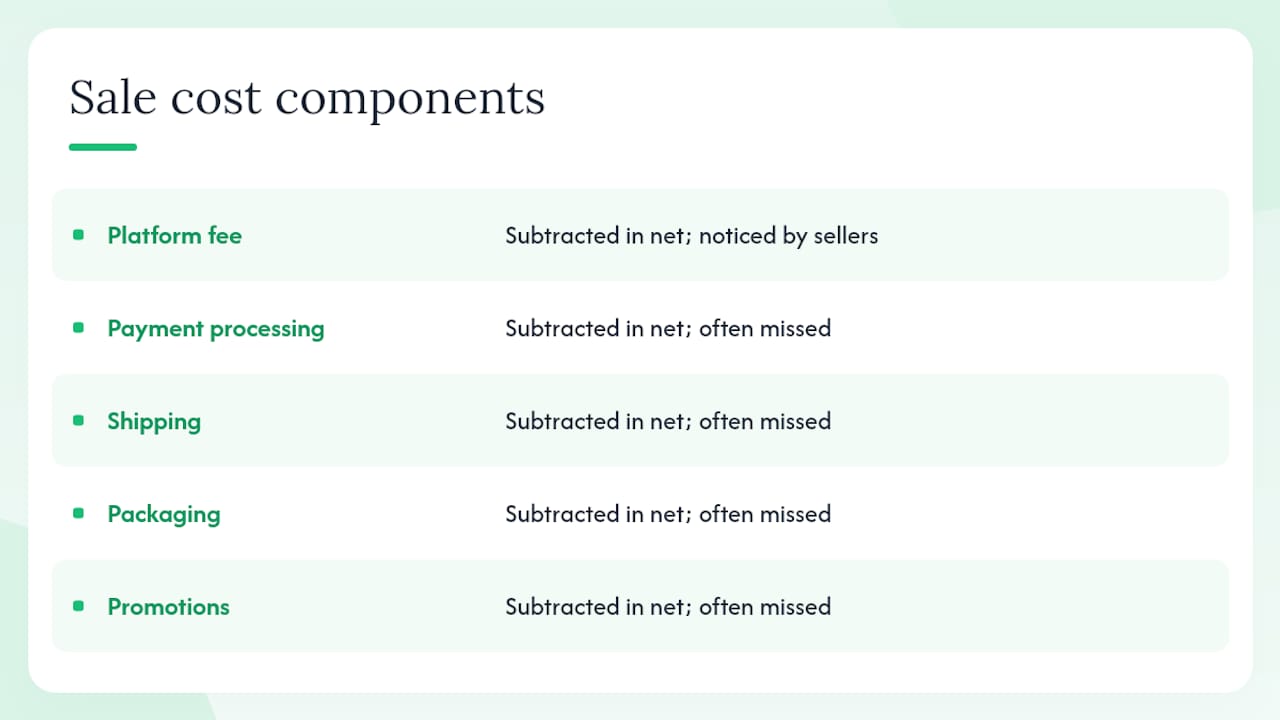
Typical fee components
| Fee Component | Typical Range | Notes |
|---|---|---|
| Platform/transaction fee | 0–20% of sale price | Varies by platform and category |
| Payment processing | 2.9% + typical fixed fee | Often bundled into platform fee |
| Shipping (seller-paid) | $4–$15+ depending on weight | Some platforms include prepaid labels |
| Packaging materials | $1–$5 per shipment | Often overlooked |
| Promoted listing / boost | $0–$5+ per listing | Optional but affects visibility |
Example: a $75 sale
Say you sell a pair of sneakers for $75 on a platform charging 10% plus 2.9% payment processing, with a $7 prepaid shipping label:
- Platform fee: $7.50
- Payment processing: $2.18
- Shipping: $7.00
- Packaging: $2.00
- Net to seller: $56.32 (75% of sale price)
Run the same item locally with no shipping and no packaging cost, on a platform charging a transaction fee in the 5–10% range, and your net jumps to $67–$71. That's a meaningful difference on a $75 item, and it compounds across dozens of sales.
Effective fee reality: Fee analysis across leading resale platforms shows all-in effective rates commonly landing between 13% and 25% once shipping and processing are included, even on platforms that advertise lower headline rates.
Flat fees vs. percentage fees: flat fees favor high-priced items (a $2.95 flat fee on a $100 sale is 2.95%), while percentage fees favor low-priced items only when the percentage is genuinely low. Promotions and boosts are worth running on items that have been sitting for more than a week — the incremental visibility usually pays for itself on items priced above $40.
For reselling as a side hustle, tracking cost of goods and all-in fees per sale is what separates profitable resellers from ones who are busy but breaking even.
How do you sell faster and stay safer on any platform?
The fastest, safest listings combine clear photos, honest condition descriptions, competitive pricing, and the right fulfillment method for the platform. Listings with multiple high-quality photos consistently outperform single-image listings across every major marketplace.
Safety for in-person meetups
CNN's reporting on safe online transaction practices recommends meeting in public, well-lit locations, ideally police station "safe exchange zones" that many departments now designate specifically for this purpose. Bring a friend when possible, complete the transaction during daylight hours, and never invite a stranger to your home for a first meeting. Accept cash, platform-integrated payments, or a verified payment app — never a check, money order, or wire transfer from an unknown buyer.
The case for going local first
Most resale advice defaults to national platforms because the audience numbers are bigger. That logic makes sense for rare collectibles or niche items with thin local demand. For everything else, it often costs sellers money.
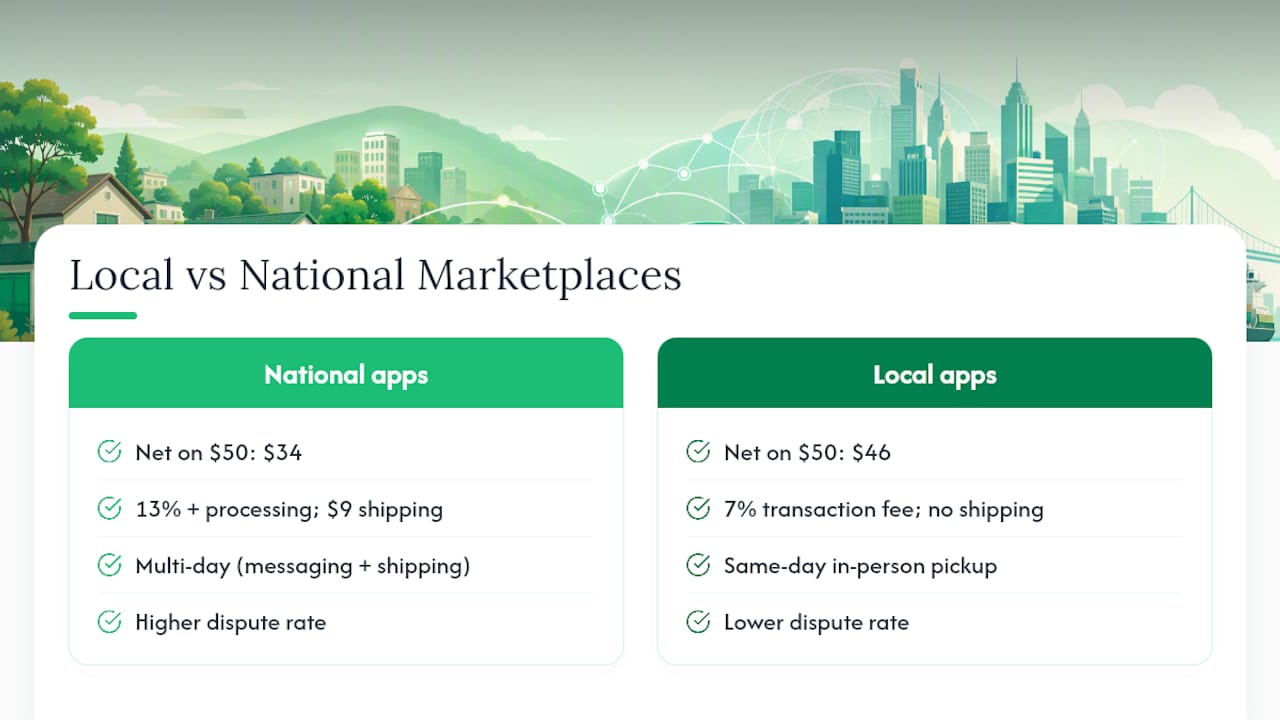
Shipping is the hidden tax on peer-to-peer resale. A $50 item that costs $9 to ship, with a 13% platform fee and payment processing, nets you around $34. Sell the same item locally with a 7% transaction fee and no shipping, and you keep $46. That's not a marginal difference. Multiply it across 20 sales a month and you're looking at a real income gap.
The other thing national platforms don't replicate is the speed of a local cash deal. A buyer who can inspect an item in person and walk away with it that afternoon doesn't need three days of messaging, a shipping wait, and a returns window. The transaction closes faster, and the dispute rate is lower because the buyer saw exactly what they were getting.
Local-first platforms work best when they solve the trust problem, which is the main reason people default to national apps in the first place. Verified seller ratings and in-app messaging do that without requiring a massive platform fee to fund the infrastructure. That's the actual value proposition, and it's one that gets undersold in most marketplace comparisons.
Marketplaceapp: list locally, sell faster
Skip the shipping label and the all-in fee hit. Marketplace - Buy & Sell Locally connects you with verified local buyers through location-based search, in-app messaging, and secure payment processing, all in one place.
Listing takes a few minutes on mobile: snap photos, set your price, choose your pickup radius, and your item is live. Verified seller profiles build buyer trust before the first message arrives, and push notifications keep you in the conversation without refreshing a feed. For sellers who want fast local sales across electronics, fashion, furniture, vehicles, or home goods, it's a direct alternative to paying national platform fees on items that could sell down the street. Start your first listing and see how quickly local buyers respond.
Sources and further reading
The following sources informed the platform comparisons, fee guidance, and safety recommendations in this article.
For deeper seller workflows, the Marketplaceapp blog covers local selling strategies, garage sale pricing tactics, and category-specific guides for sellers at every experience level.