
Sign up with just an email and a password, publish a listing with at least three honest photos and a clear title, offer local pickup, respond fast to the first message, and turn on payouts once a sale looks real. Everything else, including identity verification and tax details, can wait until money is actually on the table.
TL;DR:
- Sellers can list their items quickly with minimal initial setup by providing only an email or phone number, location, and optional display name.
- Identity verification generally clears within minutes for individuals using automated systems, but business verification may take up to five days due to additional documentation.
- High-quality listings should include four to six photos, a clear, specific title, detailed description, and all relevant attributes to improve visibility.
- Price items at roughly half to two-thirds of retail value depending on condition, and use "negotiable" to attract faster offers, adjusting price slightly above your minimum target.
- Local pickup in public, well-lit locations with safety precautions increases the chance of swift sales, and prompt, verified profile responses build buyer trust.
Table of Contents
- Account Essentials: What to Fill Out Now vs. Later
- What Does Seller Verification Actually Involve?
- How Do You Build a Listing That Actually Gets Views?
- How Should You Price a Used Item to Sell Fast?
- Local Pickup, Shipping, and Staying Safe in Person
- Setting Up Payouts and Understanding Basic Tax Rules
- Getting Your First Sale: Speed and Promotion Tactics
- What Makes Onboarding Feel Fast Instead of Frustrating?
- Why Most Onboarding Advice Gets This Backward
- Ready to List Your First Item Today?
- Sources
Account Essentials: What to Fill Out Now vs. Later
Most new sellers stall before they ever list an item because the signup form asks for too much too soon. It doesn't need to. A working account needs an email or phone number, a password (or a single sign-on option through Google or Apple), and a rough location so buyers know you're nearby. A display name is nice but skippable for now.
That's genuinely it for step one. A well-built marketplace onboarding flow intentionally separates what you need to create an account from what you need to actually get paid, pushing payout and tax fields until a sale is close instead of front-loading them at signup.
Here's what to handle immediately, and what to leave for later:
- Now: email or phone, password or SSO, general location
- Now: a display name if you want one, but a placeholder works fine
- Later: payout method and banking details
- Later: tax forms and identity documents
- Later: store branding, saved templates, or seller bio
If the signup screen offers save-and-resume, use it. A live preview of your profile also helps you catch typos before a buyer ever sees them.
What Does Seller Verification Actually Involve?
Verification exists to confirm you're a real person, not to slow you down, though it can feel that way if you're not prepared. Marketplaces typically ask for a government-issued ID, sometimes paired with a selfie or a quick liveness check, to confirm the name on your account matches a real identity.
Rules to know before you list:
- Prohibited items almost always include weapons, recalled products, and counterfeit goods
- Dispute policies usually require photo evidence and prompt communication if a buyer complains
- Return expectations vary, so read the platform's stated policy instead of assuming
Here's the reassuring part: individual identity checks usually clear in minutes with automated systems, while business verification can take one to five working days because it involves more documentation. If a document gets rejected, it's almost always a lighting or glare issue on the photo, not a real problem with your identity. Retake it in natural light and resubmit.
How Do You Build a Listing That Actually Gets Views?
A strong listing follows a formula, and skipping steps is the single biggest reason items sit unsold for weeks. Buyers scroll fast. Give them a reason to stop.
- Take at least four to six photos. Shoot the front, back, any tags or labels, and a close-up of wear or damage. Buyers trust sellers who show flaws instead of hiding them.
- Keep images under typical upload limits, usually a few megabytes each, and use natural daylight instead of flash.
- Write a title with brand, item, and one key spec. "Trek 820 Mountain Bike, 21-Speed, Size Medium" beats "Bike for sale" every time.
- Fill in the description using a simple pattern: condition, age or purchase date, why you're selling, and any accessories included.
- Use every attribute field the category offers. Size, color, brand, and material fields feed the search filters buyers actually use.
Pro Tip: Keep a saved template with your go-to phrasing for condition and pickup instructions, using tips from Launching a New Product on your E-Store? Here’s how you can market it better – Oxedent. Reusing a proven structure cuts listing time in half and keeps your descriptions consistent buyer after buyer.
Mapping your item to the right category also matters more than most sellers realize. A "console table" filed under "furniture" instead of "home decor" shows up in more of the searches buyers actually run, which for more detail on wording, see this breakdown of listing description tips that actually convert.
How Should You Price a Used Item to Sell Fast?
Pricing is where most new sellers either scare off buyers or leave money on the table. The fix takes five minutes: search the platform for the same or a similar item marked "sold," not just active listings, since active prices are often wishful thinking.
- Adjust the sold price down slightly if your item has more wear, missing parts, or no original box
- Adjust up if you're including accessories, extra parts, or proof of purchase
- For general condition ranges, expect roughly half to two-thirds of retail for lightly used items and less than half for heavily worn ones
- Mark a price "firm" only if you genuinely won't move, since "negotiable" tends to draw more messages and faster responses
A price that's 10 to 15 percent above your realistic floor, tagged negotiable, tends to get the fastest first offer.
Local Pickup, Shipping, and Staying Safe in Person
Local pickup is the fastest path to a completed sale because there's no shipping cost, no box, and no waiting on a carrier. It also removes the biggest source of buyer hesitation: the fear that an item won't match photos.
Set a public meeting spot, like a coffee shop parking lot or a bank lobby with cameras, rather than your home address. If you do offer shipping for smaller or higher-value items, weigh the box first and buy postage that matches the actual weight instead of guessing.
- Choose well-lit, public locations for exchanges, ideally with other people around
- Bring a friend for higher-value items, or meet during daylight hours
- Confirm the buyer's profile has some activity history before agreeing to meet
- Communicate through the app's messaging instead of moving to text right away
Pro Tip: Screenshot the final agreed price and pickup time before you meet. It sounds unnecessary until a buyer "remembers" a different number.
Verified ratings do real work here too. Buyers consistently treat prompt replies and verified profiles as the clearest signal that a transaction will go smoothly, which is exactly why filling out your profile fully pays off before you even meet anyone.
Setting Up Payouts and Understanding Basic Tax Rules
Payout setup is one of the few steps worth doing right, not fast, since a mistake here delays your money. Most platforms support direct deposit or a linked debit card, and both typically require a quick verification check tied to your name and bank details.
- Direct bank transfer, usually the fastest once verified
- Debit card payout, convenient but sometimes capped at lower amounts
- Digital wallet options, where available, for near-instant access
New sellers sometimes see a short hold on their first payout. Platforms do this to confirm the transaction is legitimate, and automated verification tied to payout eligibility actually speeds this up rather than slowing it down once your identity clears. Tax forms vary heavily by country and by how much you sell in a year, so check your specific platform's threshold rather than assuming a flat rule applies to you.
Getting Your First Sale: Speed and Promotion Tactics
The first 48 hours after you go live decide how much momentum your account builds, so treat that window seriously.
- Publish more than one item at once. Sellers who launch with several listings instead of a single item tend to get their first inquiry noticeably faster.
- Post during evening or weekend hours when local buyers are actually scrolling, and refresh or bump listings if the platform allows it.
- Offer a small, temporary incentive, like "free pickup" phrasing or a modest discount for the first buyer, to break the ice.
- Reply within minutes, not hours. A fast first response is often the deciding factor between a buyer messaging you or moving to the next listing.
- Ask for a rating right after a smooth handoff. Do it while the good experience is still fresh, not days later.
What Makes Onboarding Feel Fast Instead of Frustrating?
The best seller flows treat progress as visible, not hidden. A completeness meter that shows exactly what's left, paired with a clear note on why payout or tax fields are deferred, keeps sellers from wondering if the app is broken or just being cautious.
- A resumable checklist that saves your place if you close the app mid-signup
- Real-time status messages during identity verification instead of silence
- A short sample "perfect listing" or a two-minute video showing the ideal photo angles and title format
- Inline tooltips that explain a field the moment you hit it, instead of a wall of instructions upfront
None of this is complicated engineering. It's just respecting that a casual seller listing one old bike doesn't want to read a manual first.
Why Most Onboarding Advice Gets This Backward
Most guides on this topic treat onboarding like a compliance exercise: collect everything up front, verify everything immediately, and hope the seller sticks around long enough to finish. That approach is exactly backward for casual, individual sellers who are testing whether selling online is even worth their time.
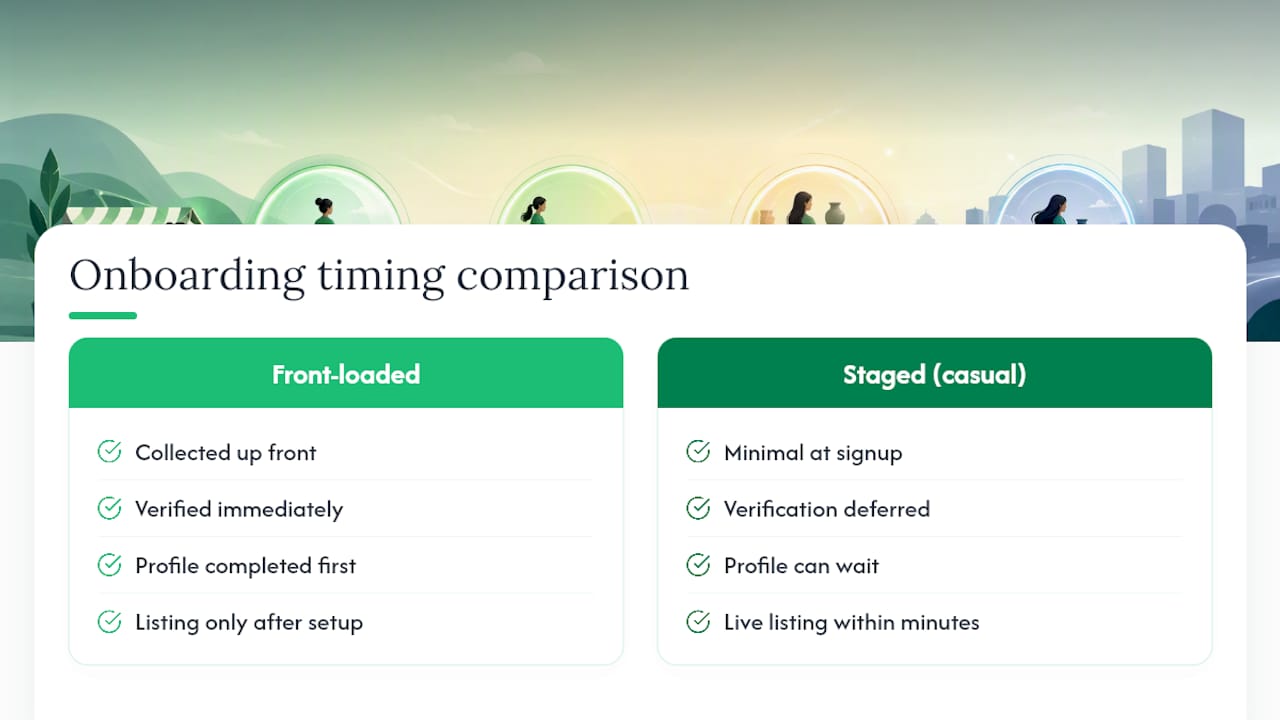
The sellers who actually publish and sell are the ones who hit a live listing within minutes, not the ones who filled out the most complete profile first. Deferring payout setup and tax documentation until a sale is imminent isn't cutting corners. It's matching the effort to the seller's actual intent at that moment, which is usually just "will anyone buy this old bike?"
Where conventional advice really falls short is treating every seller like a business. A parent clearing out a garage doesn't need a tax primer before listing a stroller. What they need is a fast path to a live post and a quick, honest sense of whether it will sell. Prioritize the listing. Prioritize the reply speed. Everything else can catch up once there's real money on the table.
— Marketplace
Ready to List Your First Item Today?
The platform is built around exactly this: getting your item in front of local buyers without a long setup process standing in the way. Location-based search helps place your listing in front of people close enough to actually meet you, instant chat lets you answer questions promptly, and push notifications keep you updated without constantly refreshing the app.
Seller ratings give buyers a reason to trust you before you've even exchanged a message, which matters more for a first-time seller than almost anything else on the profile. Together, these features help shorten the time between publishing a listing and completing a sale. If you're ready to stop overthinking the setup and just get your item listed, create your seller account and publish your first listing today.
Sources
For deeper detail on automated verification and payout timing, see Marketplace Onboarding: Process & Automation and Seller onboarding for marketplaces. For safety norms during local exchanges, read local marketplace etiquette.
- Marketplace Onboarding: Process & Automation
- Marketplace onboarding: activations and automation
- Seller onboarding for marketplaces: how to verify and pay sellers at scale