
Good local marketplace etiquette is a short list of safety-first behaviors that help buyers and sellers close deals quickly, avoid scams, and treat each other with basic respect. Follow these rules before any listing goes live or any meetup gets scheduled.
Quick dos and don'ts to keep on hand:
- Do read the full listing before messaging — asking about price when it's in the title wastes everyone's time
- Do reply within a few hours; silence past 24 hours signals you've moved on
- Do meet in a public, well-lit spot — police station parking lots are the gold standard
- Do inspect the item before handing over any payment
- Do mark your listing as Pending or Sold the moment a deal is confirmed
- Don't send a one-word opener like "Is this available?" — lead with who you are and when you can meet
- Don't pay before you've seen the item in person
- Don't share your home address with a stranger before you've exchanged a few messages and checked their profile
- Don't ghost a seller after agreeing to buy — cancel politely and promptly if plans change
- Don't accept overpayment by check or money order and send back the difference
- Don't negotiate a price in messages and then renegotiate again at pickup
These eleven rules cover the situations where most local transactions go sideways. The sections below explain each one in depth, with message templates you can copy directly.
Key Takeaways
Courteous, specific communication combined with public meetups and verified payment methods is what separates smooth local transactions from frustrating ones.
| Point | Details |
|---|---|
| Lead with availability | Open every message with when and where you can meet, not just "Is this available?" |
| Inspect before paying | Test electronics, check condition, and measure furniture before any money changes hands. |
| Use SafeTrade meetups | Police station parking lots with security cameras are the safest choice for in-person exchanges. |
| Never accept overpayment | Overpayment-then-refund is the most common local marketplace scam; decline and report it. |
| Marketplaceapp supports safe deals | Verified ratings, secure payments, and instant chat on Marketplaceapp reduce friction and disputes. |
Table of Contents
- What does good local marketplace etiquette look like in practice?
- How should sellers prepare listings, and what should buyers look for?
- How do you negotiate price without making it awkward?
- Where and how should you meet for a safe pickup?
- Which payment method is safest for local transactions?
- What are the red flags for scams in local marketplace deals?
- How do you handle no-shows, cancellations, and disputes?
- How do platform rules and community norms work together?
- Ready-to-copy message templates for common situations
- Why etiquette is the real engine behind a healthy local marketplace
- Marketplaceapp makes local transactions easier from the first message
- Sources
What does good local marketplace etiquette look like in practice?
Clear, courteous communication is the foundation of every smooth local transaction. Consumer Protection BC's etiquette guidance puts it plainly: read the full post before asking questions, reply promptly, be honest about item condition, and take safety precautions for in-person meetups. Those four points cover most of what goes wrong.
The 7 Cs of communication — clear, concise, concrete, correct, coherent, complete, and courteous — work as a fast pre-send checklist for any marketplace message. Run through them before you hit send: if your message fails "concrete" (no pickup time, no location preference) or "courteous" (no greeting, blunt demand), expect a slow or no reply.
Timing expectations matter more than most buyers realize. A reasonable reply window is 2–4 hours during daytime. If you haven't heard back in 24 hours, one polite follow-up is fine. After that, move on. Sellers should confirm a meetup at least an hour before the scheduled time — a quick "Still on for 3 PM at the Walgreens on Main?" takes ten seconds and prevents a wasted trip.
Example messages that actually work:
Buyer to seller: Seller to buyer: Both messages open with availability, include a location preference, and give the other person everything they need to say yes. No back-and-forth required.
Pro Tip: Never open with "Is this still available?" It's the most common message sellers receive and the easiest to ignore. Instead, lead with when you can meet and where. Sellers respond faster to buyers who signal they're ready to commit.
How should sellers prepare listings, and what should buyers look for?
A well-built listing answers every question a buyer might have before they ask it. That means less inbox clutter for the seller and faster decisions for the buyer.
Essential elements every listing needs:
| Element | What to include |
|---|---|
| Title | Brand, model, and condition in plain language ("Sony headphones — good condition") |
| Price | Firm or OBO (or best offer) stated clearly; never leave it blank |
| Measurements | Dimensions for furniture, clothing size for apparel, screen size for electronics |
| Condition | Honest description: new, like new, good, fair, or poor — with specifics on any damage |
| Photos | Minimum four: one wide shot, one close-up of damage or wear, one of the model/serial label, one with a common object for scale |
| Pickup/shipping | State your preference upfront: local pickup only, porch pickup available, or willing to ship |
| Hold policy | "No holds" or "holds with a non-refundable deposit" — spell it out so there's no argument later |
Photos deserve extra attention. Shoot in natural daylight, not indoor fluorescent. Place a ruler or a common object (a soda can, a hand) next to the item so buyers can judge size without asking. One photo of the damage or wear is worth more than five glamour shots — it builds trust and filters out buyers who would complain at pickup.

Pro Tip: For items over $100, photograph the serial number or model label. It protects you if a buyer later claims the item isn't what was listed, and it helps buyers verify authenticity before they arrive.
Buyers should check measurements, model numbers, and visible defects in the listing before sending a single message. If any of those are missing, ask specifically — "Can you share the dimensions?" is a reasonable first message. Arriving at pickup to find a couch that won't fit through your door is a problem a tape measure in the listing photo would have prevented.
How do you negotiate price without making it awkward?
Most sellers price with a small buffer expecting an offer. A modest reduction from the listed price is generally considered a reasonable opening offer — much lower risks insulting the seller and ending the conversation. The community etiquette guide from The Hopewell Homestead is direct on this: lowball offers land better in person than in a chat thread, where they read as dismissive.
Negotiation dos and don'ts:
- Do make your offer specific: "Would you take $65?" beats "Can you do better?"
- Do signal seriousness: mention you have cash and can meet today or tomorrow
- Do accept a counteroffer gracefully or decline politely — "I understand, I'll keep looking" is a complete sentence
- Don't offer $20 on a $90 item without a reason (visible damage, missing parts)
- Don't agree to a price in messages and then try to renegotiate at pickup
- Don't ghost after a seller accepts your offer
Two quick examples:
Buyer making an offer: Seller holding firm: Both are honest, brief, and leave the door open. A seller who says "firm" isn't being rude — they've done the math. A buyer who walks away after a polite no isn't being difficult. The deal either works or it doesn't.
When a seller lists "OBO," that's an explicit invitation to negotiate. When the listing says "firm," respect it. Pushing past a stated firm price wastes time for both sides.
Where and how should you meet for a safe pickup?
The safest meetup spot is a police station parking lot. Many departments across the U.S. have designated "SafeTrade" zones — marked parking spots with security cameras specifically for peer-to-peer transactions. Local marketplace norms documented for Milwaukee confirm that SafeTrade meetups have become a standard community practice, layered on top of platform policies that don't specify a location.
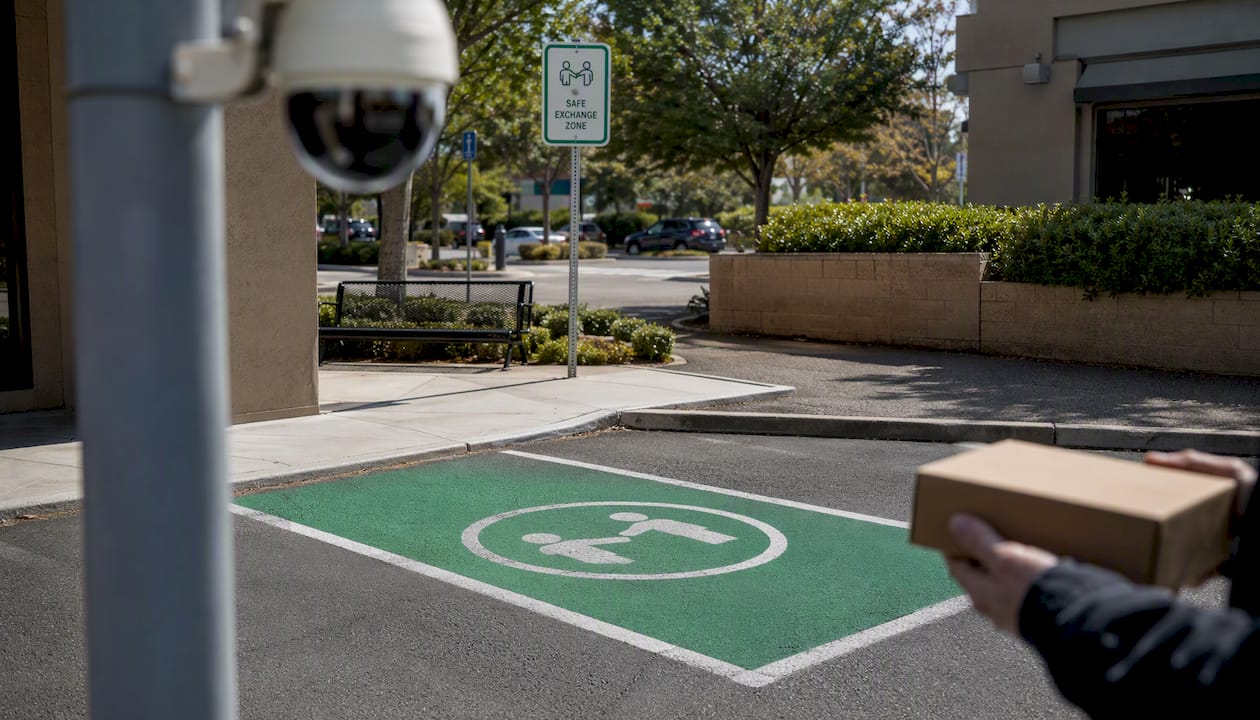
If a police station isn't convenient, any busy, well-lit public space works: a bank parking lot, a grocery store entrance, or a coffee shop. Avoid residential side streets, parking garages, and any location the other party insists on that feels off.
What to bring and check at pickup:
- Cash in the agreed amount (exact change if possible) or your payment app ready to send
- A tape measure or your phone's measurement app for furniture or large items
- Power on electronics and test basic functions before paying
- A flashlight for checking under furniture or inside bags in low light
- A friend or family member, especially for high-value items or evening meetups
Vetting the other party before you go:
- Check profile age: accounts created within the last few days with no activity are a warning sign
- Scan their message history for consistent, specific replies — vague or scripted responses are a red flag
- Request a time-stamped confirmation message the morning of the meetup: "Still on for 2 PM at the Target on Elm?"
Pro Tip: Tell a friend or family member where you're going, who you're meeting, and when you expect to be back. A quick text check-in after the exchange takes 30 seconds and adds a real layer of safety — especially for evening meetups or high-value items.
Porch pickup is acceptable for low-value items ($20 or under) when both parties are comfortable. Leave the item in a bag with the buyer's name on it, confirm payment before you set it out, and mark the listing Sold the moment the buyer confirms they've picked it up.
Which payment method is safest for local transactions?
Cash is still the fastest and most dispute-proof option for in-person local transactions. There's no reversal, no fee, and no waiting for a transfer to clear. The tradeoff is that it requires exact change and carries a small physical risk if the amount is large.
| Payment method | Speed | Reversible? | Fees | Best for |
|---|---|---|---|---|
| Cash | Instant | No | None | In-person, any amount |
| Platform payment (in-app) | Fast | Yes (dispute process) | Varies by platform | Shipped items, added buyer protection |
| P2P apps (Venmo, Zelle, Cash App) | Fast | Zelle: no; Venmo/Cash App: limited | Usually none for standard transfers | Porch pickup, trusted buyers |
Practical handling tips:
- Count cash before the other party leaves — do it openly, not suspiciously
- For P2P payments, request the transfer before handing over the item, then confirm it shows in your account
- Send a short confirmation message after payment: "Received $85 via Venmo — thanks!" creates a written record
- Mark the listing Sold immediately after the exchange, not hours later
The biggest payment scam in local marketplaces involves overpayment. A "buyer" sends a check or money order for more than the asking price, asks you to deposit it and send back the difference, and the original payment bounces days later. The rule is simple: never accept more than the agreed amount, and never send money back to a buyer.
For high-value items like electronics or vehicles, verifying item authenticity before any payment changes hands protects both sides. A seller who welcomes inspection signals confidence in what they're selling.
What are the red flags for scams in local marketplace deals?
Most scams follow predictable patterns. Recognizing them early lets you exit before any money moves.
Top warning signs:
- New or empty profile: account created recently, no ratings, no listing history, no profile photo
- Pressure to pay before meeting: "I'll hold it if you send a deposit via Zelle right now" from someone you've never transacted with
- Overpayment scheme: buyer "accidentally" sends too much and asks for a refund of the difference
- Off-platform communication request: "Text me at this number instead" removes the message trail and platform protections
- Unusual pickup location: a private address far from the buyer's stated area, or a location that keeps changing
- Too-good-to-be-true price: a $1,200 laptop listed at $150 with a vague "moving, need it gone" explanation
- Stolen goods signals: seller can't power on the device, has no original packaging for a brand-new item, or gets evasive about where they got it
What to do when something feels off:
- Pause the conversation — don't feel pressured to decide immediately
- Ask a direct clarifying question: "Can you show me a photo of the item powered on with today's date on a piece of paper?"
- Suggest a public meetup location and watch how they respond — a legitimate seller won't object
- Report the listing to the platform before or after declining
- If you feel physically threatened at any point, contact local law enforcement
Community best practices recommend verifying profile signals and requesting final confirmations in the messenger thread before any meetup. A profile with zero history asking for payment upfront is a near-certain scam.
How do you handle no-shows, cancellations, and disputes?
No-shows happen. How you handle them determines whether the transaction ends cleanly or turns into a dispute.
If you're the seller and the buyer doesn't show:
- Send one follow-up message: "Hey, just checking — are we still on for today?"
- Wait 15–20 minutes past the agreed time before leaving
- If no response, send a brief message: "I waited until [time] — I'm going to relist the item. Feel free to reach out if you'd still like it."
- Relist immediately; don't hold the item for someone who ghosted
If you're the buyer and the item is misrepresented:
- Document the discrepancy on the spot — photograph the damage or missing parts before leaving
- Address it calmly with the seller: "The listing said 'good condition' but there's a crack here that wasn't in the photos — would you consider $X instead?"
- If the seller refuses and the misrepresentation is significant, decline the purchase and report the listing to the platform
Deposits and holds: A non-refundable deposit for a hold is a local norm for items over $100, not a platform-mandated rule. If you offer a hold with a deposit, state the terms in writing in the chat before any money moves. If a buyer cancels after paying a deposit, the deposit stays with the seller — but only if that was agreed upfront.
Pro Tip: Screenshot your message thread before any meetup. If a dispute goes to the platform, a clean message trail showing agreed price, condition, and meetup details is your best evidence. The Center for Creative Leadership's communication research frames it well: following through on commitments and keeping a written record of agreements reduces conflict before it starts.
How do platform rules and community norms work together?
Every marketplace platform publishes a set of commerce policies: no prohibited items, honest descriptions, no price manipulation, follow payment and shipping rules. These are the floor. Local community norms often add practices the platform doesn't spell out.
Common platform rules to follow:
- List items in the correct category with accurate descriptions
- No prohibited items (weapons, counterfeit goods, regulated substances — check your platform's specific list)
- Honor the price and condition stated in the listing
- Use the platform's payment system when it's offered, especially for shipped items
- Report policy violations using the platform's built-in reporting tool
Ratings and trust: A fair rating reflects the actual transaction. Leave one promptly after the exchange — within 24 hours is the norm. Don't weaponize ratings to punish a buyer who negotiated hard or a seller who held firm on price. A one-star review for "they wouldn't take my lowball offer" damages the community's trust system for everyone.
When to report: report listings that appear fraudulent, items that look stolen, or buyers/sellers who become threatening or harassing. Most platforms have a one-click report function on every listing and profile. Use it. The community norms documented for Milwaukee-area marketplaces note that platform policies are the baseline — local communities layer additional practices like SafeTrade meetups and deposit norms on top of them.
Ready-to-copy message templates for common situations
These templates are short, specific, and designed to get a reply. Customize the bracketed details before sending.
Initial inquiry (buyer to seller): Making an offer: Seller confirming meetup: Buyer confirming meetup: Cancellation (buyer): No-show follow-up (seller): Post-transaction rating prompt (seller): Pro Tip: If you're reselling items for profit, keep your messages neutral and transactional. If you're gifting or clearing out a home, a warmer tone ("This belonged to my grandmother — I'd love it to go to a good home") often generates faster, friendlier responses and sometimes a better price. Match your voice to your situation.
Why etiquette is the real engine behind a healthy local marketplace
The conventional wisdom treats marketplace etiquette as politeness for politeness's sake. That misses the point. Every courteous behavior — the prompt reply, the honest listing, the SafeTrade meetup — is actually a trust signal that speeds up the transaction and reduces the chance of a dispute.
Think about what happens when etiquette breaks down: a seller who ghosts a buyer after agreeing to a price doesn't just lose that sale. They get a bad rating, their future listings get fewer inquiries, and they've made the whole community slightly more suspicious. The buyer who no-shows wastes a seller's afternoon and makes that seller less likely to hold items for anyone in the future. These small failures compound.
The platforms themselves can only do so much. Verified ratings, secure payment rails, and in-app chat reduce friction — but they can't force someone to show up on time or describe a cracked screen honestly. That part is entirely on the people involved. The community-sourced etiquette practices that have emerged around local marketplaces — specific opening messages, SafeTrade meetups, non-refundable deposits for holds — exist precisely because the platforms left those gaps open.
What actually separates a fast, clean transaction from a frustrating one is almost never the platform. It's whether both parties communicated clearly, showed up when they said they would, and treated the other person like someone they might run into again at the grocery store. In a local marketplace, you probably will.
Marketplaceapp makes local transactions easier from the first message
Marketplaceapp is built for exactly the kind of local, peer-to-peer transactions this guide covers. Secure in-app payments mean you're never chasing a Venmo request that never arrived. Verified seller ratings give you a real signal on who you're dealing with before you agree to meet. Instant chat keeps the entire conversation in one thread, so your message trail is always there if you need it for a dispute. Location-based search surfaces listings near you, which means shorter drives and faster pickups.
Whether you're buying and selling locally for the first time or you've done dozens of transactions and want a platform that handles the logistics cleanly, Marketplaceapp gives you the tools to close deals with confidence. Browse local listings or post your first item today at Marketplaceapp.
Sources
- Etiquette tips for buying and selling online
- Rules for Using Facebook Marketplace Milwaukee
- The 7 Cs of communication
- Communication: 1 idea, 3 facts, 5 tips (Center for Creative Leadership)
- The Unofficial Guide to Facebook Marketplace Etiquette