
Front-load a clear product noun and one decisive attribute inside the first 40 to 60 characters, since that's what mobile shoppers actually see before a title cuts off. A working formula: product noun + brand or model + size/color/condition, in that order. "IKEA Kallax Shelf, White, 4-Cube, Like New" tells a buyer everything they need before the phone screen truncates it.
TL;DR:
- Listing titles should be front-loaded with the product noun or brand, followed by a decisive attribute, to match what buyers search for.
- The optimal title length ranges from 50 to 80 characters, with most platforms emphasizing the importance of placing key information within the first 50 characters.
- Use numerals instead of words, avoid filler adjectives and emojis, and ensure all specifics are consistent with the listing to prevent losing clicks.
- Testing title variations over 7 to 14 days on one key metric helps identify the most effective structure, especially when adding specific details like size or model.
- Major mistakes include vague descriptions, mismatched details, repeated keywords, and unnecessary punctuation, all of which reduce click-through rates.
Table of Contents
- How Do You Write Listing Titles That Sell Fast?
- What Are the Character Limits on Major Platforms?
- Title Formulas You Can Copy Right Now
- Writing Titles Buyers and Search Actually Match
- How Do You Test and Improve a Listing Title?
- Mistakes That Quietly Kill Your Click-Through Rate
- What Marketplaceapp's Sellers Have Learned About Titles
- Ready to Put Your New Title to Work?
- Sources
- FAQ
How Do You Write Listing Titles That Sell Fast?
A checklist beats a mood when you're staring at a blank title field with five items to list before dinner. Run through this order every time.
- Lead with the product noun or the brand, whichever one a buyer types into search first. For a used blender, "blender" wins. For a pair of sneakers, "Nike" probably wins.
- Add one decisive attribute right after — model number, size, compatibility, or condition. This is the detail that actually separates your listing from the ten others in the same category.
- Use numerals, not spelled-out words. "3 piece" beats "three piece" because it's shorter and scans faster.
- Cut filler adjectives and emojis. "Great," "amazing," and a string of sparkle emojis burn characters without answering any buyer question.
- Preview the title on your phone before you publish. Open the draft in your marketplace app's mobile view and check exactly where it cuts off.
Pro Tip: Type your title, then read only the first 50 characters out loud. If that fragment alone doesn't tell a stranger what you're selling, move your best word earlier.
What Are the Character Limits on Major Platforms?
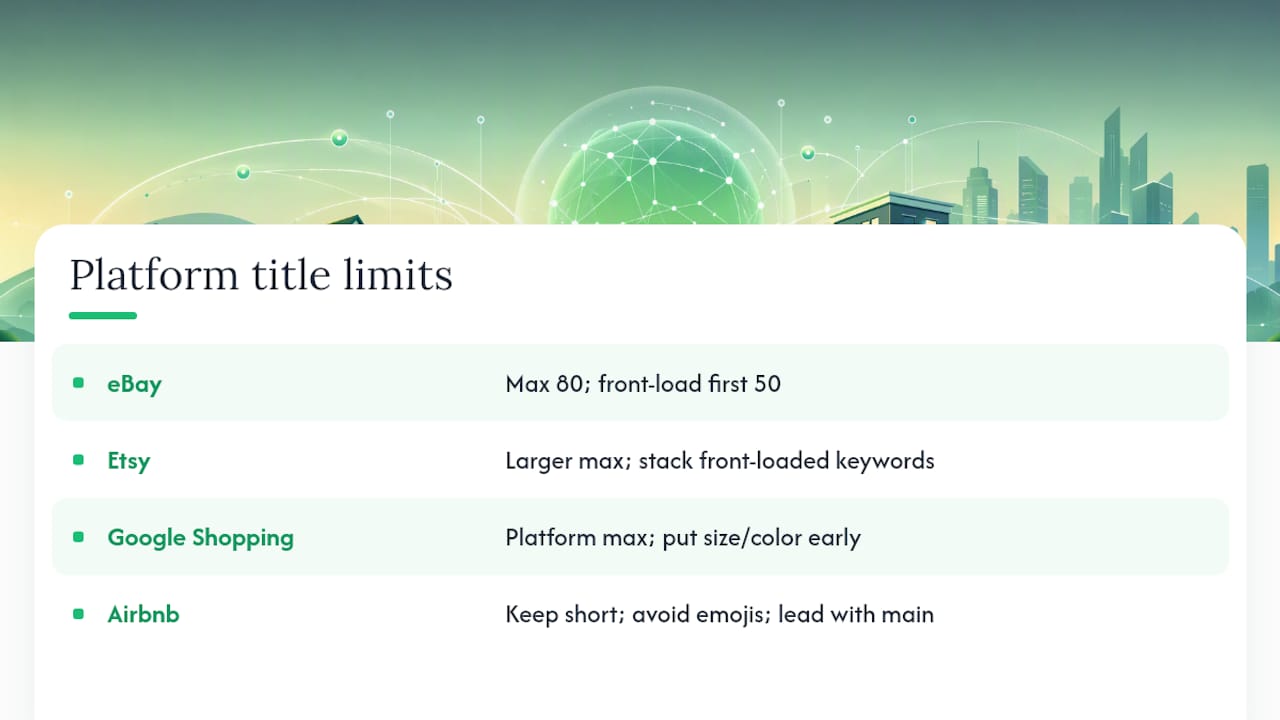
Every platform truncates differently, and guessing wrong costs you the exact words that would have closed the sale. eBay caps titles at 80 characters, but the practical cutoff is much earlier: high-performing listings put their most important keywords in the first 50 characters, then use the remaining space, targeting 78 to 80 characters total, to maximize how eBay's search actually surfaces titles.
Etsy titles allow a larger maximum length suitable for utilizing stacked keywords, and the pattern that ranks well stacks a front-loaded primary keyword with a style modifier, product type, format detail, and use case. Google Shopping titles can be up to a certain platform maximum length, which should be treated as a maximum, not an ideal length. Google reads the title as product data, so decisive attributes like size and color need to appear early and match the listing itself, not trail off as an afterthought.
Airbnb is the outlier. Hosts perform better keeping titles relatively short, typically under a modest character count limit, skipping emojis, and leading with the single most attractive detail of the space rather than stacking amenities.
Title Formulas You Can Copy Right Now
Different situations call for different formulas, and picking the wrong one for the platform is a common way to waste your best words. A keyword-first structure works when buyers are searching by product type, a brand-first structure works when the brand itself drives the click, and a descriptor-stacked structure earns its keep on platforms where browsing, not searching, dominates.
- Keyword-first (best for marketplace search): Product noun, brand, key attribute, condition. Example: "Dining Table, Solid Oak, Seats 6, Minor Scratches." Mobile-safe trim: "Oak Dining Table, Seats 6, Good Condition."
- Brand-first (best when the brand sells itself): Brand, product noun, model, attribute. Example: "Sony WH-1000XM4 Headphones, Noise Canceling, Black." Trim: "Sony WH-1000XM4 Headphones, Black."
- Descriptor-stacked (best for Etsy-style browsing): Style, product type, format, use case. Example: "Handmade Ceramic Mug, Speckled Glaze, 12oz, Coffee Lover Gift." Trim: "Speckled Ceramic Mug, 12oz, Gift."
- Use-case-first (best for niche or compatibility searches): Use case, product noun, compatibility, attribute. Example: "Phone Case for iPhone 15 Pro, Clear, Shockproof." Trim: "iPhone 15 Pro Case, Clear, Shockproof."
More examples across categories: "Kids Bike, 20-Inch Wheels, Red, Barely Used" (furniture/toys crossover), "LEGO Star Wars Set 75192, Complete, Box Included" (hobby), "Women's Leather Jacket, Size M, Black, Zara" (apparel), and "PlayStation 5 Console, Disc Edition, 2 Controllers" (electronics).
Writing Titles Buyers and Search Actually Match
Whether the brand or the product noun leads depends on what a local buyer is likely to type first. Someone hunting for a used stroller searches "stroller," not the manufacturer name, so the noun leads. Someone hunting for a specific phone case searches "iPhone 15," so compatibility leads. Get this order backward and your listing surfaces for the wrong searches entirely.
When compatibility changes the buying decision, spell it out. "Case for iPhone 15" and "Case for Samsung Galaxy S23" are two different products to a buyer, even if the case itself is nearly identical. Skipping that detail means your listing shows up in searches that were never going to convert.
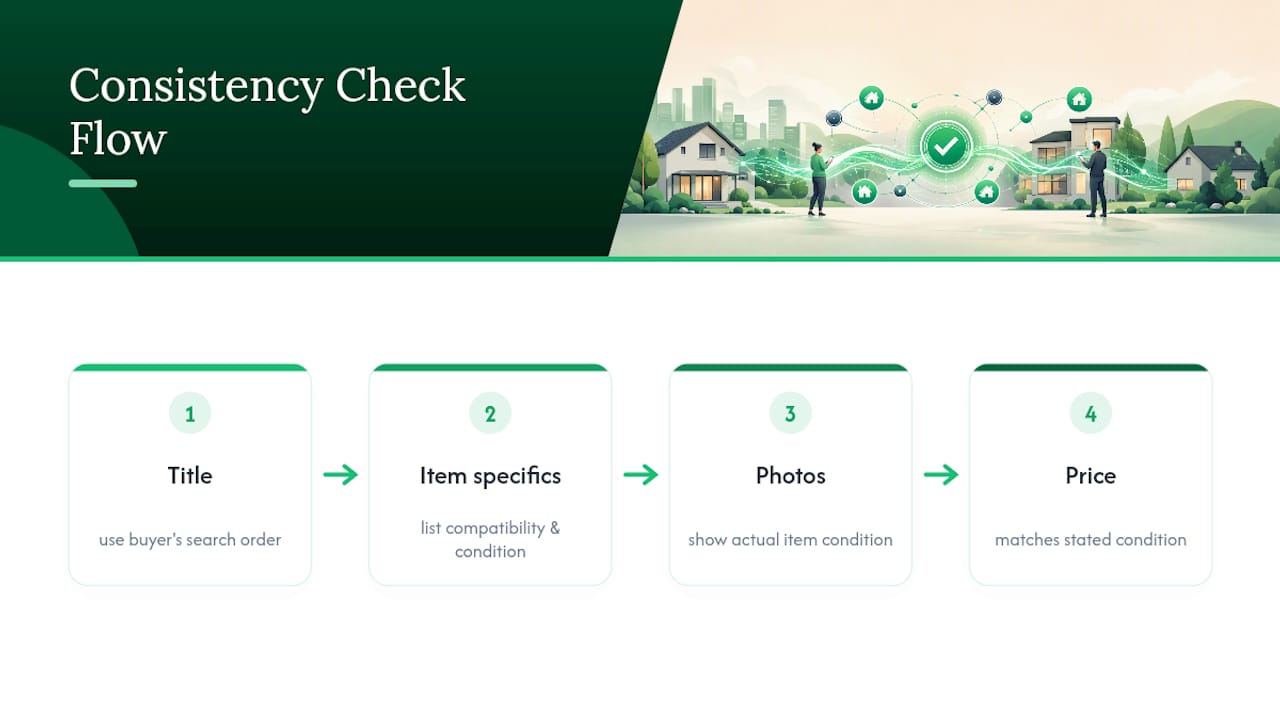
Keep every word in the title consistent with your item specifics, your photos, and your price. A title that says "Excellent Condition" next to photos showing a cracked screen doesn't just lose the sale, it damages trust for your next listing too. Plain, searchable language beats clever phrasing almost every time. A buyer searching "coffee table" will never find your listing titled "Rustic Charm Centerpiece."
How Do You Test and Improve a Listing Title?
You don't need a marketing degree to run a useful title test. You need a clock and three numbers.
- Pick one metric to watch: views, click-through rate if your platform shows it, or messages from interested buyers.
- Change one element at a time. Swap brand-first for noun-first, or add a size detail you'd left out. Never rewrite the whole title in one pass, or you won't know which change moved the needle.
- Run the test for 7 to 14 days. Shorter than that and normal daily traffic swings will fool you into thinking a bad title is working.
- Compare against your category's typical performance, not just against your own past listings, since a slow week for the whole platform can mask a genuinely weak title.
- Commit to the winner and move on. Once one version clearly outperforms, stop testing that listing and apply the lesson to similar items.
Pro Tip: If a title sits below your category's typical click-through rate after a full 14-day window, rewrite it rather than waiting for it to improve on its own — titles rarely fix themselves.
Mistakes That Quietly Kill Your Click-Through Rate
Every wasted character in a title is a character that could have answered a buyer's actual question. The four mistakes below cost sellers the most clicks.
- Vague adjectives instead of facts. "Great condition" tells a buyer nothing measurable. "Used twice, no scratches" does.
- Emojis and stacked punctuation. They eat character space that platforms like eBay and Etsy already ration tightly, and they read as low-trust to many buyers.
- Mismatched specifics. If your title says "16GB" and your description says "32GB," you're inviting a return or a canceled sale before the buyer even messages you.
- Repeated keywords. Typing "bike bicycle bike" to game search doesn't help; most marketplace algorithms flag it, and it makes your listing look cluttered next to a competitor's clean one.
What Marketplaceapp's Sellers Have Learned About Titles
Small changes move the needle more than sellers expect. Adding a single measurable detail, like "size 8" or "128GB," to a previously vague title is one of the most consistent click-through improvements we've seen across seller guides. Before publishing anything, run a quick pass: do your photos match the title, is your price visible and reasonable for the category, and does the listing sit in the correct category rather than a nearby one. For the words after the title, our guide on writing listing descriptions and our piece on categorizing listings correctly cover the next two steps.
— Marketplace
Ready to Put Your New Title to Work?
A sharp title only pays off if the listing behind it is easy to post and safe to sell through. The platform gives local sellers secure payments, seller ratings, and instant chat with buyers, helping listings work without the seller handling cash meetups or unanswered messages. Users can create listings directly without needing to compare separate apps or wait for callbacks. You draft the title using the checklist above, then create your listing on Marketplaceapp and let local buyers find it today.
Sources
- eBay Listing Title Best Practices (2026) | Ecomli
- How to Write Etsy SEO Titles That Rank | Ratio Ready
- Guidelines for writing your listing title | Airbnb
FAQ
How Long Should a Listing Title Be?
It depends on the platform, but a safe general target is 50 to 80 characters, front-loaded with your most important words. eBay caps titles at 80 characters, while Etsy allows up to 140.
Should I Put the Brand or the Product Name First?
Put whichever word a buyer types into search first. If people search by product type, like "office chair," lead with that; if the brand itself drives searches, like a well-known sneaker line, lead with the brand.
Can I Use Emojis in My Listing Title?
Skip them. Emojis eat scarce character space and Airbnb explicitly advises against them because they reduce readability and trust on most listing platforms.
How Often Should I Change a Title That Isn't Working?
Give a new title 7 to 14 days before judging it, since shorter windows get skewed by normal traffic swings. If it still underperforms your category's typical click-through rate after that, rewrite it.
Does Marketplaceapp Charge to List an Item?
Pricing details for creating and promoting listings are available directly on Marketplaceapp, where you can check current options before you post.