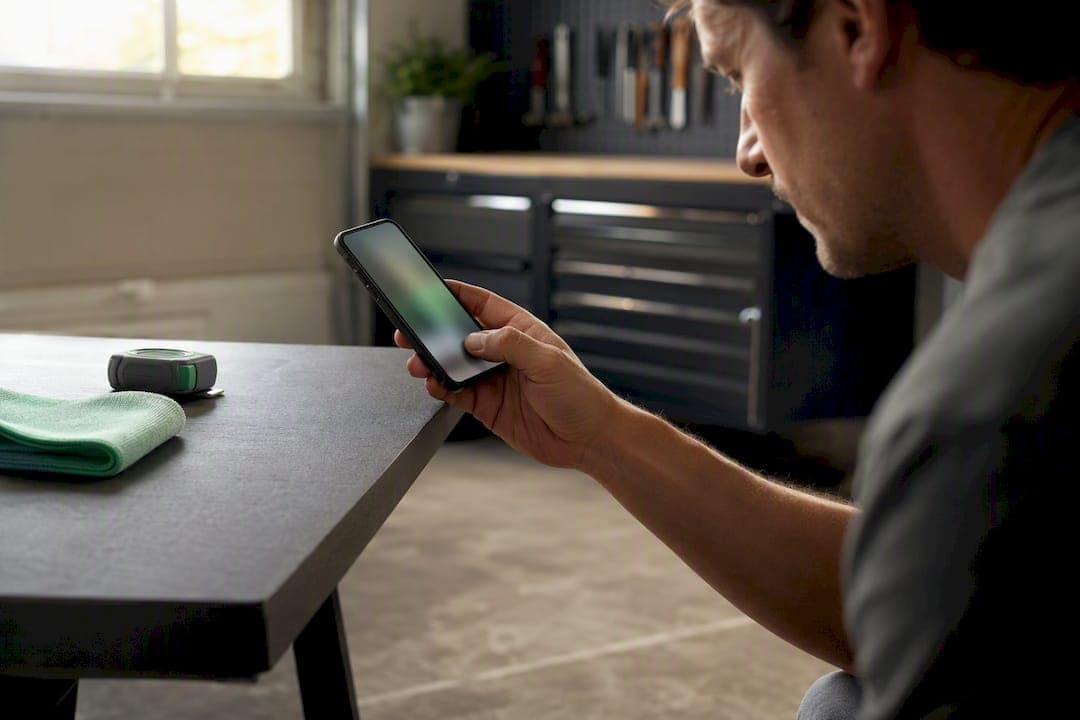
The fastest, safest way to sell locally is to match your item to the right platform, post a listing with sharp photos and real dimensions, price it with room to negotiate, and confirm payment before you hand anything over. Skip any one of those steps and you either sit on unsold inventory or walk into a scam. Start now: take four clean photos and grab a tape measure before you write a single word of copy.
TL;DR:
- Setting a firm price with negotiation room and accepting verified in-platform payments significantly increases the chances of a quick, scam-free local sale.
- Using specific, searchable titles and detailed photos showcasing size and flaws helps attract genuine buyers and reduces inquiries about availability.
- Listing on the appropriate platform based on the item category — not convenience — boosts visibility and speeds up the selling process.
- Meeting in public places, confirming payment before handing over the item, and avoiding off-platform communication or overpayment offers safeguards against scams.
- Posting during peak hours, bundling related items, and setting narrow pickup windows enhance speed and reduce no-shows in local transactions.
Table of Contents
- Selling Locally Tips: A Checklist You Can Use Today
- Which Local Selling Platform Should You Use First?
- How Do You Write a Listing That Actually Sells?
- How Should You Price and Negotiate a Local Listing?
- What's the Safest Way to Meet a Buyer and Get Paid?
- How Do You Close a Local Sale Fast?
- Should You Sell Locally, Ship It, or Just Donate It?
- How Marketplace Features Cut Risk for Local Sellers
- What Experienced Local Sellers Do Differently
- List and Sell Locally Without the Guesswork
- Sources
Selling Locally Tips: A Checklist You Can Use Today
Most local sales stall for the same handful of reasons: bad photos, a vague title, a price nobody wants to touch, or a pickup time that never gets confirmed. Work through this list in order and most of that friction disappears.
- Photos and measurements first. Shoot in daylight, wipe down the item, and measure height, width, and depth before you write a description.
- Pick one primary platform based on the item category, not whichever app you happen to have open.
- Set a price with built-in negotiation room, and decide upfront which payment methods you'll accept.
- Block off a narrow pickup window (a two-hour slot beats "anytime this weekend") and confirm it the morning of.
Pro Tip: Do the cleaning and measuring before you open the listing app. Sellers who write the description first almost always forget a dimension or a flaw, and that's exactly what triggers a "still available?" message you never answer.
Handle those four things and you've already beaten most of the competing listings in your area. Everything past this point is about optimizing each step, from picking the right app to closing the sale without getting ghosted at the pickup spot.
Which Local Selling Platform Should You Use First?
The category of item you're selling should decide your platform, not habit. Furniture, appliances, and anything too bulky to ship belongs on general local marketplaces like Facebook Marketplace or a marketplace app built around location-based search, because buyers in these categories almost always want to see and touch the item before paying. Tools, vehicles, and equipment tend to do better on classified-style channels where buyers are already searching by specific make, model, or spec. Small electronics, collectibles, and fashion items move fastest on app-first marketplaces where photo browsing and instant chat are the default experience, since mobile-created listings routinely get more impressions than desktop ones.
Here's a quick reference for where to start:
- Furniture and appliances: general local marketplaces with map-based browsing (Facebook Marketplace, marketplace apps)
- Tools, vehicles, and equipment: classified-style channels where buyers search by spec
- Small electronics and collectibles: app-first marketplaces with instant chat
- Clothing and accessories: neighborhood groups or app marketplaces with strong photo feeds
- Anything you need gone fast: neighborhood or Nextdoor-style groups, where buyers are already nearby and less picky about negotiating shipping
Cross-posting can extend your reach, but it comes with one hard rule: the moment an item sells, mark it sold everywhere, immediately. Nothing kills your reputation on a local platform faster than a buyer showing up for something you already sold to someone else three hours earlier. If you're listing on more than one channel, set a phone reminder to check all of them before you leave for a meetup, not after.
A hybrid approach works well for anything you're not in a rush to unload: list locally first, and only expand into shipped, national channels if the item hasn't sold within a reasonable window. This matters more for bulky or low-margin items where shipping cost, fragility, and size make local buyers your only realistic pool. A $40 lamp isn't worth the box, the tape, and the shipping label. A rare vinyl record might be.
One more platform-fit wrinkle: pricier or more specialized items (a vintage guitar, a graded card, a niche tool) often do better waiting an extra day or two for the right local buyer than getting rushed onto a general marketplace where they'll get lost among couches and strollers. If you're weighing which marketplace app fits your specific item, think about who's actually searching for that category, not just where you already have an account.
How Do You Write a Listing That Actually Sells?
Photos do more work than your description ever will. Specific titles, precise dimensions, and honest photos are consistently the biggest lever for faster local sales, and that holds true whether you're selling a couch or a graphics card.
1. Shoot at least five photos, in this order: a clean front shot in good light, a shot from an angle that shows depth, a close-up of any wear or damage, a photo of tags or model numbers if visible, and one shot of the item in a room for scale. That last one matters more than people think. A couch photographed alone against a wall gives buyers no sense of size. The same couch next to a coffee table or a person's leg tells them instantly whether it fits their space.
2. Add a short video only when the item has moving parts or functionality to prove. A blender that needs to show it still spins, a bike with working gears, a laptop that boots up. For anything static like clothing or furniture, skip it. A 15 second clip is plenty; nobody is watching a 90-second product tour for a used end table.
3. Write your title using a simple formula: brand or make, model or key spec, and condition. "Ikea Kallax 4x4 Shelf, White, Good Condition" beats "Bookshelf for sale" every time, because it matches exactly what a buyer types into search. If there's no brand (a couch you built yourself, a random end table), lead with the most searchable descriptor instead: material, color, size.
4. Fill the description with everything a buyer would otherwise have to ask about. Exact dimensions, any defects (a scratch, a missing screw, a stain), what's included (original box, charger, remote), whether you're flexible on pickup timing, and which payment methods you accept. Skipping a defect doesn't make it disappear. It just guarantees an awkward conversation at the door when the buyer notices it themselves and either walks or tries to renegotiate on the spot.
Pro Tip: List the flaw before the buyer has to ask about it. "Small scratch on the left arm, priced accordingly" builds more trust in four words than a flawless photo set that quietly leaves it out.
For longer or more complex items, a full guide to writing high-converting listing descriptions walks through structure in more depth.
How Should You Price and Negotiate a Local Listing?
Start by checking what similar items actually sold for nearby, not what other people are asking. Asking prices tell you what sellers hope for. Sold prices tell you what buyers will actually pay, and most local marketplace apps let you filter for that if you know where to look.
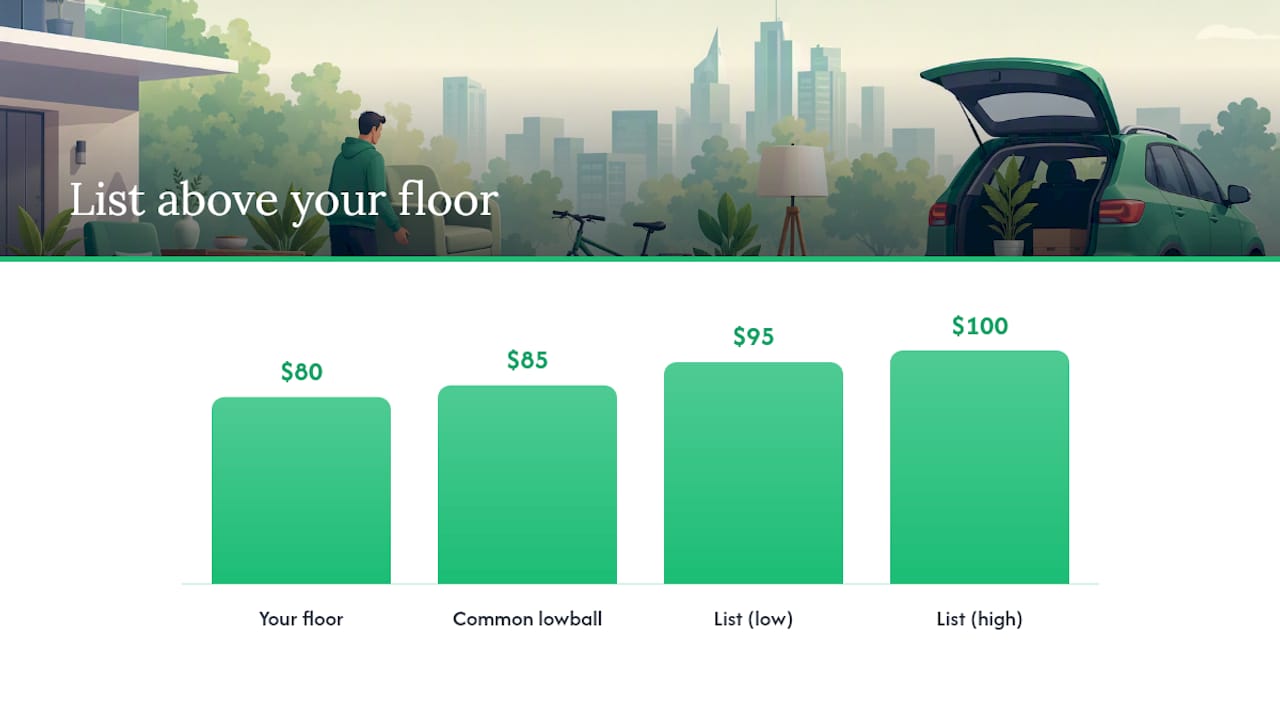
- Build negotiation room into your listing price on purpose. If your real floor is $80, list at $95 to $100 so a buyer who lowballs you at $85 still feels like they won, and you still hit your number.
- Use "OBO" sparingly. It invites every lowball offer in the neighborhood. A firm price with obvious room to move usually filters out more time-wasters than an open "or best offer" tag.
- Watch your engagement signals, not the calendar. Plenty of views but zero messages after 48 hours means your price is the problem. Zero views means your title or photos aren't getting found.
- Drop price in small, deliberate increments rather than one big cut. A 5 to 10% reduction is often enough to trigger renewed visibility on algorithm-driven marketplaces without training buyers to expect steep discounts.
Relisting works the same way. If an item goes quiet after four or five days, a small price adjustment paired with a fresh post (rather than just editing the old one) puts it back near the top of search and browse feeds, since most local marketplace algorithms favor recency and reward small price drops with a visibility bump.
One habit worth building: don't discount before you've fixed your listing quality. A staged photo and title upgrade routinely outperforms an aggressive early price cut, and it costs you nothing but ten extra minutes.
What's the Safest Way to Meet a Buyer and Get Paid?
Every scam that targets local sellers follows one of two patterns: the buyer pushes you off the platform fast, or the buyer pays you before you've actually confirmed the payment cleared. Both are avoidable if you stick to a short list of rules.
- Keep every conversation inside the platform's chat until you've vetted the buyer. Scammers push hard to move to text or email because it strips away the ratings and message history that protect you.
- Meet in a public, well-lit place. A grocery store parking lot, a bank lobby, a police station's designated exchange zone if your area has one.
- Bring someone with you for anything valuable, and tell a friend or family member where you're going either way.
- Confirm payment before the item leaves your hands, not after. Count cash on the spot. For Venmo or Zelle, wait until the funds actually show as received in your account, not just a screenshot of a "payment sent" confirmation, which is trivially easy to fake.
- Walk away from any buyer who offers to overpay and asks for the difference back, or who wants to ship you a check before picking up the item.
The most common local marketplace scams share a pattern: the buyer creates urgency, offers more money than asked, or insists on moving communication off the platform before you've had a chance to verify anything. Refusing all three of those moves eliminates most fraud attempts before they get anywhere near a handoff.
Official consumer protection guidance on digital and online scams backs up all of this: verified on-platform payment, public meetups, and refusing shipping-before-payment requests are the baseline, not optional extras. A closer look at local marketplace etiquette and safe communication habits covers the softer side of this, like how to politely decline a sketchy request without escalating it into an argument.
How Do You Close a Local Sale Fast?
Speed comes from timing and structure, not from cutting your price.
- Post during peak browsing hours (typically evenings and weekends), since that's when listings created and posted through mobile apps tend to get the strongest early engagement, and treat the first 48 hours as your make-or-break window.
- Bundle related items when you have them. A single "moving sale: desk, chair, and lamp, $120 for all three" listing often outsells three separate posts, because it removes the buyer's need to coordinate three separate pickups.
- Use "first to confirm pickup time gets it" language when you have multiple interested buyers. It creates urgency without sounding pushy, and it rewards the buyer who's actually ready to commit.
- Set a narrow pickup window and reconfirm it the morning of. A specific two-hour slot creates a firmer commitment than a vague "come by whenever," which quietly reduces no-shows.
- Line up a backup buyer before the first pickup, especially for anything in demand. If buyer one flakes, you message buyer two immediately instead of starting the whole process over.
A speed-focused playbook for closing local sales fast goes deeper into juggling multiple listings at once if you're clearing out a whole room rather than one item.
Should You Sell Locally, Ship It, or Just Donate It?
Not everything is worth listing locally, and forcing a sale on something better donated wastes more time than it earns you in cash.
- Sell locally when the item is bulky, fragile, or low-margin. Furniture, appliances, and anything where shipping cost would eat most of the sale price.
- Ship it when the item is small, durable, and has a narrow buyer pool nearby. A specialty electronics part or a niche collectible often sells faster nationally than to the three interested people within twenty miles of you.
- Donate when the item is functional but low-value, or you need it gone fast. Habitat ReStore locations accept many used home goods and often offer pickup for larger furniture donations, which solves the "nobody wants to pay for this couch" problem without a trip to the dump. Local junk removal and donation pickup services for furniture fill the same gap if ReStore isn't nearby, and a breakdown of large-item disposal and donation options is worth a look before anything heavy heads to the curb.
A practical rule: try local for 7 to 10 days first, since that window matches how most successful hybrid local-to-shipped strategies are structured. If nothing bites, decide then whether to ship it, drop the price, or donate it and take the deduction.
How Marketplace Features Cut Risk for Local Sellers
A lot of the friction covered above (verifying a buyer, confirming payment, arranging a safe meetup) gets easier when the platform itself is built for it. Secure in-app payment processing removes the guesswork of confirming whether a Zelle transfer actually cleared. Verified seller and buyer ratings give you a read on someone's track record before you agree to meet them, which is exactly the kind of signal that separates a real buyer from a scam attempt. Instant chat keeps the whole conversation on-platform and timestamped, so there's a record if something goes wrong. Location-based search puts your furniture listing in front of buyers who are actually close enough to pick it up the same day.
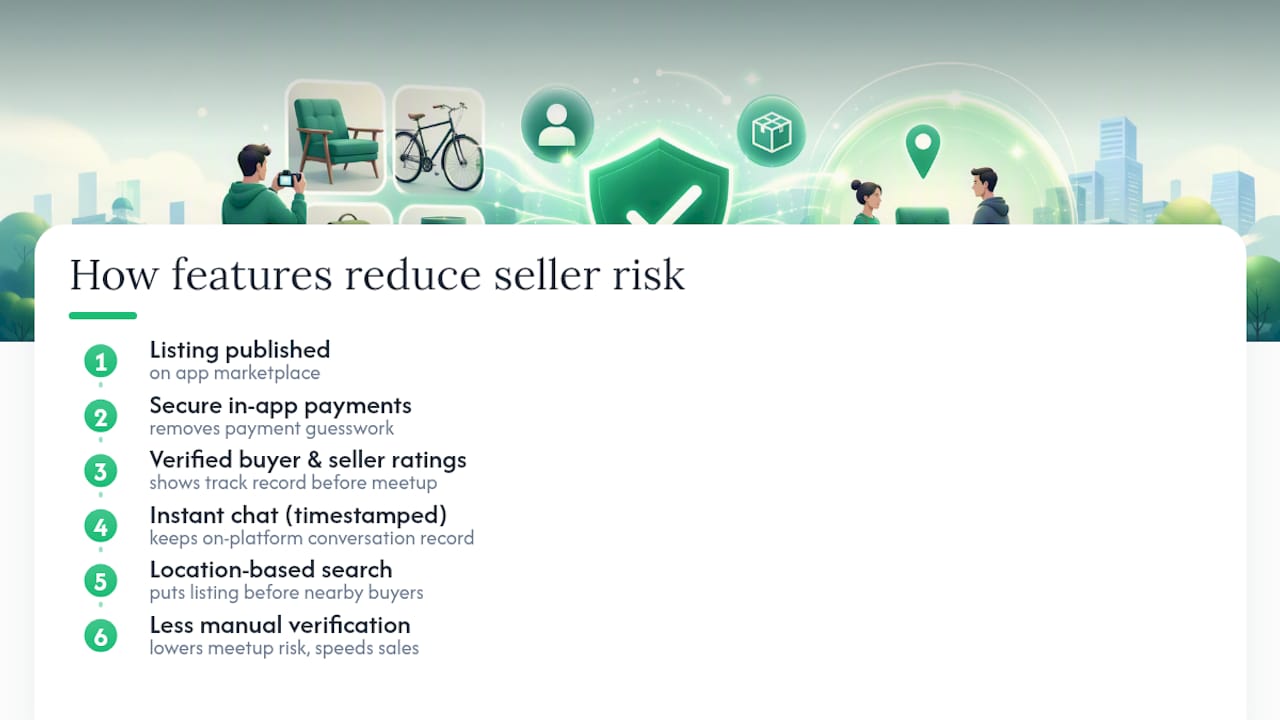
None of that replaces good judgment at the meetup. But it removes a lot of the manual verification work that used to fall entirely on the seller, and it's a big part of why local sales through app-based marketplaces tend to move faster than a bare classified post with no built-in messaging or rating history.
What Experienced Local Sellers Do Differently
The sellers who move items fast almost never have better inventory than everyone else. They just skip the mistakes. Lazy, dim photos taken in a cluttered garage. Titles like "couch, good condition" that tell a search algorithm nothing. Pickup windows so vague ("anytime this week works") that nobody commits and everybody flakes.
What actually works is boring and repeatable: reply within an hour, post from the phone the moment the photos are taken instead of waiting until evening, and mark an item sold the second it's gone. One seller clearing out a garage sold a bike within three hours simply by adding a scale photo and a firm two-hour pickup window, after the same bike sat untouched for a week with a single blurry photo. Another turned a "make offer" listing that drew nothing but lowballs into a fast sale just by removing the OBO tag and adding "$45 firm, negotiable for cash today."
None of this is complicated. It's just consistency most sellers skip.
— Marketplace
List and Sell Locally Without the Guesswork
Everything above works better with the right tool doing the heavy lifting. Marketplaceapp is built around the exact steps that get local items sold fast: post from the mobile app for stronger visibility, use location-based search so nearby buyers actually see your listing, and keep every conversation in secure, timestamped chat instead of texting a stranger.
Verified seller ratings mean you're not guessing whether the person messaging you about your couch is legitimate, and built-in secure payment options take the "did that Zelle actually go through" question off your plate entirely. If you want more eyes on a listing during a slow week, promoted listing options push your item higher in local search results without you having to relist from scratch every few days. Head to Marketplaceapp to list your first item, and see how quickly a properly built listing turns into an actual conversation with a nearby buyer.
Sources
For readers who want to check the guidance above against the original sources:
- Habitat
- Selling locally on Facebook Marketplace: zero-fee guide — ListingForge
- Underpriced
- Facebook Marketplace listing tips that actually sell — AllisonSkiff