
When a lowball offer lands in your inbox, reply fast, stay short, and don't explain yourself. A brief, professional counter or a firm "no thanks" ends the back and forth before it starts, because it signals you know your price and won't be worn down. If the offer is not worth your time, say nothing at all.
Copy this and adjust the numbers: "Thanks for the offer! I can do $X firm, otherwise the price stands as listed."
Three quick checks tell you what to do next:
- Offer under 50% of your asking price with no message? Ignore or block.
- Offer 70 to 85% of asking with a polite note? Counter once.
- Same buyer messaging multiple listings with copy-paste lowballs? Block and move on.
Key Takeaways
Handling lowball offers well comes down to fast, unemotional replies, a firm walk-away number, and listing controls that filter out weak offers before they reach you.
| Point | Details |
|---|---|
| Reply fast and short | A brief, professional counter or decline shuts down back and forth better than a long explanation. |
| Know your floor | Set a walk-away number covering costs, fees, and minimum profit before you negotiate. |
| Use decision rules | Match offer percentage, buyer tone, and listing age to a set action instead of deciding case by case. |
| Prevent lowballs at the listing level | Clear photos, firm language, and comps cut down on offer volume before it starts. |
| Marketplace supports the system | Minimum-offer settings, verified ratings, and batch inbox tools help sellers filter and manage offers at scale. |
Table of Contents
- How to Respond to Lowball Offers Without Overthinking It
- A Checklist for When to Engage, Counter, or Walk Away
- Listing Tactics That Cut Down on Lowball Offers
- Countering a Low Offer Without Losing Your Leverage
- When Taking a Lowball Offer Actually Makes Sense
- Running Lowball Responses Like a System, Not a Scramble
- It Never Really Stops, But It Stops Bothering You
- How Marketplace Helps You Manage Offers Without the Back and Forth
- Frequently Asked Questions
- Sources
How to Respond to Lowball Offers Without Overthinking It
Handling lowball offers doesn't require a unique reply for every buyer. Eight short scripts cover almost every scenario you'll run into, and knowing which one fits the tone in front of you is what actually saves time.
- Polite decline (buyer seems unaware of value): "Appreciate it, but I'm firm on the listed price."
- Firm counter (buyer is reasonable but low): "I can meet you at $X, that's as low as I'll go."
- Final offer (you've countered once already): "$X is my final number, let me know today."
- No response (offer is insulting or automated): silence, then archive.
- Polite education (buyer doesn't know comps): "This model sells for $X to $Y used, mine includes [extra]."
- Accept if pickup now (you want it gone): "I'll take $X if you can grab it within the hour."
- Block or report (rude or repeat offender): use the platform's block/report tool and stop replying.
- Quick bundle offer (buyer wants a deal): "I'll do $X if you take both items together."
Rude or urgent buyers rarely deserve a paragraph back. Match the script to the tone, not the buyer's mood.
A Checklist for When to Engage, Counter, or Walk Away
Handling lowball offers gets easier once you stop deciding case by case and start applying the same rule set every time. Run each offer through five signals before you type a single word.
- Offer as a percent of your asking price: below 50% signals a throwaway bid, not a real negotiation.
- Buyer tone: polite and specific means engage; single-word or rude means decline or ignore.
- Listing age: brand new listings can hold firm; older ones justify more flexibility.
- Payment method requested: anything off-platform or unusual is a decline regardless of price.
- Buyer rating or history: unrated or newly created accounts warrant more caution before you counter.
Match the result to an action: engage if the offer is reasonable and the buyer seems serious, counter once if it's close but low, hold if you're unsure, auto-decline if it's far under floor, and block if the buyer is abusive or repeats the same tactic across listings.
Pro Tip: Never respond with sarcasm or anger, even to a ridiculous offer. A screenshot of a heated reply can end up in a review or a dispute, and that follows your seller rating longer than the lost sale ever would.
Listing Tactics That Cut Down on Lowball Offers
The best way to handle lowball offers is to stop most of them before they arrive. Price near the top of the current market range for your item, then treat the bottom of that range as your real floor. This gives you room to counter without ever dropping below what you actually need, an approach echoed in Swappa's guide to negotiating used tech sales.
A handful of listing details do most of the heavy lifting:
- Clear, well lit photos from multiple angles reduce "is this even real" style lowballs.
- Sold comps or a quick note on recent comparable sales anchor your price in reality.
- Firm language in the description ("price is firm," "no lowballs") filters out casual testers.
- Specific pickup or shipping terms remove the guesswork buyers use to justify a lower bid.
Many platforms also offer minimum-offer or auto-decline settings, required-offer fields, and no-negotiation flags. Turn these on for high-demand items and skip them for things you genuinely want gone fast. Practical, seller-focused steps like these also come up often in advice on stopping lowball offers on Facebook Marketplace.
Pro Tip: Mute notifications for a set window and batch-process offers twice a day instead of reacting to every ping. Fewer reactive replies mean fewer replies you'll regret.
Countering a Low Offer Without Losing Your Leverage
The fastest way to counter a lowball offer is one clear number tied to market comps or your floor, not a wall of justification. A single firm counter reads as confident; three paragraphs explaining your reasoning reads as desperate.

Before you type anything, know your walk-away number. Add up your cost of goods, platform fees, shipping or supplies, a small reserve for returns or damage, and the minimum profit you'll actually accept. That total is your floor, and it should never move mid-conversation.
From there, decide once: split the difference if the buyer's offer is close and reasonable, or hold at one final number if the gap is wide. A lowball offer is often just a deliberately low opening bid meant to anchor the negotiation in the buyer's favor, and it works better in buyer-favorable markets than in ones where you clearly have the advantage, per Investopedia's explanation of lowball tactics. When the gap between the offer and your floor is too wide to close, CNBC's guide to countering low offers makes a point worth borrowing from salary talks: consider a non-monetary tradeoff, like faster pickup, or simply walk.
Pro Tip: Skip the backstory about why the item is worth more. Long explanations signal insecurity and invite another round of lowballing instead of shutting it down.
When Taking a Lowball Offer Actually Makes Sense
Not every low offer deserves a fight. Sometimes taking it is the smarter move.
- You need the cash now more than you need the extra $20 to $50.
- The item is costing you storage space, gas money for repeat meetups, or mental bandwidth.
- It's damaged, seasonal, or otherwise unsellable at full price elsewhere.
- Bundling it into a lowball offer clears two listings instead of one.
- You've set a deadline to clear inventory and the item has been sitting past it.
Weigh time against money before you decide. A lowball offer that saves you two more weeks of listings, messages, and canceled meetups is often worth more than the extra cash you'd hold out for.
Running Lowball Responses Like a System, Not a Scramble
Once you're listing dozens of items, handling each lowball offer individually stops being realistic. Set an auto-decline floor for each category and adjust it by how long the item has sat. Fresh listings can defend a high floor; older ones can afford more flexibility or a switch to bundling.
A simple weekly routine works: check offer volume, adjust floors on stale listings, and tighten description language on items pulling in the worst offers. A tiered response system with clear auto-decline rules is the approach experienced resellers use to protect margins without burning hours on every message, according to Underpriced.
| Offer vs. floor | Action |
|---|---|
| Below floor | Auto-decline |
| Within 10% of floor | One-step counter |
| At or near list price | Accept or call to confirm pickup |
Pro Tip: Save your five best scripts as templates and block off two inbox sessions a day. Reactive, one-off replies are where most sellers leak both time and patience.
It Never Really Stops, But It Stops Bothering You
Lowballers don't disappear no matter how well you price or photograph an item, and expecting otherwise sets you up for frustration. What changes is your reaction. Once you're working from scripts, a real floor, and a decision checklist, a rude offer becomes routine instead of personal. The energy you used to spend stewing over a $20 insult gets redirected into pricing the next listing better.
How Marketplace Helps You Manage Offers Without the Back and Forth
Marketplaceapp builds several of these tactics directly into the listing tools, so you're not relying on willpower alone to hold your floor. You can set minimum-offer thresholds that quietly filter out lowballs before they hit your inbox, check verified buyer ratings before you engage, and use a batch inbox to process offers on your own schedule instead of reacting to every notification.
Listing templates also let you reuse the language that's worked for you before, including firm-price notes and pickup terms, so every new listing starts with the same protections. If you're tired of typing the same counter offer for the tenth time this week, it's worth setting up your next listing on Marketplace and letting the platform's offer controls do some of that filtering for you.
Frequently Asked Questions
What's the best first response to a lowball offer? A short, professional counter or a firm decline works best. Skip long explanations about why your item is worth more.
Should I ever ignore a lowball offer completely? Yes. If the offer is far below your floor or comes with no message, ignoring it and moving to the next inquiry is often more efficient than engaging.
How do I stop getting so many lowball offers? Price near the top of your market range, use clear photos and firm language in your description, and turn on minimum-offer or auto-decline settings where your platform allows it.
Is it ever smart to just accept a lowball offer? Yes, when you need fast cash, the item is costing you storage or time, or the offer clears out inventory you were going to discount anyway.
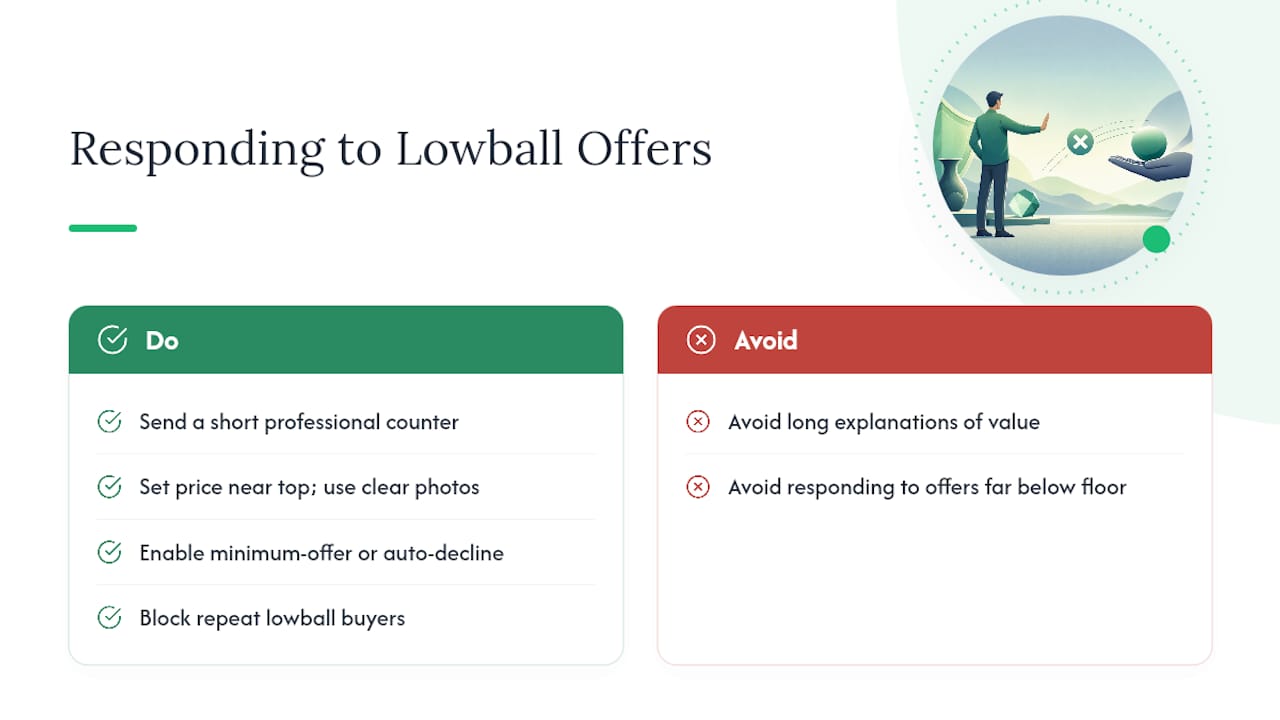
How do I handle a serial lowballer who keeps messaging different listings? Block them. A buyer who repeats the same low, copy-paste offer across multiple items is not negotiating in good faith.