
Yes, reselling is a reliable side hustle — and you can make your first sale within a week. The model is simple: buy low, sell on platforms where buyers already search (Facebook Marketplace, eBay, Poshmark), and pocket the difference after fees. Side Hustle School puts it plainly: you can start with items you already own, check sold prices to validate demand, and get fast feedback on what works. The IRS will eventually want a cut once you cross reporting thresholds, so tracking profit from day one matters. It fits students, part-timers, and anyone with a free weekend and $20–$50 to test the waters.
The U.S. secondhand market is growing steadily, with new platform entrants and fee shifts in 2026 signaling stronger buyer demand than ever. That's the tailwind. The skill is learning to read it.
Quick-start checklist for this weekend:
- Pick 5–10 items you already own (clothes, books, small electronics)
- Search each item on eBay using the "Sold Listings" filter to confirm real sale prices
- Photograph each item in natural light against a plain background
- List on Facebook Marketplace (free, local, no shipping required) or Poshmark (clothing)
- Set prices 10–15% below the median sold comp to move inventory fast
- Keep a simple notes app log: what you paid, what you listed it for, what it sold for
Table of Contents
- How does the reselling model actually work?
- Your first-weekend plan to test reselling with low risk
- Where do you find inventory to resell?
- What are the best categories to resell for beginners?
- How do you price items and research value before you list?
- What mistakes kill your margins, and how do you fix them?
- How do you scale from casual flips to $500–$2,000 a month?
- How Marketplaceapp helps resellers move inventory faster
- Key Takeaways
- When should you scale, maintain, or walk away from reselling?
- Marketplaceapp: the local-first option for quick flips
- Useful sources and tools to go deeper
How does the reselling model actually work?
The formula has three parts: buy price + all costs = your break-even; sale price minus break-even = actual profit. Most beginners skip the middle part and wonder why they're not making money.
Here's what "all costs" actually includes:
- Platform fees: — eBay charges roughly 13.25% on most categories; Poshmark takes a flat 20% on sales over $15; Mercari charges 10%; Amazon FBA fees vary by size and weight
Worked example — a thrift-store clothing flip:
You find a name-brand fleece jacket at Goodwill for $7. Sold listings on eBay show comparable jackets selling for $38–$45. You list at $40.
| Cost item | Amount |
|---|---|
| Purchase price | $7 |
| eBay fee (13.25%) | $5.30 |
| Shipping (USPS First Class) | $6.00 |
| Packaging | $1.00 |
| Total costs | $19.30 |
| Net profit | $20.70 |
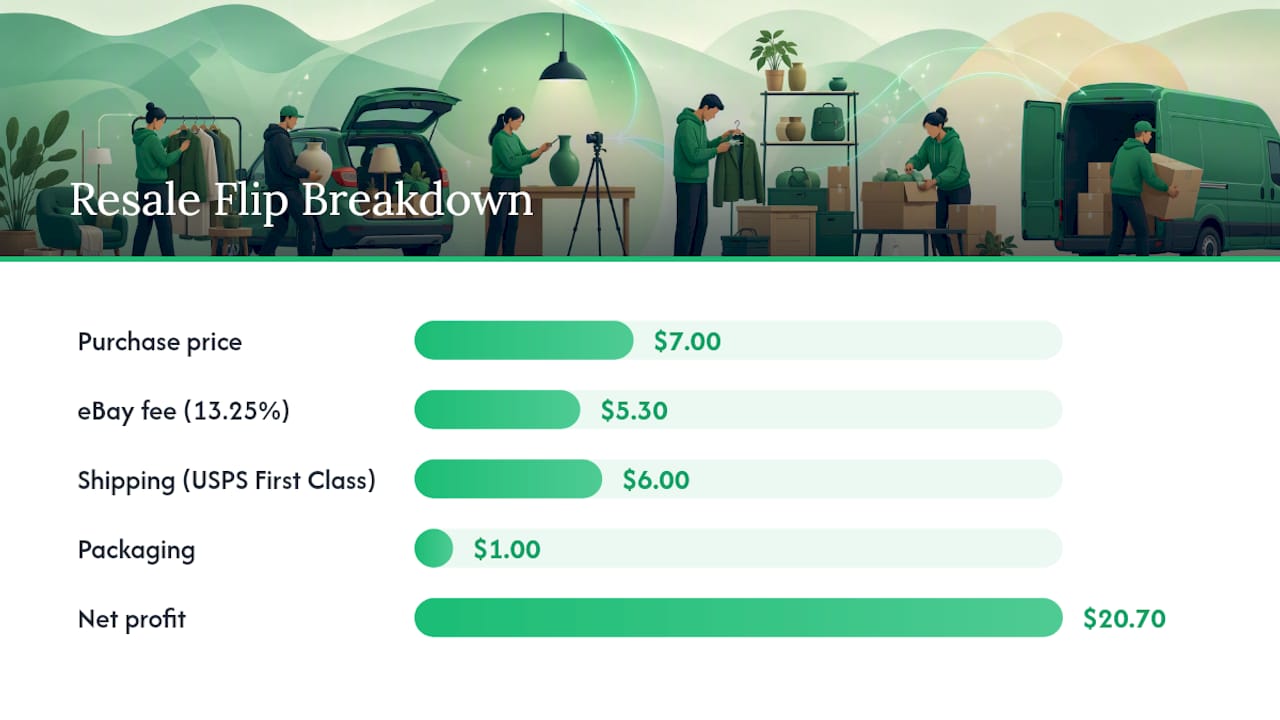
That's a 52% margin on a $40 sale — solid for a beginner flip. The CNBC Select platform comparison notes that fee structures vary significantly across apps, so running this math before you buy is non-negotiable.
Always check sold listings, not active listings. Active listings show what sellers hope to get. Sold listings show what buyers actually paid. The gap between the two can be $20 or more on popular items.
Your first-weekend plan to test reselling with low risk
The goal is simple: list 10 items and make at least one sale. That's it. You're not trying to build a business this weekend — you're testing the loop.
Saturday morning (1–2 hours): Source from home
- Walk through your closet, bookshelves, and garage. Pull anything you haven't used in 6 months.
- Focus on brand names, recent electronics, and anything in clean condition.
- Aim for 10–15 candidate items.
Saturday afternoon (2–3 hours): Research and photograph
- For each item, search eBay sold listings (filter: "Sold Items" in the left sidebar). Note the median price and how fast items sell.
- Use the Amazon Seller App to scan barcodes on books and electronics — it shows current buyback and marketplace prices in seconds.
- Photograph each item in natural light: front, back, any flaws, and any brand labels. Ten photos per item is not excessive.
Saturday evening (1–2 hours): List
-
List bulky or heavy items (furniture, large electronics) on Facebook Marketplace or Marketplaceapp — no shipping, local pickup only.
-
List clothing on Poshmark or Mercari. List books and collectibles on eBay.
-
Write honest, specific titles: "Nike Air Max 90 Men's Size 10 White/Black — Worn Twice" beats "Nike Sneakers."
Sunday: Monitor, respond, and adjust
- Reply to messages within a few hours — fast responses convert browsers into buyers.
- If nothing sells by Sunday evening, drop prices 10% or relist with better photos.
Micro example: A used copy of Atomic Habits bought at a garage sale for $0.50 lists on eBay for $8.00. After a $1.06 eBay fee and $3.99 Media Mail shipping, net profit is about $2.45. Small, but it proves the loop works. Scale the item value, and the math improves fast. What success looks like: One sale and a clear sense of which categories moved fastest. If nothing sells after a week, the issue is almost always pricing or photos — not the platform.
Where do you find inventory to resell?
Sourcing is where most of your margin is made or lost. Buy wrong and no amount of clever listing saves you.
Thrift stores (Goodwill, Salvation Army, local chains) Best for: clothing, books, small home goods, vintage items. Margins can be strong — $3 in, $35 out is common on branded clothing. The downside is time: you'll sort through a lot of mediocre inventory. Go on weekday mornings when new stock hits the floor.

Garage and estate sales Sellers are motivated and prices are negotiable. Estate sales in particular often surface collectibles, tools, and vintage electronics at below-thrift prices. Arrive early for the best picks; arrive in the last hour for the best deals on what's left.
Retail clearance aisles Target, Walmart, and Home Depot clearance sections regularly stock items at 50–90% off. Use the Amazon Seller App to scan barcodes on the spot — if the Amazon price is 2x the clearance price after fees, it's worth buying. This is called retail arbitrage, and it works best on branded goods with stable demand.
Online local marketplaces Facebook Marketplace and Marketplaceapp are full of underpriced items from people who just want things gone. Search for "moving sale," "free," or specific brand names. NerdWallet notes that local marketplaces are often the lowest-friction starting point because they cut out shipping entirely.
Liquidation pallets Higher volume, higher risk. Sites like B-Stock or BULQ sell returned merchandise by the pallet. You won't know exactly what's inside until it arrives. Good for experienced resellers with storage space; risky for beginners.

Trade-ins and returns Some retailers offer trade-in credits for electronics. Buy those items at trade-in value and resell at market rate. For furniture, partner services like Fix Move Haul's pickup and haul service can help you move large sourced items without a truck of your own.
Quick sourcing signals that a flip will work:
- Recognizable brand name (Nike, Apple, Le Creuset, Lego)
- Clean condition with no major damage
- Recent model number (check sold comps for that exact model)
- Sold comps show consistent sales within the last 30 days
- Gross sale price above $25 (below that, shipping eats the margin)
Pro Tip: Before you drive anywhere, check sold listings on eBay for the category you plan to source. If you can't find 5–10 sold comps in the last 30 days, the item is hard to move — skip it.
What are the best categories to resell for beginners?
Not all categories are equal. Some are forgiving for beginners; others require expertise you'll build over time.
Clothing and shoes are the most beginner-friendly category. Brands are easy to identify, condition is easy to assess, and demand is consistent. Poshmark and Mercari have built-in buyer audiences for fashion. Shoes, especially sneakers, can flip for 2–4x cost when you find the right size and brand. For local selling, check out how to sell clothes locally for photo and listing tips that apply directly to reselling.
Books have thin margins individually but near-zero sourcing cost at garage sales. Media Mail shipping keeps costs low. Textbooks are the exception — a $2 find can sell for $40–$80 on Amazon or eBay if it's a current edition.
Electronics offer the highest margins but require testing. A working iPhone or laptop bought for $80 can sell for $200+. The risk: you need to verify it powers on, holds a charge, and isn't iCloud-locked. Never buy electronics you can't test on the spot.
Collectibles (vintage toys, trading cards, sports memorabilia) can produce outsized returns, but they demand category knowledge. A 1990s Pokémon card is worth $0.10 or $500 depending on the specific card and condition. Learn one niche deeply before expanding.
Small home goods (Le Creuset cookware, KitchenAid mixers, Dyson vacuums) flip well locally and ship reasonably. Buyers search by brand and model, so your listing title does most of the work.
Furniture is local-only territory. A $40 mid-century dresser can sell for $200 on Facebook Marketplace or Marketplaceapp, but you need a truck or a haul service to move it. Margins are excellent; logistics are the constraint.
Practical rule: target items with a gross sale price above $25. Below that threshold, a $5–$7 shipping cost plus platform fees leaves almost nothing.
How do you price items and research value before you list?
Pricing is the single skill that separates resellers who make money from those who break even. The process takes about 5 minutes per item once you have the habit.
Pricing checklist before you list anything:
- Search the item on eBay, filter to "Sold Items" only, and note the median price from the last 30 days
- Check 3–5 recent sold comps, not just the highest one
- Subtract platform fees, shipping, and packaging from your target price
- If net profit is under $8–$10 on a shipped item, reconsider buying it
- Set your list price 10–15% above your minimum acceptable net to leave room for offers
Tools that make this faster:
- eBay sold filters are the baseline for almost every category. Free, always current, and the most reliable signal of real buyer behavior.
- Amazon Seller App scans barcodes and shows current marketplace prices, sales rank, and FBA fee estimates in real time. Use it in clearance aisles and at garage sales.
- Keepa tracks Amazon price history over time, showing whether a product's current price is typical or inflated. Useful before buying retail arbitrage inventory.
- Poshmark and Mercari sold listings work the same way as eBay's — filter to sold, not active, and read the actual transaction prices.
Mini tutorial — thrift store scanner workflow: Pick up an item, open the Amazon Seller App, tap the camera icon, and scan the barcode. The app shows the current lowest price, sales rank, and estimated FBA fees within 3 seconds. If the sales rank is under 100,000 in its category and the margin after fees exceeds $10, it's worth buying. If there's no barcode, search the item title on eBay sold listings instead.
What mistakes kill your margins, and how do you fix them?
Most margin problems are predictable. Here's what to watch for:
- Tracking revenue instead of profit. Fix: run the full cost calculation before every purchase, not after the sale.
- Ignoring shipping weight. Fix: weigh items before buying. A heavy item that looks profitable can turn into a loss once you pay actual shipping rates.
- Holding inventory too long. Fix: apply the 30/60/90-day markdown rule without exception. Sentiment about what something "should" sell for is expensive.
- Poor photos. Fix: natural light, plain background, 8–10 angles including any flaws. Listings with clear photos sell faster and get fewer returns.
- Not checking sold comps. Fix: never price from active listings. Always filter to sold.
- Buying without a clear exit platform. Fix: before you buy, know exactly where you'll list it and confirm there's a buyer audience.
Red-flag sourcing checklist:
- Obvious signs of counterfeiting (misspelled brand names, off-color logos, no country-of-origin label)
- Items on CPSC recall lists (check cpsc.gov before listing any children's products or electronics)
- Heavy damage that the seller is downplaying
- Electronics that won't power on and can't be tested
Selling counterfeit goods is illegal and can get your account permanently banned on every major platform. When in doubt, skip it. The Side Hustle School reselling guide is direct on this: your reputation as a seller is a long-term asset worth protecting.
How do you scale from casual flips to $500–$2,000 a month?
Scaling is a systems problem, not a sourcing problem. Once you've proven the model works, the bottleneck shifts to how efficiently you can list, track, and restock.
Timeline:
- Months 0–1: Learn the loop. List 10–20 items, track every cost, identify which categories produce the best profit per hour.
- Months 1–3: Refine sourcing. Find 2–3 reliable channels (one thrift store, one garage sale circuit, one clearance aisle) and visit them on a schedule.
- Months 3–6: Build inventory cadence. Batch your listing sessions (2 hours on Sunday evening, for example). Cross-list items across two platforms to increase sell-through.
- Months 6–12: Add systems. Use a basic inventory spreadsheet or app, consider cross-listing tools that publish one listing to multiple platforms simultaneously, and evaluate whether FBA makes sense for barcoded retail items.
Scaling checklist:
- Cross-list every item on at least two platforms
- Batch photography into one weekly session instead of listing one item at a time
- Dedicate a specific storage area so you're not hunting for sold items
- Set a weekly review: check sell-through, markdown slow items, restock best categories
- When monthly net profit consistently exceeds $500, consider whether a resale license makes sense in your state
Side Hustle School case studies show that casual resellers working 5–10 hours weekly typically generate a few hundred dollars a month. Reaching $1,000–$2,000/month usually requires 15–20 hours weekly and a tighter sourcing system. The Side Hustle Nation ideas library highlights furniture flipping and niche collectibles as two categories where part-timers have built consistent four-figure monthly income without going full-time.
When to consider FBA or wholesale: if you find a retail arbitrage item that sells consistently and you can source it reliably, FBA removes the shipping work entirely. The tradeoff is FBA fees and storage costs. Run the math with Keepa and the Amazon Seller App before committing to volume. Wholesale (buying directly from distributors) is a step beyond arbitrage and requires more capital and category knowledge — it's a year-two decision, not a weekend-one.
How Marketplaceapp helps resellers move inventory faster
For local flips, Marketplaceapp is built around exactly the friction points that slow resellers down: no mandatory shipping, location-based buyer search, in-app chat for fast negotiation, and secure payment processing that protects both sides of the transaction.
Where it fits in a reselling workflow:
- Bulky items: furniture, appliances, large home goods, and exercise equipment belong on a local platform. No shipping means no dimensional weight surprises and no damaged-in-transit claims.
- Fast cash flips: a local buyer can pick up the same day you list. For items priced under $50, this beats waiting 2–3 weeks for a shipped sale.
- No-shipping quick flips: list a pile of items from a garage sale haul on a Friday afternoon and have cash in hand by Saturday.
- Building a local repeat-buyer base: buyers who find you reliable will message you first when they need something in your category.
Local listing checklist for Marketplaceapp:
- Write a specific title: brand, model, size, and condition in the first 8 words
- Upload 8–10 photos including any wear or damage
- State the condition honestly (new, like new, good, fair) — it reduces disputes
- Include your general location so buyers can estimate pickup distance
- Specify accepted payment methods (cash, verified payment apps)
- Note whether you'll hold the item and for how long
Pro Tip: Use Marketplaceapp's promoted listing feature for higher-value items ($75+). The incremental visibility cost is small relative to the faster sale and the avoided markdown.
Verified seller ratings on the platform build trust with local buyers over time, which matters more than any single listing optimization. Browse the Marketplaceapp blog for platform-specific tips on categories, photography, and pricing for local sales.
Key Takeaways
A resell side hustle works when you track real profit, check sold comps before every purchase, and match item type to the right platform from the start.
| Point | Details |
|---|---|
| Profit, not revenue | Subtract all costs (fees, shipping, packaging, time) before declaring a flip successful. |
| Sold comps are the rule | Always filter to sold listings on eBay or Poshmark — active listings show hope, not reality. |
| Local first for bulky items | Furniture and large goods belong on Facebook Marketplace or Marketplaceapp to avoid shipping losses. |
| Tax threshold in 2026 | Payment processors issue a 1099-K at $600 gross — track receipts from your first sale. |
| Start on Marketplaceapp | List one local item on Marketplaceapp this week; it takes under 30 minutes and requires no shipping. |
When should you scale, maintain, or walk away from reselling?
The conventional wisdom says "scale everything that makes money." That's wrong for reselling, and it's worth saying plainly.
Reselling rewards a specific kind of person: someone who genuinely enjoys the hunt, tolerates the admin, and can treat a $12 profit as a data point rather than a disappointment. If you find yourself dreading the listing sessions or the post-office runs, no amount of optimization fixes that. The work doesn't get less repetitive at scale — it gets more so.
Three questions worth asking after your first 60 days:
1. What is my actual profit per hour? If you're netting less than your minimum acceptable hourly rate after tracking everything honestly, the category or sourcing channel is wrong — not the model. Switch categories before quitting.
2. Does the sourcing feel like a chore or a hobby? Resellers who stick with it long-term almost universally describe the sourcing as the part they enjoy. If you hate thrift stores and garage sales, the income rarely justifies the friction. If you find it genuinely interesting, that's a signal to keep going.
3. Is capital the constraint? A consistent $300/month side income is achievable at 5–8 hours weekly with $100–$200 in rotating inventory. Scaling to $1,500/month requires more capital, more storage, and more time. If you're capital-constrained, focus on high-margin single items rather than volume.
When to formalize: if monthly net profit consistently exceeds $1,000 for three or more months, talk to an accountant about whether an LLC or Schedule C filing structure makes sense for your situation. The Fidelity side-gig guide frames this well: treat the side hustle as a system, reinvest profits deliberately, and make the decision to scale or stop based on numbers, not optimism.
The best resellers aren't the ones with the most inventory. They're the ones who know exactly what their time is worth and source accordingly.
Marketplaceapp: the local-first option for quick flips
If you're sourcing bulky items, running fast-cash flips, or just want to skip the shipping entirely, Marketplaceapp is built for exactly that. Local buyers search by location, in-app chat lets you negotiate and confirm pickup in minutes, and secure payment processing means you're not handing over goods on a promise. There's no mandatory shipping label, no waiting on a carrier, and no dimensional weight math.
The categories that move fastest locally are furniture, home appliances, electronics, clothing, and sports equipment — all things that are either too heavy to ship profitably or too cheap to justify the packaging time. List one item today and see how quickly a local buyer responds. The platform's verified seller ratings also compound over time: a strong local reputation brings repeat buyers who message you first.
Create your first listing on Marketplaceapp and make your first local flip this week.
Useful sources and tools to go deeper
- How to Resell for Profit | Side Hustle School
- How to Start a Reselling Side Hustle: Flipping for Profit (Real Stories) | Side Hustle School
- How to Start a Reselling Side Hustle (w/Examples) + FAQs
- Where to Sell Stuff Online: 12 Ideas - NerdWallet
- Best apps and websites for reselling items | CNBC Select
- Is Reselling a Good Side Hustle? 2026 Data + Tips
- Side Hustle Nation — side hustle ideas
- How to make extra income: side‑job ideas and tips | Indeed
- Side-gig mindset: how to make extra money and keep it | Fidelity
This article is general information, not tax or legal advice. Confirm current IRS reporting rules and any state sales-tax requirements with a qualified tax professional or the IRS directly.