
A verified seller badge tells buyers a marketplace has confirmed something specific about you, usually your identity, your payout account, or your track record of good sales. It matters because platforms increasingly use it to decide who shows up higher in search and who gets access to payout features. Check your account or seller settings today to see what your platform requires.
TL;DR:
- Most verified seller badges confirm identity, performance, or program status, but none guarantee high sales quality or buyer trust without further effort.
- Automated identity verification typically completes within a few days, with common rejection causes including blurry ID photos and mismatched details.
- Performance badges are based on seller metrics like ratings and shipping speeds, with some programs updating instantly once criteria are met.
- Labels like verified, trusted, or top-rated often mean different underlying checks, so sellers should review each platform's help resources for accurate interpretation.
- Verifying your identity first is essential, as completing this step quickly boosts credibility and reduces the risk of rejected sales or delays.
Table of Contents
- What is a verified seller badge, exactly?
- Why a verified badge actually moves the needle for sellers
- Do you qualify? Common eligibility criteria to check
- How to get a verified seller badge, step by step
- Badge labels vary more than you'd think
- How long verification takes, and what goes wrong
- MarketplaceApp's approach to seller verification
- A quick note on priorities
- Sell with confidence using Marketplaceapp's built-in trust tools
- Sources
What is a verified seller badge, exactly?
A verified seller badge is not one thing. Platforms attach the word "verified" to at least three different concepts, and mixing them up leads to false expectations.
Identity verification confirms you are a real person with a valid ID, a working payout account, and sometimes a liveness check where you photograph yourself alongside your document. eBay's version, for instance, confirms specific account information and is still rolling out to limited buyers, with eBay stating plainly that the Verified Seller badge is not a guarantee of performance.
Performance badges work differently. TikTok Shop grants its "Top Rated Seller" status automatically once a shop meets specific performance score and product feedback thresholds.
Program-based badges sit apart from both. TCGplayer's Gold Star and Certified Hobby Shop tiers require sustained feedback ratings near 99.5% plus transaction minimums, closer to a loyalty tier than a one-time check.
- Identity badges confirm who you are
- Performance badges confirm how you sell
- Program badges confirm how long you've sold well
The caveat that matters most: no badge is an absolute guarantee. Always check your specific platform's help page before assuming what your badge covers.
Why a verified badge actually moves the needle for sellers
Buyers hesitate before handing money to a stranger online, and a badge shortens that hesitation. It signals someone already checked the boxes buyers would otherwise have to check themselves.
The visibility effect is real and platforms are leaning into it harder. Facebook's newer seller app rolled out free verified badges that now appear across Marketplace, Dating, Groups, and Profile surfaces, which means a single verification can boost your credibility everywhere your name shows up on the platform.
Fast fact: Vestiaire Collective's Trusted and Expert seller badges are awarded based on criteria like sales volume, description accuracy, and shipping speed; sellers who earn them receive boosted item and profile visibility.
Beyond visibility, verification carries operational upside too:
- Higher click-through on listings, since buyers scan for trust signals before price
- Access to payout tools or promotional features gated behind verification
- Fewer disputes, and faster resolution when your identity is already tied to your account
Do you qualify? Common eligibility criteria to check
Most platforms build eligibility around three pillars: who you are, how you've performed, and whether your account is fully set up.
Identity documents. A government-issued ID (driver's license, passport, or national ID card) is standard. Photos need to be clear, uncropped, and current. Blurry uploads are the single most common reason identity checks stall.

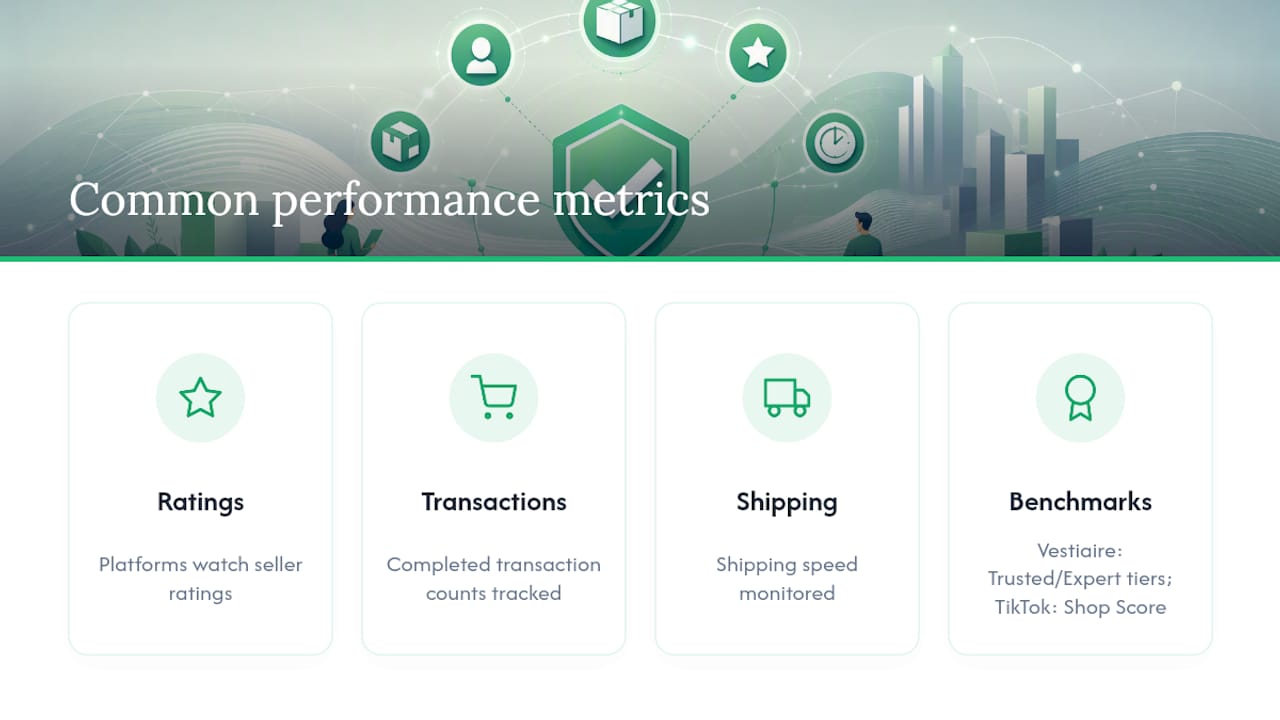
Performance metrics. Platforms watch seller ratings, completed transaction counts, and shipping speed. Vestiaire Collective ties its Trusted and Expert tiers to specific conformity and shipping benchmarks, while TikTok Shop uses its Shop Performance Score.
Account setup basics. You typically need a linked and verified payout account, tax information on file if required by your jurisdiction, and a confirmed phone number or email address.
Some categories go further. Specialty marketplaces for high-value goods, like watches, sometimes require ongoing legal or business compliance rather than a one-time check, similar to how Chrono24 revalidates its Trusted Seller badge periodically for dealers.
How to get a verified seller badge, step by step
Verification looks slightly different on every platform, but the sequence below covers the process most sellers will encounter.
- Find the verification option. Go to account or seller settings and look for a tab labeled "verification," "trust and safety," or "seller status."
- Gather your documents and set up your device. You'll need a photo ID and a well-lit space for a selfie or liveness check. Marketplaces are shifting these checks into mobile apps that use your phone's camera directly.
- Upload your ID and complete the liveness check. This usually means holding your phone steady while the app confirms you match your ID photo in real time.
- Connect your payout account. Add bank or payment details if you haven't already; some platforms won't finalize verification without this step.
- Wait for confirmation, and follow up if needed. Check your email and in-app notifications. If rejected, review the stated reason before resubmitting.
Pro Tip: Take your ID photo against a plain background in natural daylight. Glare and shadows are the top reason automated ID checks bounce back for manual review, which can add days to your wait.
Badge labels vary more than you'd think
"Verified," "Trusted," and "Top-rated" sound interchangeable, but they usually point to different underlying checks.
Common labels you'll run into:
- "Verified" almost always points to identity or account confirmation, not sales history
- "Trusted" or "Expert" typically reflects a performance history, like Vestiaire Collective's volume and shipping benchmarks
- "Top-rated" or "Gold Star" usually signals sustained high feedback over many transactions, as with TikTok Shop and TCGplayer
The only reliable way to know what a badge on your platform actually means is to read that platform's own help page. Assuming "verified" always means the same thing across sites is one of the most common mistakes sellers make when comparing their profile to a competitor's.
How long verification takes, and what goes wrong
Most identity checks resolve within a few days, though automated performance badges (like score-based programs) can update instantly once you cross the threshold. Business-level or specialty programs, by contrast, can take longer because a human reviews documentation manually.
Common rejection reasons include:
- Blurry or expired ID photos
- Name mismatches between your ID and your account profile
- Incomplete payout or tax information
- Liveness checks failing due to poor lighting or a shaky camera
If you're rejected, check the specific reason given rather than resubmitting blindly. Most support teams respond faster when you include your case number, a clear new photo, and a short note explaining what changed since your last attempt.
MarketplaceApp's approach to seller verification
Marketplaceapp builds verified seller ratings directly into secure payments, so buyers see confirmed identity and transaction history in one place rather than piecing it together themselves. That combination is deliberate: a rating without a verified account behind it tells a buyer less than one that does.
A few habits help sellers get the most out of it:
- Keep your listings accurate; our guide on verifying item authenticity covers how description precision affects buyer trust
- Sharpen your copy using our listing description tips so performance metrics stay strong
- Follow basic local marketplace etiquette to protect your shipping and communication scores
- Revisit your verification status periodically, since payout details and ID documents can expire
A quick note on priorities
If you take one thing from this article, verify your identity first. Everything else, accurate listings, fast shipping, responsive messages, builds credibility on top of that foundation, not instead of it. Badges reward consistency more than perfection.
Go check your account settings now. Five minutes today can save you a rejected sale next week.
— Marketplace
Sell with confidence using Marketplaceapp's built-in trust tools
Marketplaceapp gives local sellers something a plain classifieds listing never could: a verified rating tied to secure payments, visible right where buyers are deciding whether to message you.
That combination matters more than any single feature on its own. Buyers browsing electronics, fashion, or home goods nearby can see your seller rating, message you directly through the app, and complete payment without exchanging personal banking details, all inside one flow instead of juggling separate apps for chat, payment, and reviews. For sellers moving higher-value items, pairing your listing with independent checks like watch authentication guidance can add another layer of buyer confidence before a sale closes.
If you're ready to build a trusted profile and start turning unused items into cash, set up your seller account on Marketplaceapp and see what verification requirements apply to your category today.
Sources
- TikTok Shop business blog
- Thurrott — coverage of Facebook seller app and verified badge
- Trusted and Expert Seller badges — Vestiaire Collective