
Right now, the best items to flip are the ones that turn fastest and cost the least to get wrong: power tools, retired LEGO sets, used game consoles, sneakers, and refinished furniture top the list for margin-per-hour. Here's the shortlist to start with this week.
- Power tools: fast local sales, ~$89 average margin per unit, low storage needs.
- Retired LEGO sets: sealed sets swing $90 to over $1,000 in spread, slow but huge upside.
- Used game consoles: quick 3 to 7 day turnaround, steady demand year round.
- Sneakers (limited editions): high margin per pair, but authentication risk if you skip verification.
- Smartphones: easy to source, fast to sell, margins shrink fast with damage.
- Vintage clothing: cheap to source at thrift, slower sell cycle but strong niche demand.
- Trading cards: low buy-in, huge margin ceiling on graded rookie cards.
- Furniture: bulky but local-only sales mean no shipping headaches, often good margins on appliance sets.
- Luxury handbags: highest dollar spread of anything on this list, but authentication is mandatory.
Key Takeaways
The best items to flip combine fast local turnaround with verified sold-comp pricing, and margin-per-hour beats chasing rare, high-dollar finds.
| Point | Details |
|---|---|
| Start with fast-turning categories | Phones, consoles, and power tools sell in days and teach you the process with low risk. |
| Verify sold prices, not asking prices | Always check completed sales before buying to avoid paying based on wishful pricing. |
| Match category to your setup | Bulky items like furniture and appliances need a vehicle and local-only selling to stay profitable. |
| Authenticate before you buy luxury goods | Handbags, watches, and sneakers carry counterfeit risk without a serial or provenance check. |
| List locally to skip shipping costs | Marketplaceapp's local-first listings and push alerts help flippers close sales faster without shipping logistics. |
Table of Contents
- Which Category Fits Your Starting Capital and Skills?
- The Best Items to Flip for Profit, Category by Category
- How to Calculate Profit Before You Buy Anything
- Where to Find Items to Flip This Week
- Shipping, Authentication, and Safety Rules That Actually Matter
- Your First 10 Flips: A 7-Step Weekend Checklist
- Start Small, Track Everything, Scale What Works
- List Locally, Sell Faster With Marketplaceapp
- Frequently Asked Questions
- Sources
Which Category Fits Your Starting Capital and Skills?
Picking a lane matters more than picking the "best" category on paper. A $50 starter budget and a truck full of tools point you toward completely different flips, and forcing the wrong fit wastes both money and weekends.
Someone with under $200 to start and no vehicle should stick to small, shippable items: phones, sneakers, trading cards, electronics accessories. Someone with a truck, a garage, and some repair skill should lean into furniture, power tools, and appliances, where local pickup avoids shipping costs entirely and competition is thinner because fewer people can move a washer set.
| Category type | Typical resale value | Profit margin range | Sourcing ease | Best platform type | Shipping difficulty |
|---|---|---|---|---|---|
| Smartphones/electronics | $50 to $600 | 15 to 40% | Easy | Shipped or local | Low |
| Power tools | $30 to $300 | 20 to 35% | Moderate | Local | High (heavy/bulky) |
| Sneakers/collectibles | $40 to $500 | 20 to 50% | Moderate | Shipped | Low |
| Furniture/appliances | $50 to $450 | 25 to 40% | Moderate | Local only | Very high |
| Luxury handbags/watches | $200 to $600 | 20 to 50% | Hard | Shipped or local | Moderate |
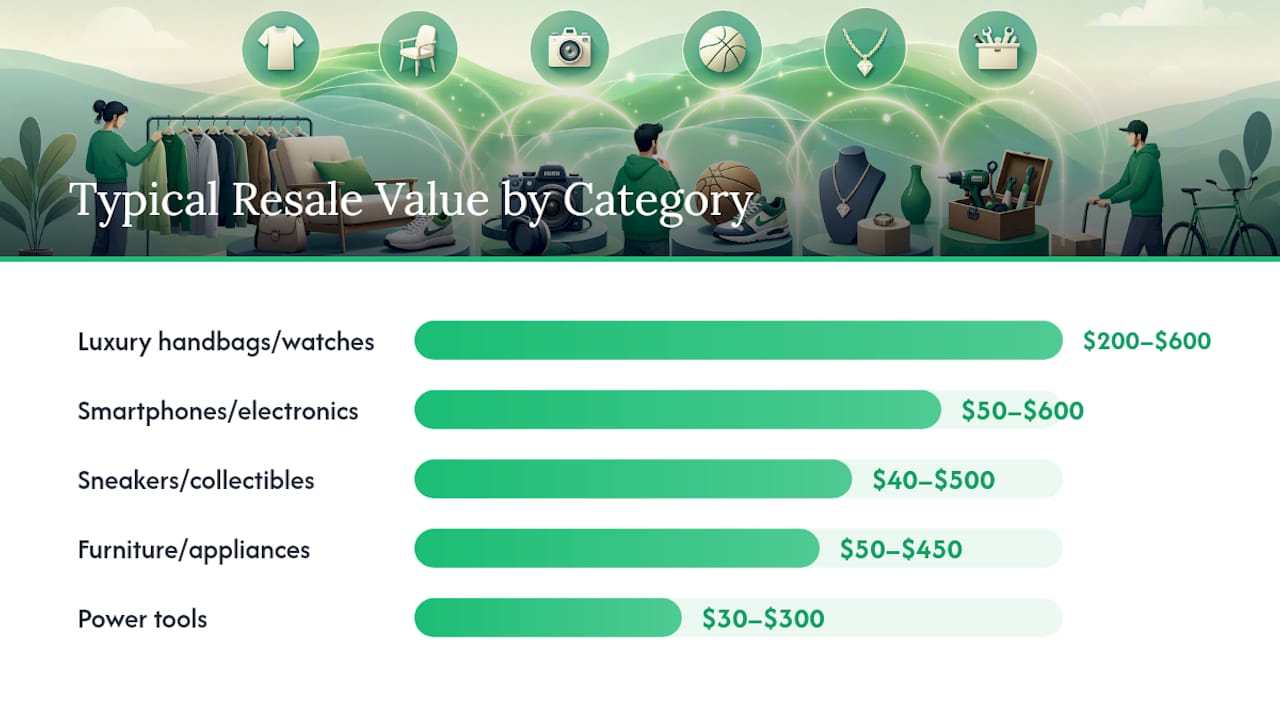
Two quick profiles show how this plays out. A low-capital starter with $100 and a bike can build a rotation flipping phones and trading cards bought from local marketplace apps, reselling within days. A truck owner with $2,000 in reserve capital can scale into furniture and appliance flips, since local-first selling removes shipping cost and logistics risk entirely, letting the truck itself become the competitive edge.
The Best Items to Flip for Profit, Category by Category
Electronics, sneakers, furniture, power tools, and vintage collectibles consistently produce higher resale margins and steady buyer demand across resale platforms, and that pattern holds whether you're buying from a garage sale or a liquidation pallet. Here's what to look for in each category, and where the real money hides.
Smartphones (used iPhones and Android phones) remain the fastest-turning flip on this list. Check IMEI status, screen condition, and battery health before buying. A cracked-screen iPhone bought for $80 and repaired for $30 in parts can resell for $220, a realistic $110 margin in under a week. Sell locally through marketplace apps to skip shipping insurance hassles, or ship nationally through resale-focused platforms for wider reach.

Laptops and tablets follow similar logic but demand more technical scrutiny. Test the battery cycle count, check for bent chassis or swollen batteries, and always wipe and reinstall the OS before listing. Margins run 20 to 35% on clean units; a $150 refurbished laptop that sells for $280 nets a solid flip in about a week and a half.
Gaming consoles and games move fast because demand is constant and testing takes minutes. Check for disc-read errors, controller drift, and included cables. Sealed retro games and limited-edition consoles carry premium margins, sometimes 50% or more, while standard used consoles turn in 3 to 7 days at 20 to 30% margin.
Sneakers and limited-edition footwear deliver some of the highest margin percentages on this list, but only if you verify authenticity first. Check stitching, box labels, and serial codes, or use an app that matches sneaker listings against sold comps. A pair of limited-run sneakers bought for $120 and flipped for $280 nets $160 in profit, often within days on a dedicated shoe-selling platform.

Luxury handbags and accessories post the widest dollar spreads of any category here, sometimes $500 or more per item, but they carry the highest authentication risk. Never skip verifying item authenticity on a handbag before you buy, since fakes are common at estate sales and secondhand shops. Sell through platforms built for high-value goods where buyers expect and pay for verification.
Watches work similarly to handbags: check serial numbers, movement authenticity, and box/papers provenance. A vintage mechanical watch bought for $200 can flip for $450 to $600 once cleaned and verified, but budget extra time, often two to four weeks, for the right buyer to appear.
Vintage clothing rewards patience and a trained eye. Look for union tags, fabric quality, and designer labels that don't show up in a quick glance. Margins vary wildly, from 30% on common vintage pieces to 300%+ on rare designer finds. Selling locally cuts shipping risk on delicate fabrics; a local clothing sale guide covers pricing and photo tactics specific to apparel.
Trading cards and collectibles (Pokémon, sports cards) have some of the lowest buy-in costs and highest margin ceilings when you hit a graded rookie card or a rare pull. Sealed booster boxes and graded cards move fastest; loose commons take longer and sell for pennies. Turnaround ranges from days for hot cards to months for niche sets.

Toys and sealed sets (LEGO, Funko) are a margin-per-hour standout. Retired, sealed LEGO sets showed spreads of $90 to over $1,000 in recent sold-comp tracking, though the trade-off is a slower sell cycle, often weeks to months, since buyers wait for the right price.
Furniture and home décor is where local-only selling shines. Bulky, heavy, and expensive to ship, furniture rewards flippers with a truck and basic refinishing skill. Used washer and dryer sets typically sell in 24 to 72 hours in rental-heavy areas, often clearing $100 to $250 margins per set, with premium front-load units reaching $300 to $450.
Power tools and workshop gear average roughly $89 gross margin per unit in recent tracking, and they sell fast because contractors and DIYers check listings constantly. Look for working motors, intact batteries, and original cases; missing chargers or batteries are the biggest margin killers.
- Books and textbooks carry thin margins per unit but scale well through bulk sourcing at library sales and thrift stores; scan ISBNs before buying to check current resale value.
- Baby and kids gear can be profitable but requires a recall check every time, since car seats and cribs with safety recalls are unsellable and potentially dangerous to resell.
- Musical instruments and DJ gear reward buyers who can test functionality; a used guitar or turntable in working condition often nets 25 to 40% margin, sold best through platforms built for musicians.
- Electronics accessories (headphones, controllers) are low-risk, low-capital flips ideal for beginners testing the waters before committing to bigger categories.
Pro Tip: Buy one test item in a new category before scaling up. A single $30 controller flip teaches you the platform fees, buyer behavior, and photo tricks that matter far more than any guide, and it costs almost nothing if you're wrong.
How to Calculate Profit Before You Buy Anything
The formula is simple: buy price, plus inbound costs (gas, storage), plus repair costs, plus platform fees, plus shipping if applicable, compared against the realistic sold price, not the asking price. Skip this step and you're gambling, not flipping.
Always filter your research for completed and sold listings instead of active listings. Active asking prices are wishful thinking; sold prices are what buyers actually paid last week.
Tools that scan active listings and cross-reference them against sold history can save hours of manual comp-checking. Some Facebook Marketplace scanners now surface verified-profit alerts automatically, which helps especially when you're sourcing across multiple categories at once.
- Never trust an asking price as your ceiling; always check sold comps first.
- Factor your own time into the math; a flip that takes six hours to research, clean, and photograph isn't free labor.
- Watch platform fee structures closely, since fees can eat 10 to 15% of your sale price depending on the platform.
Warning: Overpaying at the source is the single biggest margin killer in flipping, and it's almost always caused by skipping the sold-comp check because a deal "felt" good.
Where to Find Items to Flip This Week
The highest-yield sourcing channels, ranked by accessibility, are local marketplace apps, thrift and consignment stores, garage and estate sales, auctions, and liquidation pallets. Facebook Marketplace, OfferUp, Craigslist, thrift stores, estate sales, flea markets, and auctions all show up repeatedly among experienced resellers as the highest-volume, most repeatable sources.
- Local marketplace apps: set keyword alerts for underpriced listings and check them multiple times daily during peak posting hours.
- Thrift and consignment stores: visit the same locations weekly, since inventory turns constantly and staff often know your face after a few visits.
- Garage and estate sales: arrive early, but the real gold is often in boxes nobody's opened yet, tools, jewelry, and sealed collectibles buried under linens.
- Auctions (online and in-person): set a firm stopping number before bidding and factor in buyer's premium and pickup logistics, or you'll overpay in the heat of competition.
- Liquidation pallets: useful once you know a category well enough to spot which SKUs are worth the gamble; risky for beginners.
Pro Tip: Estate sale managers and flea market vendors remember buyers who show up regularly and pay fairly. Build that relationship over a few months and you'll get first look at inventory before it hits the public floor.
Your own house counts as inventory too. Auditing closets and storage produces zero-risk practice flips while you're still learning pricing and photography.
Shipping, Authentication, and Safety Rules That Actually Matter
Deciding between local pickup and shipping comes down to three questions: how heavy is it, how fragile is it, and how big is the buyer pool locally versus nationally? Furniture and appliances almost always stay local; small electronics and collectibles usually ship better.
- Weigh platform fee differences: shipped sales often carry higher fees than local, cash-based transactions.
- For luxury handbags and watches, check serial numbers, request provenance, and consider a professional authentication service before buying or listing.
- For baby and kids gear, always check recall databases before buying or reselling car seats, cribs, and strollers.
- For local meetups, choose public locations, bring a friend for high-value exchanges, and confirm payment clears before handing over the item.
Metros with the highest flip activity don't always deliver the best returns; some high-volume markets underperform on ROI compared to quieter regions, which is a good reminder that local demand and local prices matter more than raw activity numbers when you're deciding what to source and where.
Your First 10 Flips: A 7-Step Weekend Checklist
- Audit your closets, garage, and storage for anything sellable this week.
- Pick one starting category based on your capital, space, and skill.
- Set alerts on local marketplace apps for keywords in that category.
- Buy one small test item under $50 to learn the process risk-free.
- List it using a tested title and photo template (see below).
- Price it to sell within 3 days, or hold for a premium if demand is soft.
- Close the sale, then record your buy price, fees, and time spent.
Title checklist: brand, model, size or capacity, condition, key feature. Photo checklist: front, back, close-up of flaws, any included accessories, proof of function if electronic.
Start Small, Track Everything, Scale What Works
Every flip you do teaches you something the last one didn't, so treat the first ten as tuition, not profit. Log your buy price, time spent, and sale price for each one; that spreadsheet becomes your real competitive edge once patterns show up.
Local market math varies more than most guides admit. National reports showing home-flipping profit margins around 25.4% still depend heavily on metro and price band, and the same logic applies to consumer flipping: what sells fast in one city sits for weeks in another. Keep receipts and mileage logs from day one; that habit pays off at tax time regardless of how big this gets.
List Locally, Sell Faster With Marketplaceapp
Every category above turns fastest when you cut shipping out of the equation entirely, and that's exactly where Marketplaceapp earns its keep. Local-first listings put your flip in front of buyers who can meet today, not next week, while push alerts notify nearby shoppers the moment you post so you're not waiting around for algorithm luck.
- Local-first listings mean no packaging, no shipping insurance, no lost-in-transit disputes.
- Push alerts notify buyers near you the moment a matching listing goes live.
- Secure payment holding and verified seller ratings protect both sides of a high-value exchange.
If you've got a flip ready to move this weekend, list it locally on Marketplaceapp and start collecting offers from buyers in your own area today.
Frequently Asked Questions
What are the most profitable items to resell right now? Power tools, retired LEGO sets, sneakers, smartphones, and furniture consistently rank among the most profitable flips because they combine steady demand with manageable sourcing costs.
Is cross listing worth it for a beginner flipper? Cross listing across multiple platforms increases exposure and often speeds up sales, but it adds time managing multiple listings and syncing inventory, so weigh that against your available hours before committing to a full cross listing strategy.
Where do experienced flippers find the best inventory? Local marketplace apps, thrift stores, estate sales, and auctions remain the top sourcing channels, with vendor relationships and alerts making sourcing repeatable over time.
How long does it typically take to flip an item? Turnaround varies by category: phones and consoles often sell within a week, furniture and appliances within days locally, while collectibles and luxury goods can take weeks to find the right buyer.
Do I need to report flipping income on my taxes? Yes, income from regular reselling activity is generally taxable, so track your buy prices, fees, and sale prices from your very first flip to keep accurate records when tax season arrives.
Sources
- Best Items to Flip for Profit – Easy Money Picks
- Best Places To Find Items To Flip
- Items to Flip — eBay Market Research & Profit Calculator