You can legally resell a used car seat in most of the United States, but "legal" and "safe" are two different questions. The real rule is this: sell it only if you can verify it was never in a moderate or severe crash, isn't expired, has no unresolved recall, and still has every original label, part, and manual. If you can't check every one of those boxes, don't sell it. Recycle it instead.
TL;DR:
- Reselling a used car seat is only safe and legal if it was never involved in a moderate or severe crash, is not expired, and all original parts, labels, and manuals are intact.
- Sellers must verify the seat's model number, manufacture date, crash history, recall status, and inspect all parts for damage before listing.
- Federal law bans selling recalled car seats that have not been remedied, and local regulations may impose additional restrictions or documentation requirements.
- Buyers should request proof of recall remedies, examine the seat in person, and verify all documentation before purchasing.
- Seats failing any safety check should be recycled properly by cutting straps, removing fabric, and using certified recycling programs to prevent risks.
Table of Contents
- Car Seat Resale Rules Start With a Safety Checklist
- What the Law Actually Says About Reselling Car Seats
- How Sellers and Buyers Should Actually Handle the Transaction
- When a Seat Fails the Checklist: Recycle, Don't Reuse
- Why MarketplaceAnywhere Backs Strict Car Seat Checks
- List Your Car Seat the Right Way on Marketplaceapp
- Sources
- FAQ
Car Seat Resale Rules Start With a Safety Checklist
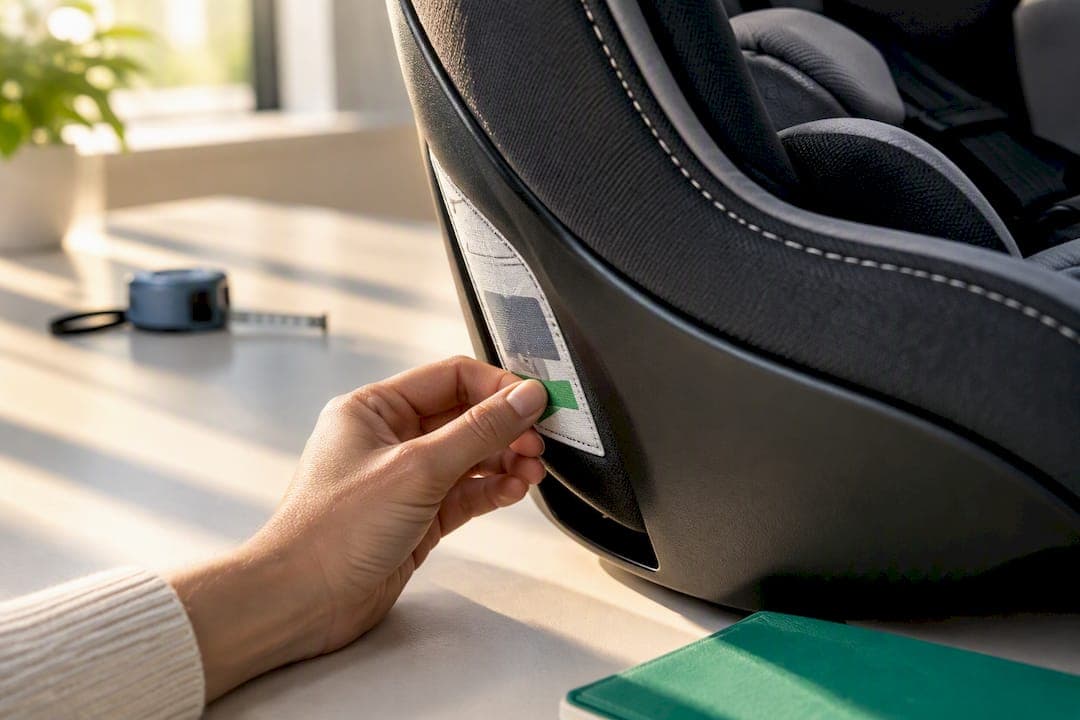
Before you list a seat or click "buy," pull the model number and manufacture date off the sticker on the shell. That date matters more than most sellers realize. Most seats have a stated useful life printed right on the label or in the manual, and sellers should check this information carefully. Once you're past that window, the plastic and foam have likely degraded even if the seat looks fine.
Here's the full checklist, in the order NHTSA recommends you work through it:
- Locate the model number and manufacture date stamped on the shell or on a label near the base.
- Find the owner's manual, either the physical copy or a PDF from the manufacturer's site.
- Confirm no crash history, including any crash where the seat was in the car but the child wasn't in it. A seat that absorbed impact energy once may not do it again.
- Compare the manufacture date to the seat's expiration, which you'll find printed on the seat itself.
- Inspect every part, harness webbing, buckle, chest clip, foam liner, and outer shell, for fraying, cracking, sun damage, or deformation.
- Run a recall check and require proof that any remedy was completed before you touch the price field.
The NHTSA used car seat safety checklist treats these as pass/fail conditions, not suggestions. If even one item comes back unknown, negative, or unverifiable, the answer isn't "sell it cheap." It's "don't sell it."
Pro Tip: Photograph the label sticker straight on, in good light, before you do anything else. If you can't read the manufacture date and model number clearly in your own photo, a buyer won't trust the listing either.
Consumer Reports has flagged a related problem: buyers of anonymous secondhand seats, thrift store finds, yard sale grabs, unmarked online listings, usually have no way to verify hidden crash damage. A seat with a known owner and a documented history is a fundamentally different product than one with none, even if they're the same model. That gap is exactly what Consumer Reports warns buyers to watch for.
What the Law Actually Says About Reselling Car Seats
Here's a distinction most sellers miss: the federal government does not have a law that directly regulates car seat resale. Federal Motor Vehicle Safety Standard 213 governs how new child restraints are manufactured and sold. It doesn't reach into your garage sale or your online listing. NHTSA's own interpretation confirms that resale sits largely outside its manufacturing rules, even though the agency still publishes detailed guidance on how to do it responsibly.
That gap doesn't mean anything goes. A separate federal law closes it for a specific case: recalled products.
- Under Section 19 of the Consumer Product Safety Act, it's unlawful to sell or offer for sale any product that's been recalled, and that includes car seats.
- The Consumer Product Safety Commission's guidance for resellers directs anyone reselling used goods to check recall status before listing, not after a buyer asks.
- A completed recall remedy fixes the specific defect the recall addressed. It does not clear the seat on crash history, expiration, or missing parts. Those are separate checks you still have to run.
Beyond the recall rule, states and other countries sometimes layer on their own requirements around licensing, record-keeping, or outright resale restrictions for certain product categories. Colorado's Department of Transportation, for example, publishes its own consumer guidance reinforcing the crash, expiration, and completeness checks, on top of whatever federal rules apply. Always check your local rules rather than assuming federal guidance is the whole picture.
For a listing to hold up to real scrutiny, it needs a documentation packet: model number, manufacture date, clear photos of every label, the manual (linked or scanned), and, if a recall ever applied, proof the remedy was completed. That packet is what separates a responsible resale from a liability.
How Sellers and Buyers Should Actually Handle the Transaction
A car seat listing isn't like listing a lamp. The order you do things in actually matters, because skipping a step early creates problems you can't fix later.
For sellers:
- Inspect the seat fully and photograph every label, the shell, the harness, and any damage you find.
- Track down the owner's manual, either the physical one or a manufacturer PDF.
- Run the model through a recall search before writing a single word of the listing.
- Photograph all identifying labels in focused, well lit shots.
- Disclose crash history and any recall remedy work directly in the listing text, not just in a private message when asked.
- Price it honestly. A seat with full documentation and a clean history can command more than one with gaps in the story.
For buyers:
- Request the full documentation packet before you agree to anything.
- If a recall applies to that model, ask for proof the remedy was actually completed, not just a seller's word.
- Inspect the seat in person before paying, checking the same items from the safety checklist yourself.
- Favor local pickup over shipping so you can verify condition face to face.
Pro Tip: Treat the meetup like you would a sale on a secure online car marketplace, a public, well lit location, daylight hours, and a traceable payment method. Cash handed over in a dark parking lot is how disputes start.
Good local marketplace etiquette applies here too: confirm the meeting spot in writing, show up on time, and don't rush the inspection just because someone's waiting.
When a Seat Fails the Checklist: Recycle, Don't Reuse
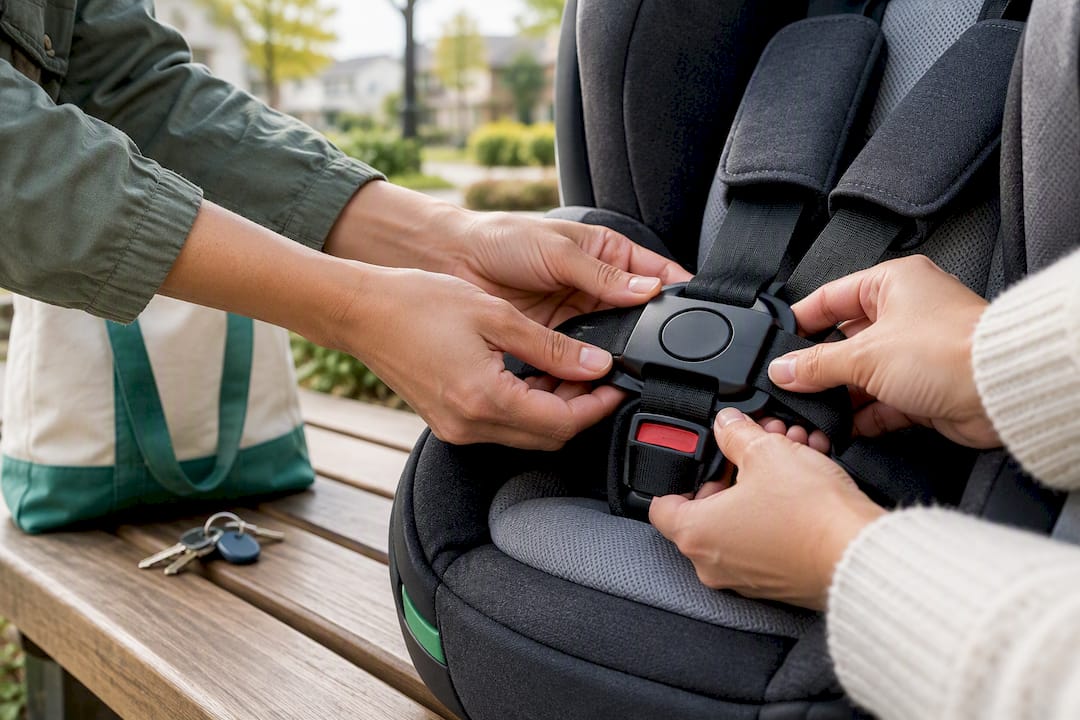
A seat that fails even one check, expired, crashed, recalled without remedy, or missing parts, should never be sold, donated, or handed down to a friend. Passing it along just moves the risk to someone else's car.
The safe move is to take it out of circulation for good:
- Cut the harness straps, remove the fabric cover, and write "DO NOT USE" directly on the shell in permanent marker.
- Check for manufacturer or retailer trade-in programs; some retailers run seasonal recycling events that repurpose the plastic and foam materials.
- Look for a certified recycling program in your area rather than setting an intact seat at the curb, where someone might grab it before it hits the truck.
Why MarketplaceAnywhere Backs Strict Car Seat Checks
We built our seller guidelines around one goal: nobody should ever end up buckling a child into a seat with a hidden crash history or an unresolved recall. That means we push documentation, not just descriptions, and we'd rather a seller walk away from a listing than fudge a detail.
Strict rules aren't friction for friction's sake. They're what keeps buyers coming back to a marketplace instead of a stranger's driveway sale. Check our seller resources before you list anything car-seat related.
— Marketplace
List Your Car Seat the Right Way on Marketplaceapp
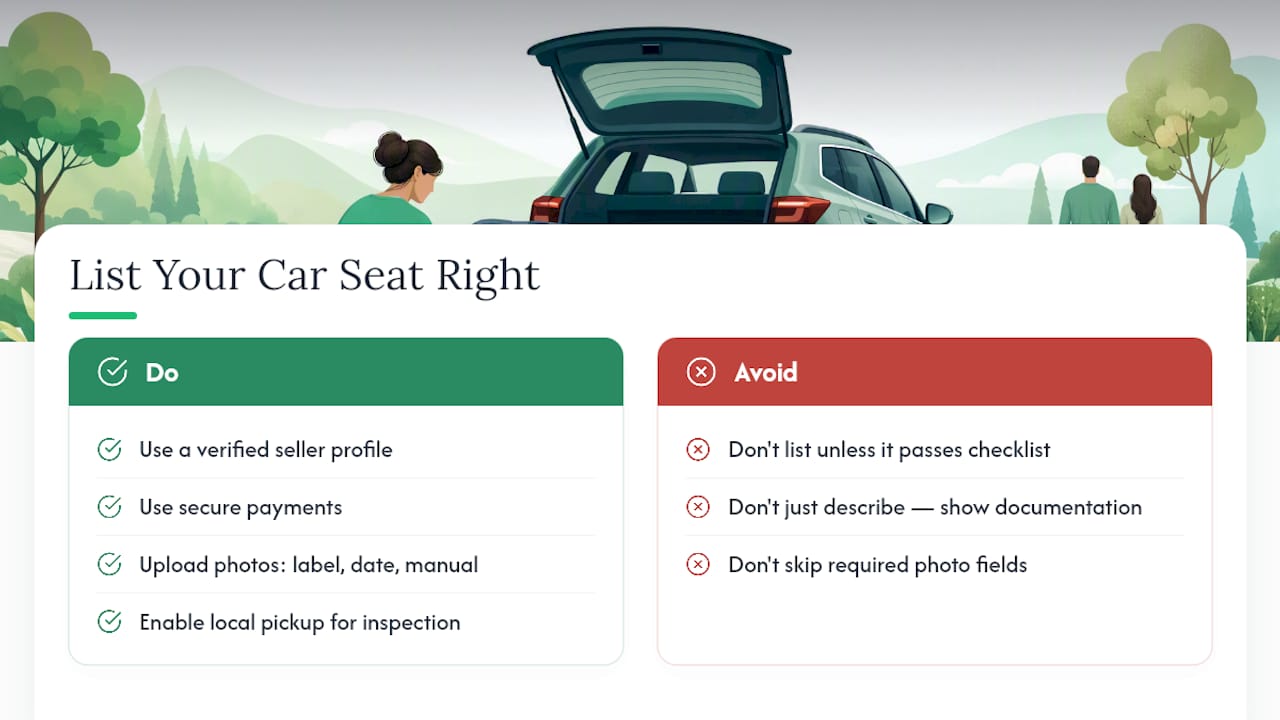
If it passed every check on that checklist, the platform provides tools to help prove it. Verified seller profiles, secure payments, and required photo fields support listings that show buyers the label, the manufacture date, and the manual, not just tell them about it.
Local pickup filters support arranging face-to-face handoffs that let a buyer inspect before they pay, which is exactly what safety guidance recommends. Pair your listing with our guide on pricing used items to set a fair number once your documentation is solid, and borrow the disclosure habits from our baby item selling guide if this is your first time listing gear.
Here's the honest version: list the seat only if it passes every item on the checklist above. If it does, start your listing on Marketplaceapp today under our Vehicle or Home & Garden categories and put that documentation packet to work.
Sources
Check NHTSA's recall search and the CPSC reseller guidance before listing or buying any used seat.
FAQ
Can you legally resell a car seat?
In most cases, yes, federal manufacturing standards don't directly regulate resale, according to NHTSA's own interpretation. The exception that overrides everything else: it's unlawful to sell a seat under an active recall that hasn't been remedied.
Can you sell used car seats in Michigan?
Michigan doesn't ban private resale of used car seats outright, but the same federal recall restriction applies there as everywhere else, you can't sell a recalled seat without proof the remedy was completed. Always check for any state-specific consumer protection rules before listing, since local requirements can add to the federal baseline.
Can I reuse a car seat for my second child?
Only if it has never been in a moderate or severe crash and hasn't passed its expiration date, both are hard stops according to the NHTSA safety checklist. If either condition applies, retire the seat rather than reinstalling it for a younger sibling.
Is it okay to use second-hand car seats?
It's okay only when you can verify the full history yourself, crash status, expiration date, recall status, and all original parts and labels intact. Anonymous secondhand seats with no verifiable owner history carry real risk, since Consumer Reports notes hidden crash damage often can't be detected by looking at a seat.
What documentation should a car seat listing include?
A complete listing needs the model number, manufacture date, clear photos of every label, a link or scan of the owner's manual, and proof of any completed recall remedy. This documentation packet is the strongest evidence a buyer can request before agreeing to a sale.