
For most U.S. sellers leaving or supplementing Depop, three platforms cover the majority of use cases: Poshmark for everyday apparel with a built-in buyer community, Mercari for fast-moving mixed inventory with low friction, and eBay for high-value or rare pieces where auction pricing extracts full market value. Add Marketplaceapp (MarketplaceAnywhere) if you sell bulky items, want zero shipping hassle, or need same-day local cash. No single platform fully replaces Depop, and professional resellers consistently split inventory across platforms to match each item type to the audience most likely to buy it.
- Poshmark — best for mainstream fashion brands (Lululemon, Free People, Aritzia); flat 20% fee on sales over $15, but buyer community is large and active.
- Mercari — best for mixed closet cleanouts; straightforward fee structure, prepaid labels, and fast payouts make it the lowest-friction option for casual sellers.
- eBay — best for rare, vintage, or high-value pieces; auction format surfaces true market price and global reach beats every other platform for niche items.
- Etsy — best for handmade, truly vintage (20+ years), or craft-adjacent fashion; buyer intent skews toward unique and artisan items, which supports premium pricing.
- Grailed — best for menswear, streetwear, and designer pieces; niche audience means serious buyers who understand value.
- thredUP — best for sellers who want zero effort; send a bag, they handle everything, but payouts are lower than self-listing.
- Tradesy — best for luxury and designer handbags, shoes, and accessories where authentication matters to buyers.
- Facebook Marketplace — best for bulky or low-margin items where shipping costs would erase profit; local pickup only, no seller fees on local cash deals.
- OfferUp — best for quick local sales of everyday items; simple app, location-based discovery, and in-app messaging.
- Marketplaceapp (MarketplaceAnywhere) — best local-first option for U.S. sellers who want secure payments, verified buyer ratings, instant chat, and push-notification alerts without shipping complexity.
Table of Contents
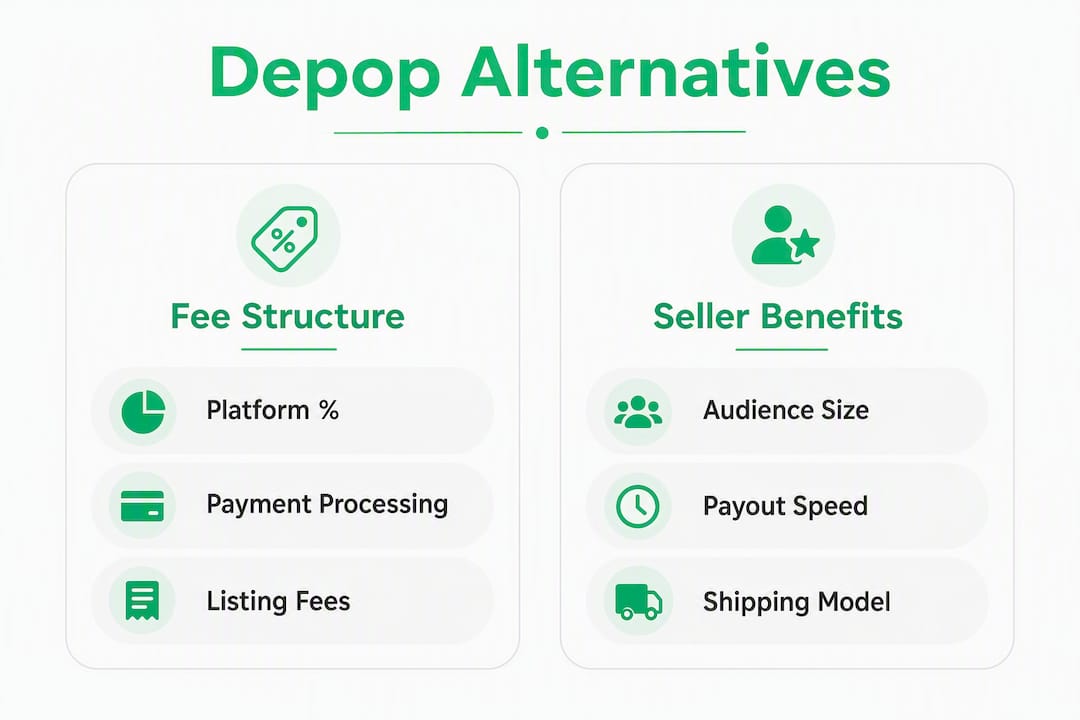
- How do these Depop alternatives compare on fees and features?
- What should you know about each platform before switching?
- How do you pick the right platform for your inventory?
- What fees and payout timelines should U.S. sellers actually expect?
- How do professional resellers actually split inventory across platforms?
- Which platform wins for each seller goal?
- Key Takeaways
- The local-first advantage most resellers overlook
- Marketplaceapp: the local-first alternative built for U.S. sellers
- Useful sources
How do these Depop alternatives compare on fees and features?
Platforms were evaluated across seller fees, inventory fit, buyer audience size and speed-to-sale, shipping model, listing discovery style, payout timing, buyer protections, and ease of use for a U.S.-based seller.
| Platform | Seller fee / model | Best for | Audience & liquidity | Shipping model | Listing style | Payout speed | Buyer protection | Ease of use |
|---|---|---|---|---|---|---|---|---|
| Poshmark | 20% on sales over $15 | Mainstream apparel, activewear | Large; moderate speed | Prepaid USPS label (buyer pays shipping) | Social feed + search | 3 days after delivery | Poshmark Protection | Moderate |
| Mercari | 10% seller fee + 2.9% + $0.50 payment processing | Mixed closet, everyday items | Large; fast | Prepaid labels or local | Search-driven | After buyer confirms | Buyer guarantee | Easy |
| eBay | ~13.25% final value fee (fashion category) | Rare, vintage, high-value | Massive; variable | Buyer-paid or seller-included | Search + auction | 2 days after payment | eBay Money Back Guarantee | Moderate |
| Etsy | 6.5% transaction + $0.20 listing + payment processing | Handmade, vintage 20+ yrs | Niche; moderate | Seller-arranged | Search-driven | Weekly deposits | Etsy Purchase Protection | Moderate |
| Grailed | 9% commission + payment processing | Menswear, streetwear, designer | Niche; slower but targeted | Seller-arranged | Feed + search | After buyer confirms | Grailed Buyer Protection | Easy |
| thredUP | Consignment; payout varies by item value | Everyday women's/kids' | Large; passive | Prepaid cleanout bag | Search-driven | After item sells | thredUP guarantee | Very easy |
| Tradesy | 19.8% fee on sales over $50 | Luxury, designer accessories | Niche; slower | Prepaid label provided | Search-driven | Instant to Tradesy credit | Tradesy Protection | Easy |
| Facebook Marketplace | 0% for local cash; 5% shipping fee | Bulky, furniture, local items | Massive local reach; fast | Local pickup or shipping | Search + map | Immediate (cash/local) | Limited (local cash) | Very easy |
| OfferUp | 0% local; 12.9% shipped | Everyday items, local deals | Large local; fast | Local pickup or prepaid | Search + location | Immediate (cash) | TruYou verification | Very easy |
| Marketplaceapp | Transaction fee model; local-first | Fashion, electronics, home, more | Growing local network | Local pickup | Location-based search | Fast local payout | Verified ratings + secure pay | Very easy |
Fee note: Vinted charges sellers $0 in fees; buyer protection fees are paid by the buyer, making it worth considering for sellers who want to keep 100% of the sale price. Vinted is not in the SERP consensus shortlist above but is a legitimate zero-fee option for fashion sellers.
Fee note: Facebook Marketplace charges no fee on local cash transactions. The 5% shipping fee applies only when you use their checkout for shipped items.
Switching platforms can reduce seller fees materially depending on fee structure and volume — some analyses show reductions of up to 50% when moving from high-percentage models to buyer-paid or flat-fee structures.
What should you know about each platform before switching?
Poshmark
Poshmark's buyer base skews toward recognizable mall and activewear brands. Items from Lululemon, Free People, Aritzia, and similar labels move faster here than on almost any other resale platform. The social mechanics (sharing, following, Posh Parties) reward sellers who engage regularly, not just list and wait. The 20% fee stings on lower-priced items, but on a $60 sale you net $48 before shipping, and Poshmark handles the prepaid USPS label automatically. Payout arrives three days after the buyer confirms receipt.
- Pro: Huge active buyer community; shipping is fully handled.
- Con: 20% fee is steep; slow movers without active sharing.
Mercari
Mercari is the closest thing to a frictionless closet cleanout. List in under two minutes, pick a prepaid label, and the app handles the rest. The combined seller fee is 10%, plus 2.9% and $0.50 for payment processing. Buyers confirm receipt or Mercari auto-confirms after three days, then funds transfer quickly. It lacks Poshmark's social layer, so discoverability depends on search keywords and competitive pricing.
- Pro: Low friction, fast payouts, works for almost any category.
- Con: Less community-driven; harder to build a following.
eBay
eBay is the right call for anything rare, vintage, or collectible where you genuinely don't know the market price. Auction format lets buyers compete, which often surfaces prices you wouldn't have thought to ask. The final value fee in the fashion category runs roughly 13.25%, and payment processing adds a bit more, but on a $200 vintage jacket the math still works. The interface is dated and listing takes longer, but the global reach is unmatched for niche pieces. Sellers exploring marketplace alternatives often return to eBay for high-value items precisely because nothing else matches its buyer depth for rare goods.
- Pro: Auction pricing, massive global audience, strong buyer protections.
- Con: Steeper learning curve; fees add up on lower-value items.
Etsy
Etsy's buyer intent is the differentiator. People shopping Etsy are actively looking for something unique, handmade, or genuinely vintage (the platform defines vintage as 20+ years old). That intent supports higher price points for the right inventory. The fee stack (6.5% transaction + $0.20 listing + payment processing) is moderate, but listing fees accumulate if you have a large catalog. Sellers who do well here treat their shop like a brand, with consistent photography and a clear aesthetic.
- Pro: Premium pricing potential; buyers expect to pay for uniqueness.
- Con: Listing fees add up; strict vintage definition limits eligible inventory. For sellers weighing Etsy against other handmade-focused platforms, this breakdown of Etsy alternatives covers fee structures and audience differences worth reading.
Grailed
Grailed is the go-to for menswear, streetwear, and designer pieces. The buyer base knows brands, understands grail pricing, and will pay for condition and authenticity. A 9% commission plus payment processing is reasonable for the niche. Items can sit longer than on mass-market platforms, but when they sell, they often sell at asking price or close to it. Listing is straightforward; the feed-plus-search model rewards good photos and accurate brand tagging.
- Pro: Buyers who understand value; strong for Supreme, Carhartt WIP, Rick Owens.
- Con: Slower velocity; primarily menswear, so women's items underperform.
thredUP
thredUP is the hands-off option. You request a cleanout bag, fill it, ship it, and thredUP handles photography, listing, pricing, and fulfillment. The trade-off is payout: consignment rates vary widely by item value, and lower-priced items may earn very little or nothing after thredUP's cut. It makes sense for sellers with large volumes of everyday women's and kids' clothing who value time over maximum margin.
- Pro: Zero effort after the bag ships; handles everything.
- Con: Low payouts on common items; no control over pricing.
Tradesy
Tradesy focuses on luxury and designer goods, particularly handbags, shoes, and accessories. The 19.8% fee on sales over $50 is high, but the buyer pool is specifically looking for authenticated luxury items, which justifies the premium. Payouts can be taken as instant Tradesy credit or transferred to a bank account. It's a narrow platform — if your inventory isn't designer or near-luxury, the audience won't be there.
- Pro: Authenticated luxury buyers; strong for Gucci, Louis Vuitton, Coach.
- Con: High fee; limited to luxury/designer category.
Facebook Marketplace
For bulky items, furniture, or anything where shipping costs would eat the margin, Facebook Marketplace is the practical answer. Zero fees on local cash transactions, a massive local user base, and map-based discovery mean fast pickup for the right items. Local platforms eliminate shipping weight and label costs entirely, which matters enormously for a $30 jacket or a $15 pair of jeans. Buyer protections are limited on cash deals, so meet in public and confirm payment before handing over the item.
- Pro: No fees on local cash; fastest local liquidity.
- Con: Minimal buyer protections; scam risk on high-value shipped items.
OfferUp
OfferUp sits between Facebook Marketplace and a traditional app marketplace. Location-based discovery, in-app messaging, and TruYou identity verification give it a slightly more structured feel than Facebook. Local transactions are free; shipped items carry a 12.9% fee. It works well for everyday items, electronics, and fashion at accessible price points. The app is clean and mobile-first, which suits sellers who list on the go.
- Pro: Clean mobile UX; TruYou verification adds trust.
- Con: Smaller buyer pool than Facebook in most markets; shipped fee is high.
Marketplaceapp (MarketplaceAnywhere)
Marketplaceapp is built for local-first selling across a broad range of categories: fashion, electronics, home goods, vehicles, and more. Location-based search connects sellers with nearby buyers, instant chat handles negotiation and pickup coordination, and secure payments protect both sides of the transaction. Verified seller ratings build trust over time, and push notifications alert buyers when relevant items appear nearby. For sellers with bulky items, low-margin pieces, or anything where shipping would kill the deal, Marketplaceapp removes that friction entirely. It also fits naturally into a multi-platform strategy for selling clothes locally alongside shipped platforms.
- Pro: No shipping required; secure local payments; broad category support.
- Con: Audience size depends on your local market density.
How do you pick the right platform for your inventory?
Match your top two seller goals — whether that's speed, margin, niche pricing, or local pickup — to the platform strengths above, then run the fee math before committing.
- Check seller tools and analytics — Platforms with dashboard analytics (views, saves, conversion rate) help you price competitively. eBay's Seller Hub and Mercari's stats panel are the most useful for data-driven sellers.
Red flags to watch: Opaque mid-cycle fee changes (read the fee policy page before listing, not after). Poor seller support response times on disputes. Platforms with high delisting rates for policy violations that aren't clearly communicated upfront. On shipped platforms, double-selling risk is real if you crosslist manually without a delist workflow.
Pro Tip: Set a calendar reminder to reconcile your active listings across all platforms every morning before 9 AM. A sold item that stays live on a second platform is a customer service problem waiting to happen.
What fees and payout timelines should U.S. sellers actually expect?
Fees have three components most sellers undercount: the platform percentage, payment processing, and shipping. Here's how they stack in practice.
| Platform | Platform fee | Payment processing | Listing fee | Shipping model | Typical payout window |
|---|---|---|---|---|---|
| Poshmark | 20% fee on sales over $15 | Included | None | Prepaid USPS (buyer pays) | 3 days post-delivery |
| Mercari | 10% | 2.9% + $0.50 | None | Prepaid label or local | After buyer confirms (or 3-day auto) |
| eBay | ~13.25% (fashion) | ~2.9% + $0.50 processing | — | Buyer-paid or included | 2 days after payment |
| Etsy | 6.5% transaction | — | $0.20 per listing | Seller-arranged | Weekly |
| Grailed | 9% | ~2.9% + $0.50 processing | None | Seller-arranged | After buyer confirms |
| thredUP | Consignment (varies) | Included | None | Prepaid cleanout bag | After item sells |
| Tradesy | 19.8% fee on sales over $50 | Included | None | Prepaid label provided | Instant credit or bank transfer |
| Facebook Marketplace | 0% local / 5% shipped | Included in shipped | None | Local pickup or shipped | Immediate (local cash) |
| OfferUp | 0% local / 12.9% shipped | Included | None | Local pickup or prepaid | Immediate (local cash) |
| Marketplaceapp | Transaction fee (local) | Secure payment processing | None | Local pickup | Fast local payout |
Payout timing matters more than sellers expect. Poshmark's three-day hold after delivery means a sale on Monday might not clear until Thursday or Friday. eBay releases funds two days after payment confirmation, which is faster. Local platforms (Marketplaceapp, Facebook Marketplace, OfferUp) pay immediately on cash or in-app transactions, making them the fastest route to liquidity for sellers who need cash quickly.
Shipping cost reality check: On a $25 sale, a standard USPS First Class label runs roughly $4–6. On Poshmark, the buyer pays the label, so your net is $25 minus 20% ($5) = $20. On Mercari with seller-paid shipping, your net is $25 minus the 10% seller fee ($2.50), minus 2.9% and $0.50 payment processing (about $1.23), and minus $5 shipping, leaving roughly $16.27. The fee percentage alone doesn't tell the full story. Switching platforms can reduce seller fees materially — the real number to track is net per item after all three cost components.
For bulky or low-margin items, local selling platforms consistently outperform shipped marketplaces because they eliminate shipping costs entirely, which can represent 20–30% of a low-priced item's sale value.
How do professional resellers actually split inventory across platforms?
No single marketplace fully replaces Depop. Experienced sellers treat each platform as a channel with a specific buyer type, then route inventory accordingly. The practical framework looks like this:

| Inventory type | Primary channel | Why |
|---|---|---|
| Everyday apparel (mall brands, basics) | Poshmark or Mercari | Large buyer pools, fast turnover, prepaid labels |
| Streetwear, menswear, designer | Grailed or eBay auction | Niche buyers who understand value; auction surfaces true price |
| Handmade or genuinely vintage (20+ yrs) | Etsy | Buyer intent matches; premium pricing supported |
| Luxury handbags, shoes, accessories | Tradesy or eBay | Authentication-aware buyers; global reach |
| Bulky items, furniture, electronics | Marketplaceapp or Facebook Marketplace | No shipping cost; local pickup; instant liquidity |
| High-volume everyday women's/kids' | thredUP | Hands-off consignment for items not worth self-listing |
| Aesthetic-led, Gen Z discovery pieces | Depop (keep it) | Style-based discovery still works for curated, visual pieces |
The key insight from pro resellers is that Depop functions best as a discovery channel for aesthetic-led items, not a liquidation platform. Items that need faster turnover belong on platforms with higher buyer liquidity. Keeping Depop for curated, visual pieces while routing everyday inventory to Poshmark or Mercari is a common split among sellers doing serious volume.
Crosslisting tools sync listings across platforms and auto-delist items when they sell, which is the operational piece most mid-tier sellers skip.
, and combining them with daily reconciliation and platform-specific pricing rules is standard practice among sellers managing 50+ active listings.Practical tactics that work:
- Tag inventory by category before listing (streetwear, basics, vintage, luxury) so routing decisions are made once, not item by item.
- Set platform-specific price floors: the same item might list at $45 on Grailed (niche buyer, slower) and $38 on Mercari (mass buyer, faster) to account for velocity differences.
- Use consistent photo backgrounds and titles across platforms, but adjust keywords to match each platform's search behavior (Grailed buyers search brand + colorway; Mercari buyers search generic category terms).
- For local listings on Marketplaceapp, lead with condition and pickup availability in the title — local buyers decide fast and want logistics clarity upfront.
Pro Tip: The moment an item sells on any platform, delist it everywhere else before you do anything else. A daily 9 AM reconciliation habit, cross-checking your sold items against active listings on every other platform, prevents double-sells and the customer service headache that follows.
Which platform wins for each seller goal?
- Highest margin on everyday apparel: Mercari. Lower combined fees than Poshmark, fast payouts, and competitive enough buyer pool to move basics quickly.
- Fastest sale on mainstream brands: Poshmark. The social sharing mechanics and active buyer community create faster discovery for recognizable labels than search-only platforms.
- Best for streetwear and menswear: Grailed. Buyers there know exactly what they're looking for and will pay asking price for the right piece.
- Best for handmade or vintage: Etsy. Buyer intent is the strongest of any platform for unique or artisan items; premium pricing holds up.
- Best for rare or high-value pieces: eBay. Auction format and global reach consistently surface the highest prices for genuinely rare items.
- Best local-first option: Marketplaceapp. Location-based search, instant chat, secure payments, and verified ratings make it the most structured local selling experience. For casual sellers and side hustlers who want to move items without shipping, it's the natural starting point.
- Best hands-off option: thredUP. Send the bag, collect what you get. Right for high-volume, low-value items where your time is worth more than the marginal payout difference.
- When to go local-only: Any item where shipping costs exceed 15–20% of the sale price, or where the item is too bulky to ship economically. Furniture, large electronics, automotive parts, and low-priced clothing all fit this profile.
- When to crosslist: Almost always, for shipped items. Crosslisting is the standard pro-reseller tactic for increasing sell-through without increasing inventory. The only exception is exclusive-listing agreements (some platforms offer fee discounts for exclusivity) — read the terms before crosslisting.
Key Takeaways
No single platform replaces Depop for every seller: the best strategy routes each inventory type to the platform whose buyer audience and fee model match it best.
| Point | Details |
|---|---|
| Match inventory to platform | Streetwear to Grailed, everyday apparel to Poshmark or Mercari, vintage to Etsy, bulky items to local platforms. |
| Calculate net per item | Subtract platform fee, payment processing, and shipping before comparing platforms — gross sale price is misleading. |
| Crosslist by default | Listing the same item on two platforms simultaneously increases sell-through; auto-delist immediately on sale to prevent double-sells. |
| Local-first for bulky or low-margin items | Marketplaceapp and similar local platforms eliminate shipping costs, making them the better choice when shipping would consume the margin. |
| Marketplaceapp for local selling | Marketplaceapp offers location-based search, instant chat, secure payments, and verified ratings for fast, no-shipping local transactions. |
The local-first advantage most resellers overlook
Most reseller guides treat local platforms as a fallback for items that won't sell online. That framing gets it backwards. For a meaningful slice of inventory, local is the better primary channel, not the backup.
Shipping costs are the hidden tax on every resale transaction. A $20 item with a $6 label and a 13% platform fee nets you roughly $11.40. List that same item locally on Marketplaceapp, agree on $18 with a nearby buyer, and you keep close to the full amount with no label, no packaging, and no three-day wait for funds to clear. The economics aren't close.
What Marketplaceapp adds beyond the basic local-cash model is structure: verified seller ratings that build trust over time, secure in-app payments that protect both parties, instant chat for fast negotiation and pickup coordination, and push notifications that alert local buyers when your item appears. That combination addresses the two real friction points in local selling — trust and speed — without requiring you to abandon your shipped-platform listings.
The practical play is to use Marketplaceapp as the primary channel for bulky goods, low-margin items, and anything where shipping would hurt the math, while keeping Poshmark, Mercari, or eBay active for lightweight fashion that ships economically. That split covers most reseller inventory without forcing a choice between local and national reach.
Marketplaceapp: the local-first alternative built for U.S. sellers
Most resale platforms make you choose between reach and simplicity. Marketplaceapp gives you both for local transactions: a growing network of nearby buyers, location-based search that surfaces your listings to people who can actually pick up today, and in-app tools that handle the logistics without shipping labels or three-day payout holds.

For sellers who want to move fashion, electronics, home goods, or bulky items without the shipping math, Marketplaceapp is the direct answer. Secure payments protect every transaction. Verified seller ratings build your reputation over time. Instant chat means a buyer can confirm pickup in minutes, not days. And push notifications keep your listings in front of local buyers the moment they open the app.
List your first item on Marketplaceapp today and see how fast local selling moves when the platform is built for it.
Useful sources
- Closo: Apps like Depop — crosslisting alternatives — real seller breakdown of platform-by-platform performance, including Poshmark and eBay profiles.
- — walkthrough of auto-delist workflows and multi-platform inventory sync tools.
- NerdWallet: 5 reputable sites to sell clothes online — buyer-behavior context and practical seller considerations for mainstream resale platforms.
- Nifty: 10 Depop alternatives — roundup corroborating platform shortlists and inventory-matching recommendations.
- Payhip: Best Etsy alternatives for sellers — fee structures and audience comparisons for handmade and vintage sellers evaluating Etsy vs. other platforms.
- Marketplaceapp: How to sell clothes locally — local seller guide covering pricing, photos, safety, and pickup workflows.