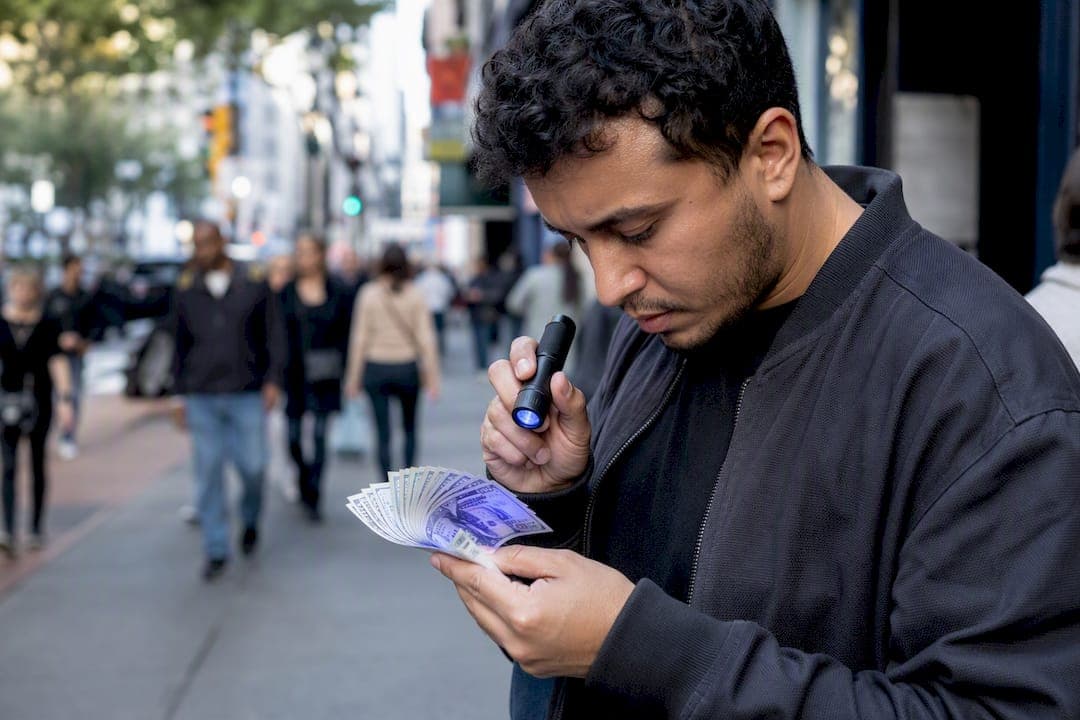
The fastest way to catch fake cash is the "Look, Feel, Tilt" method: check the bill's printing under light, feel for raised ink, and tilt it to watch the color-shifting ink and security ribbon move. If a bill fails any of those three checks, run it under a UV lamp or magnetic detector, or just walk it into a bank. Skip the detection pen unless you have nothing else. Never hand a suspect note back to whoever gave it to you, and don't spend it. Set it aside and report it.
TL;DR:
- A quick visual check using Look, Feel, Tilt can detect the majority of counterfeit bills without any equipment, especially if compared side by side with a genuine note.
- UV lamps confirm the presence of security fibers and threads but cannot verify authenticity, and detection pens are unreliable for initial screening due to high false-positive rates.
- High-volume businesses should use automatic scanners or magnetic sensors for efficiency, while small transactions can rely on manual checks with simple tools like UV flashlights.
- Regular calibration of counterfeit detectors is essential, as bulbs fade, sensitivity shifts, and currency designs update, which can all compromise accuracy over time.
- Manual checks on every bill remain the most effective method, and digital or verified cashless transactions eliminate the risk of accepting counterfeit currency altogether.
Table of Contents
- What Are the Best Tools for Fake Cash Detection?
- How Do You Check a Bill by Hand: Look, Feel, Tilt?
- How Do UV, Magnetic, and Infrared Detectors Actually Work?
- What to Do If You Suspect a Fake Bill
- How Can You Avoid Cash Risk During Local Sales?
- Where Do Detection Methods Fall Short?
- How Often Should You Calibrate a Counterfeit Detector?
- What's the Best Way to Train Staff on Spotting Fake Bills?
- Do Counterfeit Checks Change by Denomination or Country?
- Why Manual Checks Beat Gadgets Most of the Time
- Skip the Cash Risk Entirely With Marketplaceapp
- Official Resources and Training
- Sources
What Are the Best Tools for Fake Cash Detection?
No single tool catches every counterfeit. A cashier's eye, a UV lamp, and a bank's optical scanner all do different jobs, and picking the wrong one for your situation is the most common mistake small businesses make.
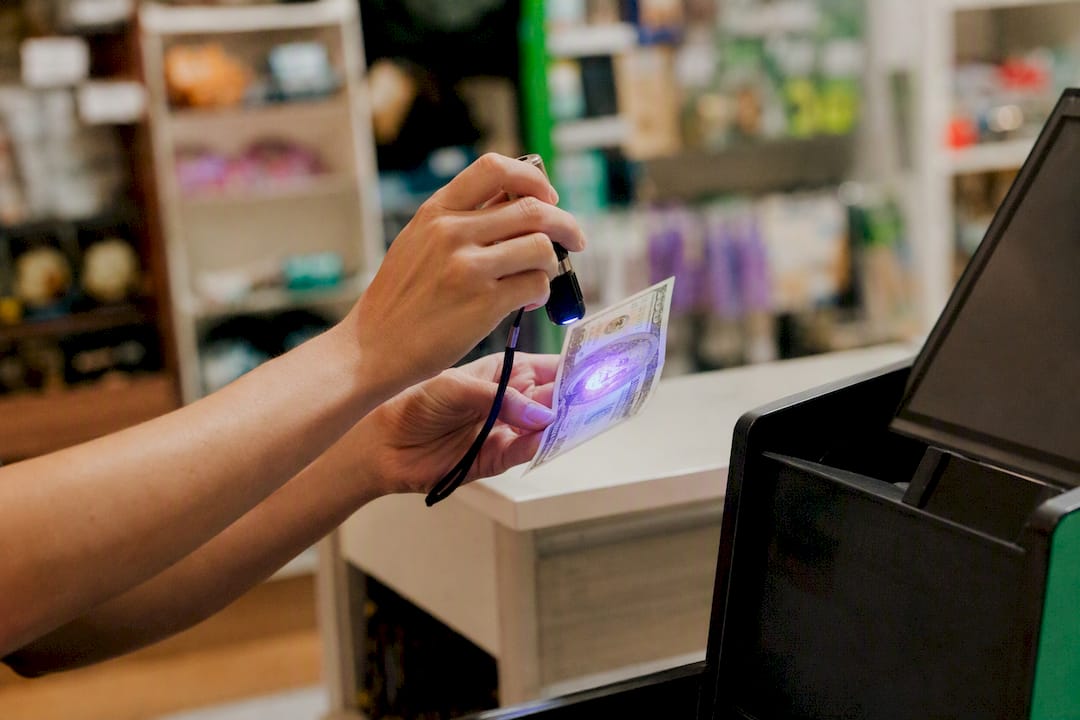
For a solo seller doing a handful of cash transactions a week, a $10 UV flashlight in a coat pocket beats a $400 scanner sitting in a drawer. For a retail counter processing hundreds of bills a day, that same flashlight is too slow, and a magnetic sensor built into the cash drawer makes more sense. High-volume operations like banks and casinos justify the cost of automatic scanners because the machine pays for itself in caught forgeries and saved labor.
If you're outfitting a register, prioritize something fast that a busy cashier will actually use every time, which usually means a magnetic sensor or a UV lamp mounted where it won't get shoved in a drawer. If you're checking a single bill from a stranger at a garage sale, a pocket UV light or your own eyes are enough.
How Do You Check a Bill by Hand: Look, Feel, Tilt?
You don't need equipment to catch most counterfeits. The Look, Feel, Tilt method from the U.S. Currency Education Program covers the three checks that catch the vast majority of fakes passed at retail counters.
- Look at the print quality first. Genuine bills have crisp, fine-line printing. Check the back for consistency with the front, and watch for red flags like foreign text or labels reading "For Motion Picture Use Only," which mark prop or novelty notes rather than currency.
- Feel the paper. Genuine U.S. bills use a cotton-linen blend, and the ink on portraits, seals, and borders is raised. Run a finger over Ben Franklin's shoulder on a $100 bill. You should feel texture, not a flat surface.
- Tilt the bill under a light. On the $100 bill, the 3-D security ribbon is woven into the paper and the bells inside it appear to move as you tilt it side to side. The numeral in the bottom corner shifts color between copper and green.
- Hold it to light to check the watermark and security thread. Both are embedded in the paper on denominations $5 and up, and both should be visible from either side of the bill.
- Use magnification for microprinting. A jeweler's loupe or even a phone camera zoom can reveal tiny text along the portrait border or security thread that a printer can't replicate cleanly.
Pro Tip: Keep a real bill of the same denomination in your wallet or register drawer. Comparing a suspect note side by side against a known genuine one makes texture and color differences jump out immediately.
How Do UV, Magnetic, and Infrared Detectors Actually Work?
Each detector category checks a different physical property of the bill, and understanding the difference keeps you from trusting a tool for something it was never built to catch.
- UV lamps shine ultraviolet light on the bill, causing embedded security fibers and the security thread to fluoresce a specific color per denomination. They're fast and cheap, but they only confirm the thread is present. They won't catch a well-made counterfeit that includes a fake thread.
- Magnetic sensors detect the magnetic properties in genuine security threads and certain inks. They work well as a second-line check in a back office, but only for bills where the magnetic signature is well documented.
- Infrared and optical scanners read multiple features at once, comparing patterns against a stored profile. That's why banks and casinos use them, and why they cost hundreds to thousands of dollars.
- Detection pens react chemically with the starch in wood-pulp paper. The problem is that they can be unreliable and produce false positives, flagging genuine bills that have picked up starch from packaging or other paper.
- Mobile apps like Cash Assist don't scan anything. They're reference guides that walk you through what to look for, which is valuable for training but not a substitute for the physical check.
No device replaces the manual check entirely. High-volume retailers typically pair a quick visual check at the register with an automatic validator during end-of-day counting, catching anything a rushed cashier missed.
What to Do If You Suspect a Fake Bill
Handle the note as little as possible once you suspect it, and slide it into an envelope rather than folding it into your wallet with everything else.
- Write down the transaction details: time, what was purchased, and a description of whoever passed the bill.
- Don't confront the person directly. Report it to local police or take it to a bank instead.
- Use the Uscurrency or contact the U.S. Secret Service field office nearest you.
- Understand that a counterfeit note has zero monetary value. Authorities may keep it as evidence once you report it, and you should get a receipt or incident number for your records.
How Can You Avoid Cash Risk During Local Sales?
Meeting a stranger to sell a used couch or a phone comes with the same counterfeit exposure as running a retail counter, just with none of the training. Meet in a public, well-lit place, and count the cash before you hand over the item, not after. Bringing a friend along or meeting inside a bank lobby (many have public counting areas) removes most of the risk in one move.
Marketplace's guide on verifying item authenticity covers the seller side of safe meetups in more detail. When cash isn't required, secure digital payment methods remove the counterfeit question from the transaction entirely, which is usually the simpler path for both sides.
Where Do Detection Methods Fall Short?
Every method on this list has a blind spot, and knowing the blind spot matters more than knowing the strength.
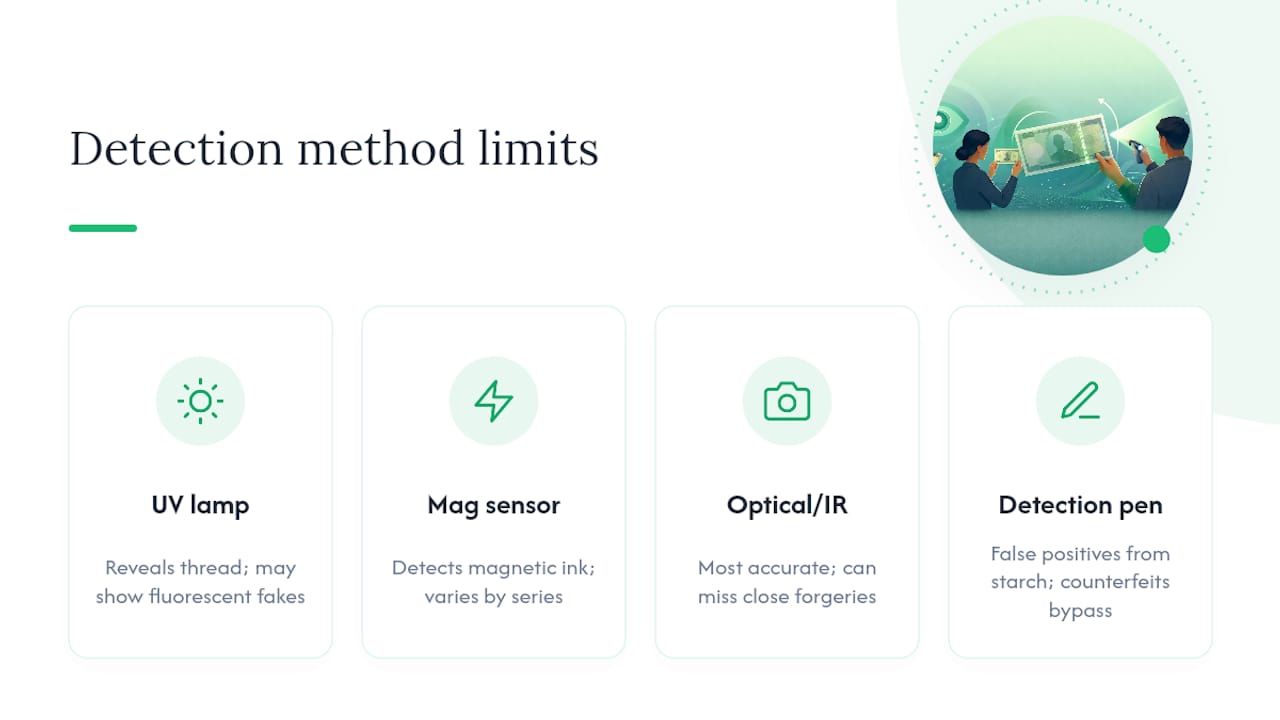
UV lamps confirm a security thread is present, but they can't tell you whether the thread is a genuine match or a cheap fluorescent substitute stitched in by a counterfeiter who read the same guides you did. Magnetic sensors face a similar problem: they detect magnetic ink, but ink formulas vary by print run and denomination, so a sensor calibrated for one bill series may miss inconsistencies in another.
Optical and infrared scanners are the most accurate option, but "most accurate" isn't "perfect." These machines compare a scanned bill against a stored reference pattern, and a counterfeit sophisticated enough to mimic that pattern closely can still slip through, particularly on older machines running outdated reference libraries.
Detection pens have the widest gap between perceived and actual reliability. The chemical reaction depends entirely on paper starch content, and legitimate bills that picked up starch residue from packaging, or that are simply old and worn, can trigger a false positive. Meanwhile a counterfeit printed on paper treated to defeat the pen chemistry sails through undetected. The Federal Reserve is blunt about this: pens are a rough filter at best, never proof on their own.
The honest takeaway is that no device is a substitute for the manual check. Devices narrow down what needs a closer look. Your eyes and fingers still make the final call.
How Often Should You Calibrate a Counterfeit Detector?
A detector that worked perfectly on day one can drift out of accuracy within months, and most small businesses never think to check.
UV lamps lose brightness as the bulb ages, and a dimmer lamp makes fluorescing threads harder to spot, especially in a well-lit store where ambient light already competes with the UV output. Replace bulbs on a schedule rather than waiting for a visible dropoff. Magnetic sensors need periodic recalibration since sensitivity can shift with temperature and humidity changes, particularly in stockrooms without climate control. Check your unit's manual for a recommended recalibration interval and stick to it.
Optical and infrared scanners are the most demanding to maintain. Currency profiles get updated as new bill designs enter circulation, and a scanner running an outdated software version may not recognize a newly redesigned note as genuine, flagging good bills as suspect. Most manufacturers push firmware updates specifically for this reason, so treat those updates as mandatory, not optional.
Even detection pens have a shelf life. The ink dries out, and a pen that's been sitting in a drawer for a year may not react at all, giving a false sense of security rather than a false positive. Test any pen on a known genuine bill before trusting it on a real transaction. A five-second sanity check beats finding out mid-shift that your only backup tool doesn't work.
What's the Best Way to Train Staff on Spotting Fake Bills?
Training beats equipment. A well-trained cashier catches more counterfeits with bare hands than an untrained one with a full detector kit, because the manual checks work on every bill, not just the ones that get pulled aside for a second look.
Start every new hire with the government's own materials. The U.S. Currency Education Program publishes a cashier toolkit with denomination-specific reference sheets, and running new staff through it during onboarding costs nothing and takes under an hour. The Cash Assist app works well as a supplementary tool here, letting employees quiz themselves on security features between customers during slow periods.
The insight most businesses miss: routine checks on every bill matter more than occasional checks on big bills. It's tempting to scrutinize $50s and $100s while waving through $10s and $20s, but counterfeiters target whatever denomination is least likely to get checked. Train staff to run the same quick Look, Feel, Tilt pass on every bill above $5, not just the large ones.
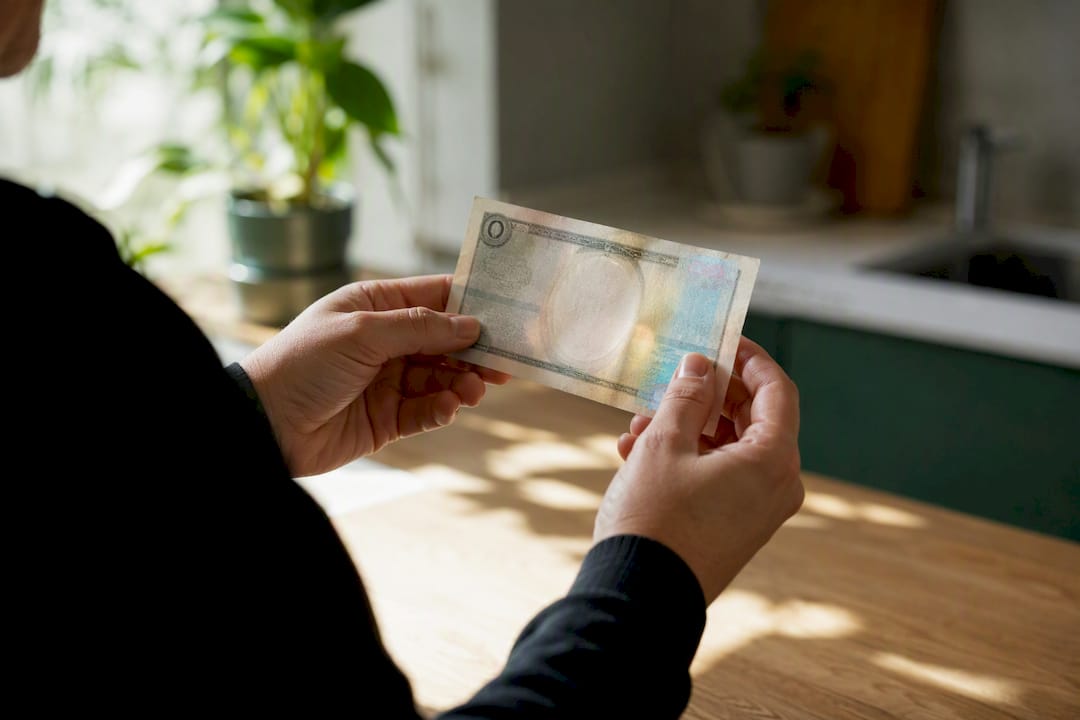
Refresher training matters too. Currency redesigns happen periodically, and a cashier trained five years ago may not recognize newer security features on redesigned notes. A 15-minute annual refresher, paired with an updated reference card taped near the register, keeps the whole team current without pulling anyone off the floor for a formal session.
Do Counterfeit Checks Change by Denomination or Country?
Security features scale with denomination, and treating a $5 bill with the same scrutiny as a $100 bill wastes time you don't need to spend.
Watermarks and security threads appear on U.S. denominations $5 and above, but the color-shifting ink and 3-D security ribbon are unique to the $100 bill specifically. A $20 or $50 won't show that ribbon effect no matter how you tilt it, so don't go looking for it there. Lower denominations rely more heavily on paper texture, intaglio printing, and microprinting, which is exactly why the "Feel" step in Look, Feel, Tilt matters even on smaller bills.
Counterfeiting patterns also shift by denomination based on what's easiest to pass unnoticed. Large bills get more scrutiny at checkout, so counterfeiters sometimes target $20s and $50s specifically because cashiers are less likely to pull out a UV lamp for a bill that size.
If your business handles foreign currency, the security features and detection methods differ entirely by country. The euro, British pound, and other major currencies each have their own hologram, watermark, and thread specifications, and a detector calibrated for U.S. bills won't necessarily catch foreign counterfeits. The Bank of England's own guidance on checking pound notes is a useful comparison point if you ever need to verify currency outside the dollar. Never assume a method that works for one country's currency transfers cleanly to another.
Why Manual Checks Beat Gadgets Most of the Time
The conventional advice on this topic leans too hard on hardware. Retailers buy a UV lamp or a scanner, treat it as a solved problem, and stop training staff on the manual checks that actually catch most counterfeits. That's backward. A $400 scanner sitting unused because nobody trained the new hire on it does less good than a five-minute Look, Feel, Tilt habit drilled into every employee.
What's genuinely overrated: the detection pen. It's cheap, so businesses buy it and treat a clean pass as proof of authenticity, which the Federal Reserve itself warns against. What's underrated: simply holding a bill to the light for two seconds. It costs nothing and catches missing watermarks and threads immediately.
If you're a small business or an individual seller, prioritize training over tools. Learn the checks, get comfortable running them fast, and treat any detector you buy as a backup, not a first line of defense. And where the situation allows it, sidestepping cash entirely through verified digital payments removes the whole problem before it starts.
— Marketplace
Skip the Cash Risk Entirely With Marketplaceapp
Marketplaceapp gives local buyers and sellers a way to complete a transaction without ever handling a suspect bill. Every listing on the platform supports secure payment processing and shows verified seller ratings, so you know who you're dealing with before you agree to meet, and you can settle payment without a stack of bills changing hands in a parking lot.

If a buyer or seller insists on cash, run the Look, Feel, Tilt checks from this guide before the money changes hands, and always meet somewhere public. But for most local transactions, there's a simpler route: complete the payment through Marketplaceapp's built-in system and skip the counterfeit question altogether. Browse listings and start a secure transaction on Marketplace the next time you buy or sell locally.
Official Resources and Training
For ongoing reference, bookmark the U.S. Currency Education Program for downloadable denomination guides, the Secret Service's counterfeit reporting channels, and the Federal Reserve's FAQ page on identifying and reporting suspect notes.
Sources
- How to Authenticate U.S. Currency — U.S. Currency Education Program
- Learn how to spot fake money before it reaches your wallet — U.S. Secret Service
- Cash Assist mobile app — U.S. Currency Education Program