A price that's too good to be true, a serial number that's been scratched off, a seller who won't answer a direct question, and a phone that's still locked to someone else's account: those four things are the strongest stolen goods warning signs on any local marketplace. None of them prove theft by themselves, but together they're the pattern investigators and consumer-safety groups point to again and again. The rest of this guide walks through exactly which checks to run, in what order, before you hand over cash or meet a stranger in a parking lot.
TL;DR:
- Low prices significantly below market value are common signs of stolen or counterfeit goods, especially in electronics and small items.
- Sellers refusing to provide serial numbers, proof of purchase, or showing locked devices can indicate stolen property.
- Cross-checking serial numbers, IMEI, or VIN with official registries is essential before completing any transaction.
- Avoid transactions with new or unverified accounts and always meet in public locations with traceable payment methods.
- Reporting suspicious listings and compiling evidence protect buyers and aid law enforcement efforts against resale of stolen goods.
Table of Contents
- Stolen Goods Warning Signs: A Red-Flag Checklist
- How to Verify an Item Before You Pay or Meet Up
- What to Do If You Think You Bought Stolen Property
- Why Verification Beats Vigilance
- Buy and Sell Locally Without the Guesswork
- Sources
Stolen Goods Warning Signs: A Red-Flag Checklist
Most stolen listings share a handful of traits, and once you know them, you can scan a listing quickly. Start with price. If a used item is listed far below what comparable listings show, that's not a lucky find. It's the single most common tip consumer advocates give for spotting counterfeit and stolen goods, because thieves need to move merchandise fast and don't care about margin.
Listing quality tells you almost as much as price. Stock photos pulled from a manufacturer's website, descriptions with no model number or condition detail, and tags still attached to "used" clothing are all signs someone is reselling merchandise they never personally owned. Watch for sellers posting several identical brand-new items at once. That pattern shows up often in reporting on organized resale of stolen goods, where a single account offloads a batch of items lifted from the same source.
Seller behavior is the third layer. A brand-new account with no history, one-word answers to questions about receipts or where the item came from, and pressure to meet immediately or pay before seeing the item in person are all classic evasion tactics. So is refusing a video call or insisting on a meeting spot far from any public area.
Identifiers matter most for anything with a serial number, IMEI, or VIN. A scratched-off or mismatched serial on a laptop, bike frame, or power tool is close to a confession. So is a phone or tablet still locked under someone else's Apple ID or Google account, since a legitimate seller can and should remove that before selling.
Category-specific flags to watch for:
- Electronics: activation lock still on, seller "forgot" the passcode, box has no matching serial
- Bikes: frame number ground off or painted over, no lock or accessories despite "barely used" claims
- Tools and equipment: unfamiliar engravings or paint marks, inconsistent branding placement
- Appliances: missing model plate, seller can't say where or when it was purchased
- Medications and cosmetics: broken safety seals, packaging that doesn't match the retail version
Consumer-safety groups note that counterfeit and stolen items frequently show up in everyday categories like small electronics, batteries, and over-the-counter medications, not just high-value goods, and some of those counterfeits skip safety standards entirely.
How to Verify an Item Before You Pay or Meet Up
A five-minute check now beats a police report later. Run through these steps in order, and stop the moment something doesn't add up.
- Ask for the serial number or IMEI in writing, before you agree to meet. A legitimate seller can pull this from the box, the device settings, or a receipt in seconds. Hesitation here is itself a signal.
- Cross-check that number against a blacklist or registry. For phones, run an IMEI or ESN check to confirm the device isn't blacklisted with any carrier. For cars, motorcycles, or ATVs, a VIN lookup tool like the National Insurance Crime Bureau's VINCheck flags reported theft or salvage history, though a clean result isn't a guarantee.
- Confirm account and lock status. Ask the seller to show the phone with Activation Lock or Google Factory Reset Protection removed, ideally in person. If they claim they can "unlock it easily" after the sale, walk away.
- Request proof of purchase. A receipt, warranty card, or order confirmation email doesn't need to be perfect, but a total absence of any paperwork on a recent, high-value item is worth asking about directly.
- Ask for fresh photos of the serial number, timestamped and matching what's in the listing. Reverse-image-search the listing photos too. Stock photos or images lifted from another sale are an easy tell.
- Pay with something traceable and meet somewhere public. Card payments or in-app escrow leave a paper trail that cash doesn't. Many local police departments also designate safe exchange spots in station parking lots, and using one costs you nothing.
- If the seller refuses any of the above, treat it as a hard stop. A legitimate seller has nothing to hide about where an item came from.
Pro Tip: Screenshot the serial number and the seller's confirmation of it before you meet. If the item turns out to be stolen, that timestamped record shows you tried to verify ownership in good faith, which matters if you ever need to dispute a payment.
Reading how to verify item authenticity before your first big-ticket purchase turns this from a mental checklist into muscle memory. If you're buying art, antiques, or collectibles specifically, the provenance checks look a little different. A guide on verifying an online art seller covers documentation standards that don't apply to electronics or bikes.
What to Do If You Think You Bought Stolen Property
Don't confront the seller directly. If your suspicion is correct, you're dealing with someone who may already be avoiding law enforcement, and a confrontation can escalate fast or simply tip them off to disappear before you've documented anything.
Instead, work the paper trail:
- Screenshot the listing, the seller's profile, and your full message history before anything can be deleted or edited.
- Save payment records: transaction IDs, timestamps, and any confirmation emails.
- Report the listing to the marketplace through its reporting tool, and file a police report with the serial number, IMEI, or VIN plus your evidence attached.
- If you already paid, open a dispute with your payment provider and explain the stolen-property suspicion directly.
Cooperate fully if police recover the item and it turns out to be stolen. A thief cannot legally transfer ownership, even to a buyer who had no idea anything was wrong, and police can seize recovered stolen property regardless of how much you paid for it. Recovering your money then depends on your payment dispute and whatever the seller has left to repay, which isn't guaranteed. Reporting still matters beyond your own case. Every report gives investigators another data point tying a listing, a serial number, and a seller account together, and that's often what turns a string of one-off complaints into an actual case.
Why Verification Beats Vigilance
Most advice about avoiding stolen goods treats it as a matter of instinct: trust your gut, watch for shady sellers, be careful. That framing undersells the problem. Instinct catches obvious scams but misses the ones that look completely normal, because organized resale operations have gotten good at looking normal. A seller with a friendly tone, decent photos, and a plausible story can still be moving stolen inventory. The checklist works because it doesn't rely on reading a person. It relies on checking a number.
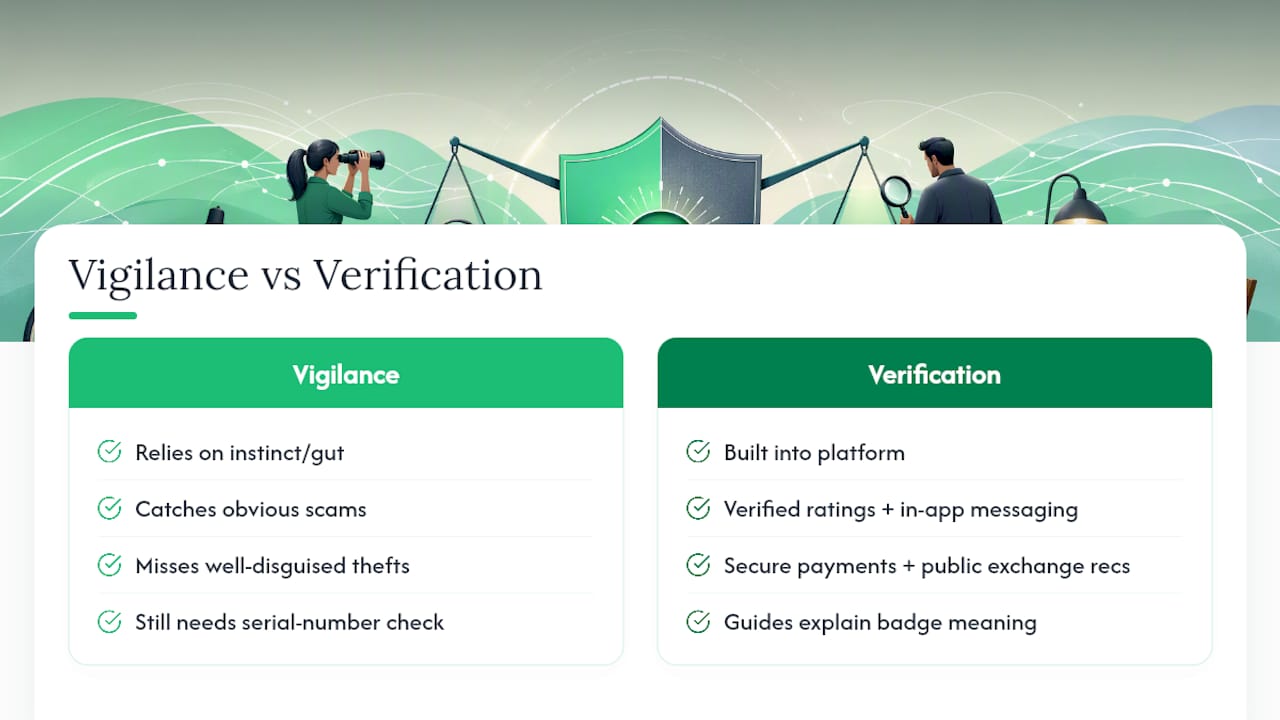
That's why Marketplaceapp builds verification into the platform instead of leaving it entirely to buyer intuition. Verified seller ratings and in-app messaging cut down on the anonymity that makes scratched-off serials and locked phones so common in the first place, because a seller with a real transaction history has something to lose by lying. Secure, traceable payment flows and posted public exchange recommendations handle the other half of the equation, giving buyers a paper trail and a safe place to run the checks above before money changes hands. Guides like what a verified seller badge means explain exactly what that history represents, and using the platform's reporting tools when something looks off helps flag risky listings before the next buyer even sees them.
No badge or filter replaces the habit of asking for a serial number and checking it. But it stacks the odds in your favor before you even start asking.
— Marketplace
Buy and Sell Locally Without the Guesswork
Every check in this guide gets easier when the platform is built for it. Marketplaceapp gives buyers verified seller ratings, in-app chat that keeps a written record of every question you ask, and secure payment options that leave a paper trail if something ever needs to be disputed. Sellers benefit too: a clean listing with real photos and a straightforward description builds trust faster than a bargain price ever will.
None of that replaces the verification checklist above. Run the serial number check, confirm the device isn't locked, and meet in a public spot no matter which platform you're using. But doing it on a marketplace with verified badges, built-in reporting, and traceable payments gives you a real advantage over a random classifieds site with none of those safeguards. If you're ready to buy or list something locally, set up your account on Marketplaceapp and browse listings with those protections already in place.
Sources
- Counterfeit and stolen goods: tips to avoid buying them online or anywhere (PIRG)
- How to tell if eBay, Amazon, and Facebook Marketplace items are stolen (Lifehacker)
- What Happens If You Buy Something Stolen on Facebook Marketplace? (LegalClarity)