
Set your walk-away price before you ever sit down, anchor with a specific number instead of a round one, and trade every concession for something the seller values less than you do. These three moves, backed by research from Harvard's Program on Negotiation and procurement studies on total cost of ownership, separate buyers who overpay from buyers who don't.
TL;DR:
- Establish your walk-away price in writing before negotiations to prevent emotional decision-making and ensure clarity throughout the process.
- Build your best alternative to a negotiated agreement and thoroughly analyze total cost of ownership to strengthen your leverage and avoid overpaying.
- Use precise numbers when making your first offer or anchoring, and pause after stating your number to give the other side room to concede.
- Ask calibrated questions and explicitly name every trade to gather information and control the negotiation dialogue effectively.
- Recognize seller pressure tactics like artificial urgency and emotional framing, responding with questions or calm redirection to maintain your bargaining position.
Table of Contents
- Deal Negotiation as Buyer: The Tactics That Actually Move Price
- How to Prepare: Building Your BATNA, TCO, and Concession Ladder
- What to Say and When to Stay Quiet During the Negotiation
- Copy These Scripts Before Your Next Negotiation
- Real Estate, Vendor Contracts, and Local Marketplace Buys
- How Long Negotiations Actually Take and What They Cost You
- The Pressure Tactics Sellers Use, and How to Read Them
- Negotiation Styles Vary by Culture, and That Changes Your Approach
- After You Shake Hands: Contract Review and Closing
- Marketplace Perspective: Helping Buyers Negotiate Safer Deals
- Sources
- FAQ
Deal Negotiation as Buyer: The Tactics That Actually Move Price
Most buyers walk into a negotiation with a number in their head and hope. That's not a strategy. Effective buyer negotiation strategies rest on preparation done before anyone speaks, not clever lines improvised in the room. Here's the ranked list of tactics that matter most, based on what negotiation researchers and procurement practitioners consistently find works.
- Build your BATNA first. Your best alternative to a negotiated agreement is the single biggest source of leverage you have. Know it cold before you make an offer.
- Decide whether to anchor or wait. If you have solid market data, making the first offer sets the frame. If you don't, ask questions and let the seller anchor first.
- Use precise numbers when you anchor. An offer of $108,750 reads as researched. An offer of $110,000 reads as a guess.
- Deploy silence deliberately. After stating your number, stop talking. The next person to speak often concedes something.
- Trade concessions, never give them away. Every "yes" should come with an "if."
- Frame the deal around total cost, not sticker price. Financing terms, service windows, and exit costs often move more money than the headline figure.
- Build rapport before you build tension. Buyers who open with genuine questions get more information and better outcomes, according to Stanford GSB negotiation research.
None of these tactics work in isolation. Skipping BATNA and going straight to anchoring is how buyers end up anchored against themselves.
How to Prepare: Building Your BATNA, TCO, and Concession Ladder
Preparation is where negotiations are actually won. Structured prep work, including a clear fact base and a rehearsed concession plan, materially improves outcomes compared to walking in cold.
Prepare carefully before any serious negotiation to work through this:
- Find your BATNA. List every realistic alternative (another house, another vendor, another listing) and pick the strongest one. That's your floor.
- Set three numbers. Your target, your reservation price (the worst deal you'd still accept), and the number that would make you walk.
- Run the TCO checklist. Add up implementation or moving costs, ongoing service or maintenance, contract timelines, exit fees, and renewal exposure. The Total Cost of Ownership framework exists because sticker price rarely reflects what you'll actually pay.
- Build a concession ladder. List what you can trade, in order, and decide who needs to approve each one before you're in the room.
- Map the stakeholders. Know who signs, who influences, and who can quietly kill the deal.
Pro Tip: Write your walk-away number on paper before the meeting. Negotiators who commit it to writing are far less likely to talk themselves past it in the moment.
What to Say and When to Stay Quiet During the Negotiation
Whether you anchor first depends on what you know. If you've done your homework and have solid comparable data, anchoring first lets you set the frame the rest of the conversation moves around. If you're negotiating in unfamiliar territory, ask questions and let the seller name a number first. Anchoring works only when you have enough information to anchor well.
- Use precise anchors. A specific figure signals research and is harder for the other side to dismiss than a round one.
- Let silence do the work. After you state a number or ask a hard question, stop. Resist the urge to fill the gap.
- Ask calibrated questions. "What would make this work on your end?" reveals constraints without giving anything away.
- Name every trade out loud. "I can close in two weeks if you cover the inspection repairs" is a real offer. A vague "maybe we can work something out" is not. Trades should always be explicit and conditional, stated as an if-then and confirmed on the spot.
- Keep it fact-based. If the seller gets emotional or defensive, redirect to numbers. Reacting emotionally is the fastest way to lose ground you fought to gain.
Mirroring the other side's language and asking open questions early on also increases the information you get back, which is often more valuable than the first number on the table.
Copy These Scripts Before Your Next Negotiation
You don't need to improvise under pressure. Three short scripts cover most situations, plus a checklist to carry into the room.
- Opening line: "Before I make an offer, can you walk me through how you arrived at this price?" This gathers information without committing you to a number.
- Counteroffer: "I can do $[your number] if you [specific trade: cover closing costs, extend the warranty, include the fixtures]." Naming the trade keeps the conversation productive instead of adversarial.
- Closing line: "That works for me. Let's put it in writing, effective [date], with [specific terms] included." Locking a verbal agreement in writing fast prevents renegotiation later.
Pro Tip: Keep your one-page checklist visible during the call: BATNA, target price, reservation price, planned concessions, timeline, and any contract terms you refuse to move on. Buyers who reference notes negotiate more consistently than buyers relying on memory alone.
Real Estate, Vendor Contracts, and Local Marketplace Buys
The core tactics stay the same across contexts. How you apply them changes.
- Real estate: Use inspection findings as leverage for repairs or price cuts. Time your offer for when a listing has sat unsold for weeks. A credible walkaway signal (a second showing scheduled elsewhere) often moves sellers faster than a higher offer.
- Business and vendor purchases: Tie your concession ladder to service level agreements, implementation support hours, and renewal price caps. If price flexibility is limited, shift the negotiation to operational terms that change the deal's economics even at the same headline price.
- Local marketplace buys: Verify the item's authenticity before you negotiate, since proof of condition or origin is leverage in itself. Point to secure payment options and seller ratings as reasons you expect a fair price, and settle pickup and return terms before you hand over cash.
How Long Negotiations Actually Take and What They Cost You
A local marketplace haggle over a used bike can resolve in a five-minute conversation. A home purchase negotiation typically runs one to three rounds of offers over several days to a couple of weeks, factoring in inspection periods and financing contingencies. A vendor or business contract negotiation often stretches over multiple weeks, especially once legal review and procurement sign-off enter the picture.
The time cost isn't the only cost. Every round of back-and-forth carries an opportunity cost. Sellers can field other offers while you deliberate, and vendors can lose patience and pad the next quote to cover the hassle. That's part of why a structured concession ladder matters: it lets you move through rounds decisively instead of re-litigating the same point three times.
Expect realistic timelines, not instant wins. Buyers who assume a single counteroffer will close the deal often get frustrated when a seller counters back. That's normal, not a sign the negotiation has failed. Two to three rounds of exchange is typical for anything above a casual local sale. What should worry you is a seller who won't move at all after a reasonable, well-justified counter. That's usually a sign either your offer is off-market or the seller has a better alternative than you realize, which is worth investigating before you concede further.
The Pressure Tactics Sellers Use, and How to Read Them
Sellers have their own playbook, and recognizing it keeps you from reacting to pressure instead of information.
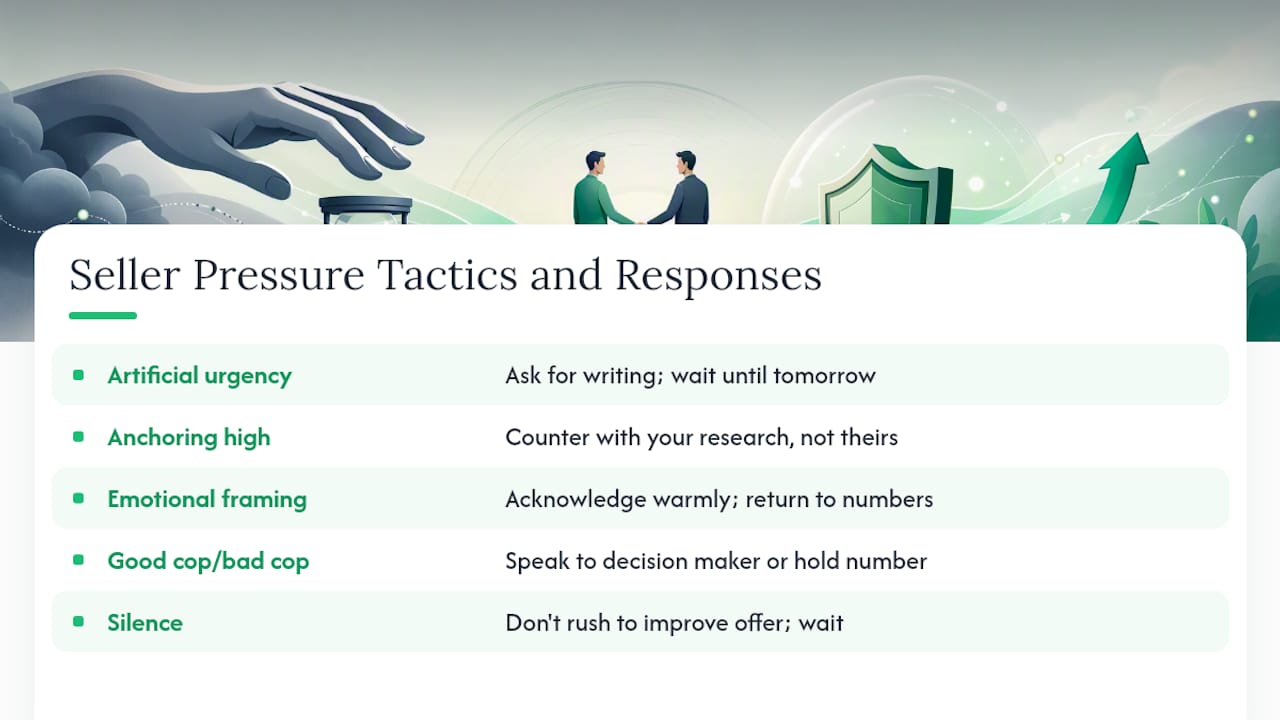
Artificial urgency ("another buyer is coming this afternoon") is the most common tactic. Sometimes it's true. Often it's designed to short circuit your comparison shopping. Ask for it in writing or simply say you need until tomorrow. A real competing offer survives that request; a bluff usually doesn't.
Anchoring high is standard practice, not manipulation, but it works on unprepared buyers. If a seller opens with a number well above market value, don't counter close to it. Counter based on your own research, not theirs.
Emotional framing ("this was my grandmother's house," "I've never had to discount this line before") is designed to make you feel guilty about negotiating hard. It's worth acknowledging warmly and moving straight back to numbers.
The good cop, bad cop dynamic, common in vendor and dealership negotiations, uses a sympathetic frontline rep and an unseen "manager" who won't approve your number. Ask to speak with the decision maker directly, or simply hold your number and let them go check.
Silence as pressure works both ways. If a seller goes quiet after your offer, resist the urge to sweeten it just to fill the gap. The pause is often a test, not a rejection.
Negotiation Styles Vary by Culture, and That Changes Your Approach
Negotiation norms differ meaningfully across cultures, and applying one script everywhere backfires. In many Western markets, particularly the United States and parts of Northern Europe, negotiation tends to be direct and transaction-focused: get to numbers quickly, close efficiently, treat the deal as separate from the relationship.
In much of the Middle East, Latin America, and parts of Asia, relationship building typically precedes serious price discussion. Rushing straight to numbers can read as disrespectful and actually slow the deal down rather than speed it up. Investing time in rapport, a tactic Stanford's negotiation research also supports for Western contexts, matters even more here.
Haggling expectations also differ sharply. In markets where posted prices are treated as a genuine opening bid (much of South Asia, the Middle East, and many local marketplace transactions worldwide), not countering can mean paying a premium nobody expected you to pay. In markets with fixed-price retail norms, the same aggressive counter can come across as offensive.
The practical takeaway: before an unfamiliar negotiation, especially a cross-border business deal or an international marketplace purchase, ask someone familiar with local norms how price discussion typically unfolds. A tactic that wins in one market can cost you credibility in another.
After You Shake Hands: Contract Review and Closing
Reaching a verbal agreement is not the finish line. Get every negotiated term in writing immediately, including price, contingencies, timelines, and any trades you agreed to. Verbal agreements have a way of getting fuzzy by the time paperwork arrives.
Read the contract against your notes, line by line, before signing anything. Look specifically for terms that quietly reverse something you negotiated, a renewal clause that auto-escalates price, a warranty period shorter than what was discussed, or a contingency that got dropped in drafting. This is where a documented concession ladder pays off twice: once during the negotiation, and again when you're checking that the paperwork matches what you agreed to.
Due diligence still applies even after price is settled. For real estate, that means final walkthroughs and confirming repairs were actually completed. For vendor contracts, that means checking references and confirming implementation timelines are realistic, not aspirational. For local marketplace buys, that means a final in-person check of the item's condition before money changes hands, ideally using handling and returns guidance as a reference point if something doesn't match the listing.
Closing is administrative, but it's not risk-free. Rushing signature just to be done with the process is how buyers miss the clause that costs them later.
Marketplace Perspective: Helping Buyers Negotiate Safer Deals
Some marketplace platforms build resources around a simple idea: buyers negotiate better when they're not also worried about getting scammed. Guides like negotiation scripts and pricing rules and local marketplace etiquette exist because leverage evaporates the moment you're distracted by trust concerns. Verified seller ratings and secure payment options can help facilitate safer transactions. They let you negotiate on price and terms instead of spending your energy vetting whether the seller is legitimate in the first place.
For anyone ready to put these tactics to use, check this Trusted Italian Fashion Retailer Checklist for Buyers to approach negotiations with confidence and ensure authenticity in fashion purchases.
— Marketplace
Sources
- Gartner — Total cost of ownership insights for procurement
- PON — In a Price Negotiation, Should You Make the First Offer?
- Negotiations
- PMC — Negotiation research and practical guidance
FAQ
What is the 70/30 rule in negotiation?
It's the idea that effective negotiators spend roughly 70% of the conversation listening and asking questions, and 30% talking. The imbalance is intentional: the side that gathers more information usually negotiates from a stronger position.
What are the seven basic rules of negotiating?
Common versions include: know your BATNA, set a clear target and reservation price, never make the first move without information, use precise anchors, trade concessions rather than give them away, stay fact-based rather than emotional, and be genuinely willing to walk away.
What are the five C's of negotiation?
Definitions vary across sources, but a common version covers clarity, common ground, creativity, compromise, and closure. Treat it as a rough mental checklist rather than a rigid formula.
What are ten tips for negotiating effectively?
Build your BATNA first, set your reservation price in advance, decide deliberately whether to anchor, use precise numbers when you do, ask open-ended questions, use silence, name every trade explicitly, calculate total cost of ownership rather than headline price, keep exchanges fact-based, and confirm agreements in writing immediately.
Should I always make the first offer as a buyer?
Only when you have strong market data to anchor with; otherwise, ask questions and let the seller anchor first, since anchoring without good information can lock you into a weaker number than the market supports.