
Whether you owe local sales tax comes down to two questions: do you have nexus in that location, and where is the sale sourced? If you have a physical presence, inventory, or meet a state's economic threshold, you likely need to register and collect. If you sell through a marketplace, the platform may already handle it. Your first move: pull up the state's official rate lookup tool and confirm your registration status before you list another item.
TL;DR:
- Local sales tax is generally limited to a 2% cap in Texas, but California incorporates local taxes into the state rate, which can vary by district.
- Nexus is triggered by physical presence or surpassing economic thresholds, meaning even warehouses or third-party fulfillment centers can establish tax obligations.
- Accurate rate determination requires using state-specific lookup tools to account for base rates, local add-ons, voter-approved taxes, and caps for each jurisdiction.
- Registration must be completed before making taxable sales, with correct allocation schedules essential for multi-jurisdiction selling to ensure proper tax reporting.
- Even if a marketplace collects sales tax, sellers may still need to register and maintain records for income tax purposes and audit readiness.
Table of Contents
- How Local Sales Tax and Local Use Tax Actually Work
- When You Actually Have to Collect Local Sales Tax
- Finding the Right Combined Rate for an Address
- Registering, Filing, and Allocating What You Collect
- When Sale Proceeds Count as Taxable Income
- A Six-Step Local Tax Checklist You Can Use Today
- How Marketplaceapp Helps Sellers Stay Organized
- Why We Push Sellers Toward Official Tools, Not Guesswork
- Sources
- FAQ
How Local Sales Tax and Local Use Tax Actually Work
Local sales tax comes from cities, counties, and special districts layered on top of the state rate. Local use tax is the mirror image, owed when a buyer brings a taxable item into a jurisdiction without paying sales tax at the point of purchase. Most states source the transaction to wherever the customer takes possession, not wherever the seller happens to sit.
The sourcing hierarchy usually runs in this order:
- Seller's place of business, if the sale happens in person
- Delivery or shipping address, for shipped goods
- Buyer's billing address, when delivery location is unclear
- A statewide default rate, as a last resort
Texas caps combined local sales tax at a maximum local portion of 2%, regardless of how many overlapping jurisdictions apply, according to the Texas Comptroller's seller guide. California works differently. Its Bradley-Burns law bakes a 1.25% local share into the statewide 7.25% rate, and sellers often allocate revenue to specific jurisdictions or route it through a countywide pool, per CDTFA's local tax guide.
When You Actually Have to Collect Local Sales Tax
Nexus is the legal trigger. You have physical nexus if you keep inventory, run a storefront, or employ someone in a given city or county. Storing goods in a third-party fulfillment center counts too. Even if you never set foot in that state, a warehouse holding your product there can create nexus and effectively become "your" place of business for sourcing purposes, per CDTFA's guidance.
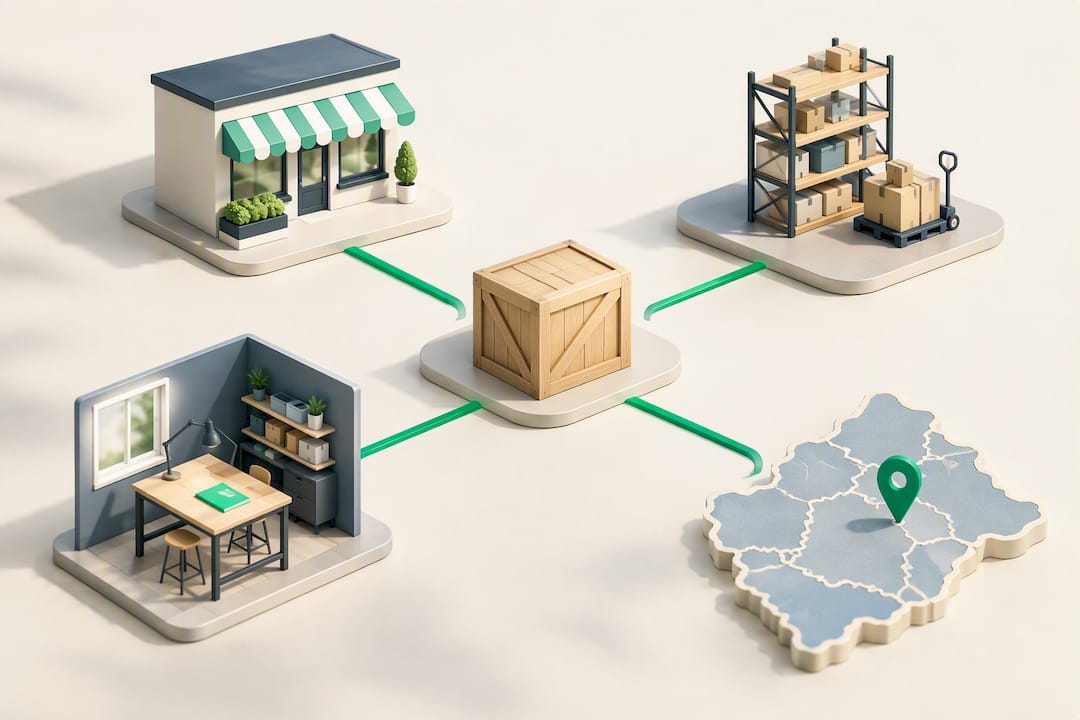
Economic nexus is different. It kicks in once your revenue or transaction count in a state crosses a threshold that state sets, no physical footprint required. Thresholds vary, so check the specific state's revenue department rather than assuming one number applies everywhere.
Marketplace facilitator laws add a third layer. In many states, the marketplace itself, not the individual seller, is legally required to collect and remit sales tax on transactions it processes, and it must notify sellers when it does so, according to Wisconsin's marketplace provider guidance.
- Physical nexus: inventory, storefront, employees, or a fulfillment center in that locality
- Economic nexus: revenue or order volume crosses a state-set threshold
- Marketplace facilitator collection: the platform remits tax, but you may still need to register separately for income reporting
Pro Tip: Don't assume "the marketplace handles it" means you're off the hook entirely. Some states still require sellers to hold a registration on file even when the platform collects tax on their behalf.
Finding the Right Combined Rate for an Address
Guessing a rate is how sellers end up over collecting or under collecting. Follow this order every time:
- Look up the state's base sales tax rate for the product category.
- Add the local rate for the specific city, county, or special district tied to the delivery address.
- Check for special local taxes layered on top, such as lodging, food and beverage, or transit taxes that voters approved locally.
- Confirm any statewide cap or single local use tax rate that limits the total.
Skip third-party calculators and go straight to the state's own tool, like the Washington Department of Revenue's local rate table. Some jurisdictions, including several counties tracked by the South Carolina Department of Revenue, add voter-approved taxes for transit, education, or green space that a generic calculator won't catch.
| State | Local tax mechanism | Combined rate cap or note |
|---|---|---|
| Texas | City, county, transit, and special districts | Local portion capped at 2% |
| California | Bradley-Burns 1.25% local share | Statewide base 7.25%, plus district add-ons |
| South Carolina | Voter-approved local option taxes | Varies by county, no statewide cap listed |
Registering, Filing, and Allocating What You Collect
Registration typically means applying for a seller's permit through your state's revenue department before you make your first taxable sale. Filing frequency (monthly, quarterly, or annual) usually depends on your sales volume, and the state assigns it once you register.
Allocation is where sellers stumble. California requires direct allocation to the jurisdiction where a sale is sourced whenever possible. When that's not possible, CDTFA routes the revenue through a countywide pool using Schedule B or Schedule C, prorating the distribution across jurisdictions in that county. Sellers operating in multiple cities or counties need to pick the correct schedule, not just report one lump sum. Nebraska and similar states publish their own adoption and rate-change procedures for local taxes, so a rate that applied last year might not apply today, per the Nebraska Department of Revenue.
- Register before your first taxable sale, not after
- Confirm your assigned filing frequency once you're registered
- Use the correct allocation schedule if you sell across multiple jurisdictions
- Bookmark the e-filing portal so deadlines don't sneak up on you
When Sale Proceeds Count as Taxable Income
Selling your old couch is not the same as running a business, at least according to the IRS. Occasional personal sales generally aren't taxable unless you sell above your original cost, in which case the gain counts. Frequent, profit-driven selling is a different story: that income belongs on Schedule C, per IRS guidance on Form 1099-K.
If a payment platform issues you a 1099-K, reconcile it against your own records rather than assuming every dollar reported is taxable.
- Keep receipts, original purchase prices, and dates for anything you might track expenses efficiently to support accurate cost basis and tax reporting
- Photograph items at the time of purchase and again before listing, to document condition and value
- Separate personal decluttering sales from repeated, profit-driven flipping in your own records
Documenting your cost basis is what keeps you from paying tax on a loss, a point Kiplinger's tax coverage makes clear for anyone offloading household items.
A Six-Step Local Tax Checklist You Can Use Today
Work through these steps before your next sale, not after the money has already changed hands.
- Determine your activity type. Is this a one-off declutter or a recurring, profit-driven pattern?
- Verify nexus. Do you have inventory, staff, or a storefront in the buyer's jurisdiction?
- Look up the official rate. Use the state's own tool for the delivery or pickup address.
- Register if required. Get your seller's permit before collecting a dime.
- Track tax on every invoice. Note the rate and jurisdiction, not just the total.
- File and reconcile. Match what you collected against what the marketplace reports.
For in-person pickup, source the sale to your location. For shipped items, source it to the delivery address instead. If a marketplace already collected tax on a transaction, note that on your own ledger so you don't double count it during reconciliation.
Pro Tip: Keep transaction records for at least three years. That covers most state audit windows and gives you a paper trail if a buyer disputes a sale later.
How Marketplaceapp Helps Sellers Stay Organized
Marketplaceapp's guides walk sellers through the practical side of local transactions, including avoiding common local selling scams and pricing higher-value items like electronics for a quick, safe local sale. Both matter for tax purposes: a documented, verifiable sale is easier to report accurately than a cash handshake with no paper trail.
- Secure payment processing that creates a transaction record automatically
- Seller ratings that add a layer of accountability to local deals
- Location-based listings that make it easier to confirm where a sale was actually sourced
If you're weighing which platform fits your selling habits, the comparison in Marketplaceapp's guide to local selling platforms is a reasonable starting point. Explore Marketplaceapp's marketplace for electronics, fashion, vehicles, pets, home and garden items, and more.
Why We Push Sellers Toward Official Tools, Not Guesswork
We built our seller resources around a simple idea: guessing at tax rules costs more than looking them up. Every state publishes its own rate lookup tool, and every seller has a slightly different nexus situation depending on where they store inventory and how often they sell. Our honest suggestion is to treat the checklist above as a starting point, not a substitute for a tax professional once your sales volume grows or you start hitting multiple states' economic thresholds.
— Marketplace
Sources
- Local Sales and Use Tax Collection – A Guide for Sellers (Texas Comptroller)
- Local Tax - Local and District Tax Guide for Retailers (CDTFA)
FAQ
How much can you sell without owing tax?
There's no single dollar threshold for personal items. Occasional sales of your own belongings generally aren't taxable unless you sell above what you originally paid, in which case the gain is reportable, per IRS guidance. Frequent, profit-driven selling is treated as business income regardless of the dollar amount.
Which tax applies to a local sale?
It depends on sourcing. If the buyer picks up the item, the sale is usually sourced to the seller's location; if it's shipped, it's sourced to the delivery address. The applicable rate is the combined state and local rate for that specific jurisdiction, found through the state's official rate lookup.
How much is local sales tax in Texas?
Texas caps the combined local portion of sales tax at 2%, on top of the state's base rate, according to the Texas Comptroller. The exact combined rate still depends on the city, county, and any special districts covering the delivery address.
Does selling an item always trigger a tax obligation?
No. A one-off sale of a personal item you no longer use, sold for less than you paid, typically creates no tax liability. Tax obligations show up when you have nexus in a jurisdiction, sell repeatedly for profit, or a marketplace facilitator's collection rules apply to the transaction.