
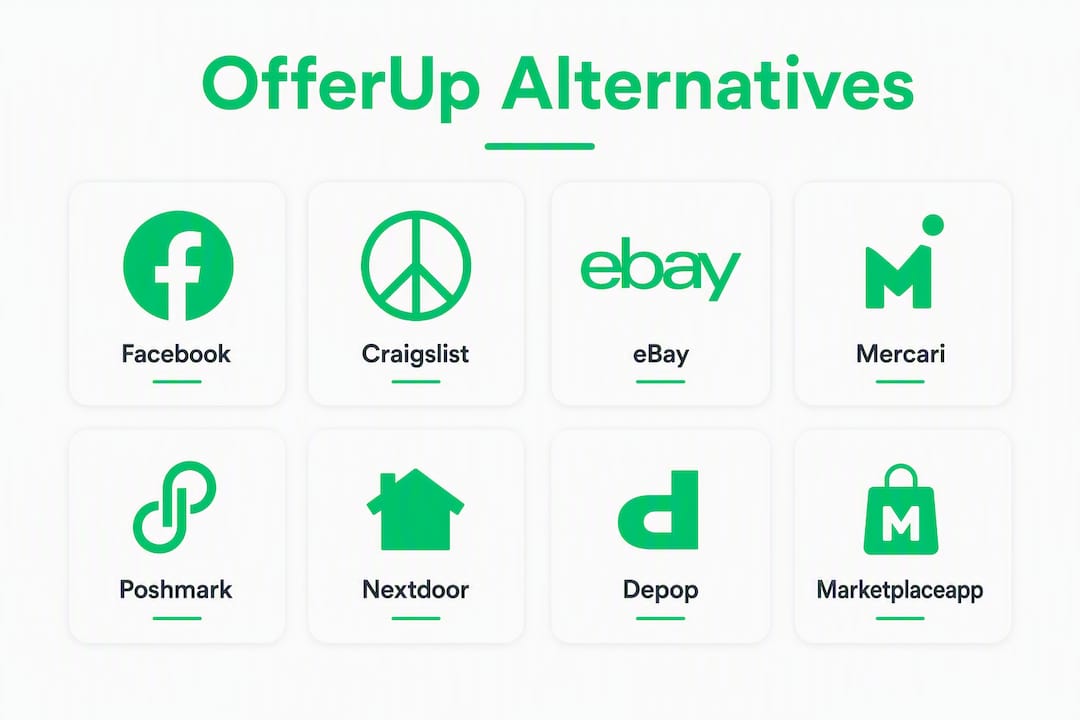
The single best rule for picking an OfferUp alternative: match the platform to what you're selling, not to what has the most downloads. Facebook Marketplace wins on raw local reach, Craigslist handles bulky items nobody wants to ship, Mercari and eBay take over when you need a buyer anywhere in the country, and Poshmark or Depop are the right call the moment fashion enters the picture. Matching platform to item type is what separates sellers who move inventory from those who relist the same couch for three months. Marketplaceapp's shortlist follows that exact logic.
Quick verdicts:
- Facebook Marketplace — best overall local reach, zero listing fees
- Craigslist — best for bulky items (furniture, appliances, vehicles)
- eBay — best for rare, high-value, or collectible items with global reach
- Mercari — best for shippable everyday goods with simple flat-rate labels
- Poshmark — best for fashion, shoes, and accessories
- Nextdoor — best for neighborhood-level sales with verified addresses
- Depop — best for vintage, streetwear, and Gen Z fashion buyers
- Marketplaceapp — best when you want verified profiles, secure local payments, and no ad clutter
Table of Contents
- How the top OfferUp alternatives compare at a glance
- Detailed breakdown of every major platform
- How to choose the right platform for your situation
- Which platform works best for each item type?
- When Marketplaceapp is the right call
- Key Takeaways
- What sellers who actually move inventory do differently
- Marketplaceapp: verified local selling without the ad clutter
- Useful sources and further reading
How the top OfferUp alternatives compare at a glance
| Platform | Best for | Seller fees | Shipping support | Reach | Category strengths | Safety/verification | Mobile experience |
|---|---|---|---|---|---|---|---|
| Facebook Marketplace | Local reach, all categories | Free to list; fees apply for shipped items | Yes (optional) | Largest in the U.S. | Furniture, electronics, vehicles | Profile-linked; no formal ID check | Excellent |
| Craigslist | Bulky local items | Free | Local only | Large, city-by-city | Furniture, appliances, vehicles, housing | Anonymous; no verification | Basic (browser-first) |
| eBay | Rare/collectible/high-value items | ~13.25% final value fee (varies by category) | Yes (required for most) | Global | Collectibles, electronics, fashion | Buyer/seller ratings; eBay Money Back Guarantee | Very good |
| Mercari | Shippable everyday goods | 10% selling fee + payment processing | Yes (prepaid labels) | Nationwide | Electronics, fashion, home goods | ID verification available | Excellent |
| Poshmark | Fashion and accessories | 20% fee on items over $15 | Yes (prepaid USPS label) | Large, fashion-focused | Clothing, shoes, handbags, jewelry | Social profiles; buyer protection | Excellent |
| Nextdoor | Neighborhood-level sales | Free | Local only | Hyperlocal | Home goods, furniture, kids' items | Address-verified accounts | Good |
| Depop | Vintage and streetwear | 10% Depop fee | Yes | Global, Gen Z-heavy | Vintage, streetwear, accessories | Buyer/seller ratings; PayPal protection | Excellent |
| Marketplaceapp | Verified local transactions | Transaction fee on completed sales | Local pickup focus | Growing U.S. local | Electronics, fashion, vehicles, home, pets | Verified seller ratings; secure payments | Excellent |

Note: eBay fees vary by category and seller tier. Poshmark's fee structure applies to U.S. sellers. Shipping support on Facebook Marketplace requires opting into the "ship only" listing format.
Detailed breakdown of every major platform
Facebook Marketplace
Facebook Marketplace is the most effective overall alternative for local selling in the U.S., with access to the largest local audience of any platform and no listing fees for local transactions. If you have one platform to try first, this is it.
Best for: Almost everything local, especially furniture, electronics, and vehicles.
- Pros: Massive local buyer pool; free to list; integrated Messenger for quick negotiation; no account creation beyond Facebook
- Cons: No formal identity verification; scam messages are common; ad density has increased
- Safety note: Always meet in a public place. Facebook profiles provide some accountability, but anyone can create one.
Verdict: The default first stop for most local sellers.

Craigslist
Craigslist remains the go-to for bulky, hard-to-ship items. It's free, city-specific, and attracts buyers who already know they're picking something up. The interface hasn't changed much in 20 years, which is either a feature or a bug depending on your tolerance for simplicity.
Best for: Furniture, appliances, vehicles, and anything too heavy or awkward to ship.
- Cons: — Zero verification; high spam volume; no in-app payment or buyer protection
Verdict: Unbeatable for bulky local items, but you're on your own for safety.
eBay
eBay and Mercari are the primary alternatives when you need nationwide shipping rather than local pickup. eBay specifically delivers the widest global reach for high-value or rare items, backed by its Money Back Guarantee and decades of buyer trust.
Best for: Collectibles, rare electronics, vintage items, anything with a niche buyer pool.
- Pros: Global reach; strong buyer protections; auction format drives prices up on rare items; established seller reputation system
- Cons: Final value fees around 13.25% (varies by category); shipping coordination required; competitive for common items
- Safety note: Stick to eBay's built-in payment system. Off-platform payment requests are almost always scams.
Verdict: The right call for anything rare, collectible, or worth shipping to the right buyer.
Mercari
Mercari simplifies the shipping side of selling more than any other platform on this list. You get a prepaid label, flat-rate options, and a clean app that walks first-time sellers through the process in minutes.
Best for: Everyday shippable goods: electronics, home goods, toys, casual fashion.
- Pros: Simple flat-rate shipping; 10% seller fee is predictable; buyer and seller ratings build trust quickly; easy listing flow
- Cons: Smaller buyer pool than eBay; less effective for bulky or local-only items; customer support can be slow on disputes
- Safety note: Mercari holds payment until the buyer confirms receipt, which protects both sides.
Verdict: The easiest on-ramp for sellers who want to ship without figuring out carrier rates.
Poshmark
Niche vertical marketplaces like Poshmark consistently outperform general platforms for category-specific items because they attract buyers actively searching for exactly that type of product. On Poshmark, that category is fashion.
Best for: Clothing, shoes, handbags, and accessories at any price point.
- Pros: Fashion-focused buyer base; social "sharing" feature increases listing visibility; prepaid USPS label on every sale; strong brand community
- Cons: 20% fee on items over $15 is steep; almost no use for non-fashion items; shipping-only model (no local pickup)
- Safety note: All transactions run through Poshmark's platform, which provides solid buyer and seller protection.
Verdict: If you're clearing out a closet, Poshmark will outperform every general marketplace.
Nextdoor
Nextdoor's address verification sets it apart from every other platform on this list. Every user has a verified neighborhood address, which reduces no-shows and scams compared with anonymous classifieds. The trade-off is a smaller, hyperlocal buyer pool.
Best for: Low-friction neighborhood sales: home goods, kids' items, plants, furniture within a few miles.
- Pros: Verified addresses build real accountability; free to list; buyers are literally your neighbors; strong community trust
- Cons: Very limited reach beyond your immediate neighborhood; no shipping option; smaller audience than Facebook Marketplace
- Safety note: The verification model means you're dealing with real, traceable neighbors, which makes it one of the safer local options.
Verdict: Best when convenience and safety matter more than maximum reach.
Depop
Depop runs on a younger, style-conscious audience. If your items are vintage, streetwear, or anything with a distinct aesthetic, Depop’s Gen Z buyer base will find them more quickly than any general marketplace.
Best for: Vintage clothing, streetwear, curated thrift finds, and accessories with visual appeal.
- Safety note: — Use Depop Payments for every transaction. PayPal goods-and-services is the backup; never accept Venmo or cash app payments.
Verdict: The right platform if your items have a story and a visual identity.
Letgo (historical context)
Letgo merged into OfferUp in 2020 and no longer operates as a separate platform in the U.S. If you used Letgo before, your current OfferUp account absorbed that history. It's worth knowing because some older guides still list it as an active option. It isn't.
Marketplaceapp
Marketplaceapp is a peer-to-peer local marketplace built around the features that users now prioritize over anonymous classifieds: verified seller ratings, secure in-app payments, and direct buyer-seller communication without ad clutter. It covers electronics, fashion, vehicles, pets, and home goods, with location-based search and push notifications built into the mobile app.
Best for: Sellers who want verified local transactions without navigating a feed full of sponsored dealership listings.
- Pros: Verified seller ratings; secure payment processing; categorized listings; clean mobile experience; no ad-heavy feed
- Cons: Smaller current user base than Facebook Marketplace or eBay; growing platform
- Safety note: Built-in payment processing and verified profiles reduce the risk of off-platform scams.
Verdict: The strongest pick when verification and payment security are your top priorities.
How to choose the right platform for your situation
The right platform depends on four things: what you're selling, how fast you need the money, whether you'll ship, and how much you trust the buyer pool. Run through this checklist before you list.
- Is the item bulky or fragile? If yes, go local-only (Facebook Marketplace, Craigslist, Nextdoor). Shipping a couch is rarely worth the logistics.
- Is it fashion or accessories? Go straight to Poshmark or Depop. General platforms will bury your listing under electronics and furniture.
- Is it rare, collectible, or high-value? eBay's global reach and buyer protections justify the higher fees.
- Do you want the simplest possible shipping experience? Mercari's prepaid labels and flat-rate model beat the alternatives for everyday shippable goods.
- Do you need verified buyers? Nextdoor or Marketplaceapp, where identity is tied to a real address or verified profile.
- What's your fee tolerance? Free listing platforms (Facebook Marketplace, Craigslist) cost nothing upfront but offer no buyer protection. Fee-based platforms (Poshmark, eBay, Mercari) take a cut but handle disputes.
Red flags to watch for on any platform:
- Buyers who immediately ask to move the conversation off the app
- Offers that are suspiciously above asking price (common in check-overpayment scams)
- Requests for payment via Zelle, Cash App, or wire transfer for a local pickup
- Listings with no photos or stock images on buyer profiles
- Pressure to complete a transaction "today only"
Pro Tip: Cross-list your item on two complementary platforms simultaneously: one local-first (Facebook Marketplace or Marketplaceapp) and one shipping-enabled (Mercari or eBay). Cross-listing reaches different buyer intents and typically cuts time-to-sale. Once it sells, delete the other listing immediately.
Which platform works best for each item type?
Specialized marketplace strategy consistently improves sell-through: heavy local goods perform better on local platforms, while fashion and small shippable items outperform on vertical platforms. The table below maps item type to the right platform category.
| Item type | Best platform category | Primary reason | Quick fee note |
|---|---|---|---|
| Bulky furniture | Local-first (Facebook Marketplace, Craigslist) | Buyers want pickup; shipping is cost-prohibitive | Free to list on both |
| Fashion/clothing | Vertical fashion (Poshmark, Depop) | Fashion-specific buyer base; higher conversion | 20% Poshmark / 10% Depop |
| Collectibles/rare items | Shipping-enabled (eBay) | Global niche buyers; auction drives price | ~13.25% final value fee |
| Everyday electronics | Shipping or local (Mercari, Facebook Marketplace) | Wide demand; both local and shipped buyers active | 10% Mercari; free local on FB |
| Vehicles | Local-first (Facebook Marketplace, Craigslist) | Test drives require in-person; title transfer is local | Free on both |
| Baby/kids' items | Neighborhood (Nextdoor, Facebook Marketplace) | Local parents; no shipping needed for gear | Free |
| Vintage/streetwear | Depop | Gen Z buyer base; aesthetic-driven discovery | 10% Depop fee |
| Home goods (small) | Mercari or Facebook Marketplace | Shippable or local; broad demand | 10% Mercari; free local on FB |
Edge cases worth noting: High-value collectibles (graded cards, signed memorabilia) belong on eBay almost exclusively. The auction format and global collector base regularly push prices well above what any local platform can match. For oversized furniture, clear pickup instructions and strong photos matter more than platform choice. For vehicles, Facebook Marketplace now rivals Craigslist on local reach, and you can sell your car locally with a structured process that covers title transfer and safe payment.
Pro Tip: If you're a mixed-inventory seller (some shippable, some bulky), keep two active accounts: one on a local-first platform for furniture and large items, one on Mercari or eBay for everything that fits in a box. Reselling apps for side hustlers break down how to manage both without doubling your workload.
When Marketplaceapp is the right call
Marketplaceapp is the strongest pick when you want verified local transactions, secure payments, and a clean feed without sponsored dealership listings crowding out private sellers. Dedicated marketplace platforms typically provide stronger buyer-seller tools and more reliable identity verification than general social marketplaces, and that gap matters most for higher-value or repeat sellers.
Three quick decision rules:
- Use Marketplaceapp when verification, secure payment, and a clutter-free local experience are your priorities
- Use Facebook Marketplace or Craigslist when you need the widest possible local reach and fee-free listing
- Use Mercari or eBay when your item ships easily and you want a national or global buyer pool
On cross-listing: it's worth the extra five minutes for items that could sell either locally or shipped. For bulky items that can only go local, pick one platform and optimize that single listing with strong photos, a clear title, and an honest description of condition. Splitting attention across three platforms for a couch rarely moves it faster.
Key Takeaways
The single most effective move for any seller leaving OfferUp is to match the platform to the item type rather than defaulting to whichever app has the most name recognition.
| Point | Details |
|---|---|
| Match platform to item type | Bulky items go local-first; fashion goes vertical; rare items go to eBay for global reach. |
| Check fees before listing | Poshmark takes 20% above $15; eBay ~13.25%; Mercari 10%; Facebook Marketplace and Craigslist are free for local listings. |
| Verify buyers for high-value trades | Use platforms with address verification (Nextdoor) or verified profiles (Marketplaceapp) when the item is worth real money. |
| Cross-list strategically | One local platform plus one shipping-enabled platform covers most buyer intents without doubling your workload. |
| Marketplaceapp for verified local selling | Marketplaceapp combines verified seller ratings, secure payments, and location-based search for safer local transactions. |
What sellers who actually move inventory do differently
The sellers who clear their listings fastest share one habit: they treat the listing itself as the product. A blurry photo and a vague title like "couch, good condition" will sit for weeks on any platform. The same item with three well-lit photos, measurements in the title, and a note about the pickup window sells in a day.
Two things most casual sellers get wrong. First, pricing: start 15–20% above your floor, not at it. Buyers almost always negotiate, and leaving no room means you either lose money or lose the sale. Second, timing: listings get the most visibility in the first few hours after posting. If yours hasn't moved in 48 hours, drop the price by 10% and refresh the listing rather than waiting another week.
The third, less obvious one: describe wear honestly and specifically. "Minor scratch on the left armrest" converts better than "some wear." Buyers who show up and find exactly what you described don't haggle. Buyers who feel surprised do, or they walk.
The behavior change you can make today: before you list anything, take photos in natural light, write the dimensions in the title, and set your price 15% above your actual floor. That alone puts you ahead of most sellers on any platform.
Marketplaceapp: verified local selling without the ad clutter
OfferUp's feed has become harder to navigate for private sellers, with sponsored dealership listings and heavy ad density pushing organic listings down. Marketplaceapp is built around the opposite experience: a clean, local-first marketplace where verified seller ratings, secure in-app payments, and direct buyer-seller chat are the defaults, not add-ons.
Three things Marketplaceapp does that matter for sellers moving on from OfferUp:
- Secure payment processing — built into every transaction, no off-app Venmo requests
Ready to list your first item? Start selling on Marketplaceapp and reach verified local buyers today.
Useful sources and further reading
Research sources used in this article:
- Facebook Marketplace statistics — data on Facebook Marketplace's reach and local selling effectiveness
- Craigslist and local delivery considerations — practical guidance on bulky item logistics and Craigslist use
- Apps like Mercari and shipping-first marketplaces — comparison of Mercari, eBay, and shipping-enabled alternatives
- Best apps for selling stuff online in 2026 — aggregated 2026 seller app recommendations and platform strategy
- Marketplace fee and verification analysis — fee structures and verification feature comparison
- Marketplace model comparisons and safety trends — analysis of OfferUp's monetization changes and user experience shifts
- Cross-listing strategies for resellers — practical cross-listing tactics for mixed-inventory sellers
- Nextdoor verification guide — how Nextdoor's address verification works and its safety implications
- Top OfferUp alternatives in 2026 — aggregated shortlist of active OfferUp replacement options
- Category-focused marketplace advantages — analysis of vertical marketplace performance for fashion and niche categories
Marketplaceapp resources for next steps:
- Best apps to sell locally — overview of local-first selling apps and when to use each
- How to sell clothes locally and get cash fast — actionable tips for listing fashion items in your area
- How to sell your car locally — step-by-step guidance on safe local vehicle sales