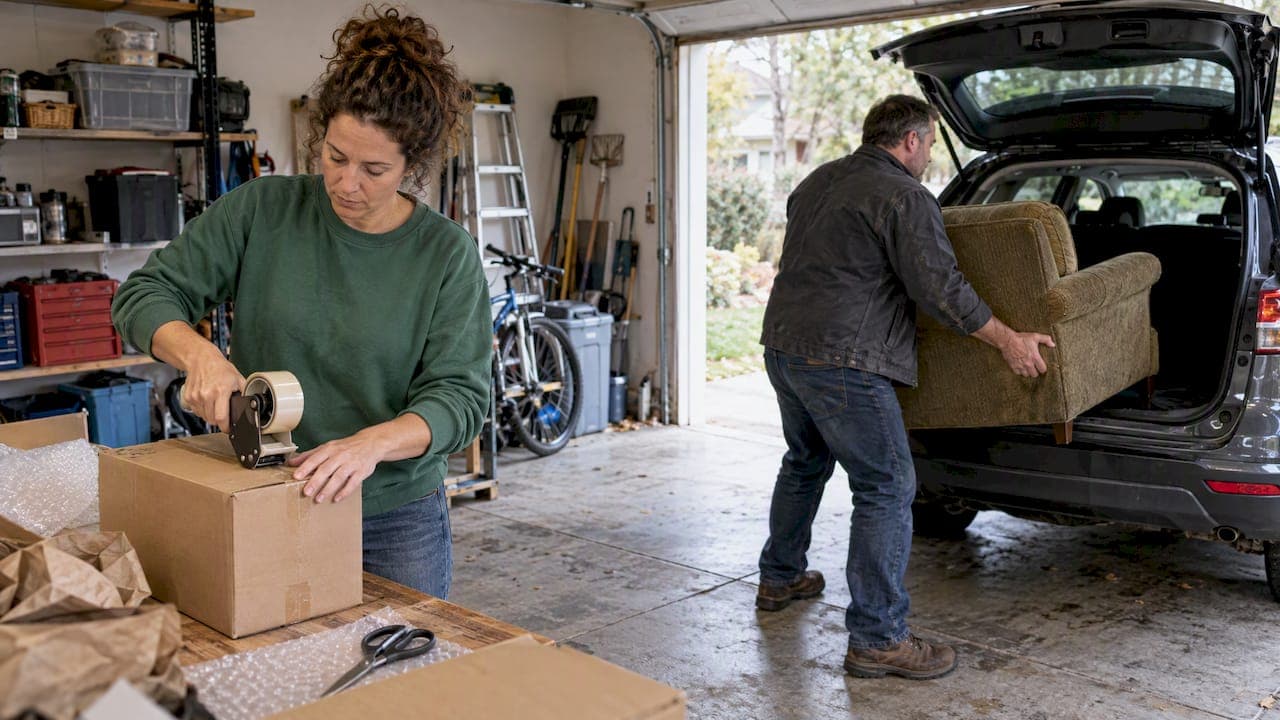
Choose local pickup for bulky, low-margin or inspect-first items, and choose shipping for small, standardized goods or buyers far away. The trade-off is speed and convenience against reach and margin. Carrier options like USPS Hold for Pickup and UPS Access Point sit in between. Start with the comparison below, then see how to arrange each method.
TL;DR:
- Pickup can happen the same day, but factor in fuel and time; agree on condition, price, meeting place, and payment before traveling.
- For shipped sales, confirm service and cost upfront, use a traceable transaction, photograph the item and packed box, and insure anything costly to replace.
- USPS Hold for Pickup keeps eligible packages for 5 to 15 days, depending on service class; certain postage methods have no added fee.
- Check carrier and local rules before listing pets, vehicles, batteries, liquids, or hazardous goods, since some items cannot use standard parcel shipping.
- Access point collection requires selecting the carrier service or arranging redirection; simply writing a store address on the parcel usually fails.
Table of Contents
- How do shipping and local pickup compare side by side?
- When is local pickup the better choice?
- When is shipping the better choice?
- How do you arrange local pickup safely and smoothly?
- What do cost and timeline look like in practice?
- Can shipping to a pickup location or access point work for you?
- What do shipping, local pickup and delivery actually mean?
- What are the legal and liability considerations?
- How do payment methods and escrow affect security and trust?
- How should buyers and sellers communicate?
- How do shipping restrictions affect certain categories?
- Which method is greener, shipping or local pickup?
- What is Marketplace's view on pickup-first listings?
- Ready to list your next item for local pickup?
- FAQ
- Sources
How do shipping and local pickup compare side by side?
Think of each method as a bundle of trade-offs rather than a winner and loser. Here is how they stack up on the factors most buyers and sellers care about:
- Cost: Local pickup usually has no carrier fee, though you may spend on fuel and time. Shipping adds carrier charges, packing materials and sometimes insurance, which either the buyer or the seller absorbs.
- Speed: Pickup can happen the same day or the next, as soon as both people agree on a time. Shipping depends on the service level and the distance between you.
- Convenience: Pickup asks both people to be available at the same place and time. Shipping lets everyone stay home, but someone has to pack and drop off the box.
- Suitability by item: Furniture, appliances and other heavy goods favor pickup. Collectibles, small electronics and standardized products favor shipping, especially when the buyer lives far away.
- Security and accountability: In person, the buyer can inspect the item before paying. With shipping, tracking numbers and carrier records create a paper trail, but the buyer sees the item only after it arrives.
Some deals fit neither extreme. Shipping to a carrier access point gives the buyer a staffed or locker location to collect from, which is covered later in this guide. If you are choosing a platform to run these workflows, our roundup of the best marketplace apps for sellers breaks them down by use case.
When is local pickup the better choice?
Pickup shines when moving the item costs more than the item is worth. A solid wood dresser, a washing machine or a set of patio chairs can cost more to crate and ship than a buyer would ever pay for them. For heavy, fragile or low-margin goods, meeting in person is usually the cheaper and safer path.
Here is what typically tips the decision toward pickup:
- Bulky or heavy items: Furniture, appliances and exercise equipment are awkward to pack and easy to damage in transit.
- Speed: A buyer nearby can often collect the same day or the next, with no waiting on a carrier.
- No carrier fees: Neither side pays postage, packaging or insurance.
- Inspection: Buyers can test, measure and look the item over before handing over money, which cuts the odds of a dispute or return.
Pickup is not free for sellers, though. Fuel, vehicle wear and your own time all count, especially if you meet someone across town. Peer-to-peer deals also tend to have less structured return and buyer-protection options than retail purchases, so confirm the condition and price before anyone drives anywhere.
If the item is too large to move at all, removal may be part of the plan. Guidance on disposing of large furniture items can help when a piece will not sell or cannot be hauled out easily. For furniture that does sell, our walkthrough on selling furniture locally shows how to get paid fast.
Pro Tip: Photograph the item next to a tape measure and a doorway reference, and tell the buyer what vehicle size they need. It prevents the classic "it did not fit in my car" cancellation.
When is shipping the better choice?
Shipping makes sense when your buyer pool is bigger than your zip code. A rare collectible or niche electronic may have only a handful of interested local shoppers, but a much larger pool of potential buyers nationwide. Small, standardized and high-value goods are the best candidates, because the postage is a small slice of the price and the item travels well.
To protect your margin and your reputation, build a few habits:
- Pack for the worst drop: Use a sturdy box, cushioning on all sides and no loose space inside. Fragile items deserve double protection.
- Insure what matters: If replacing the item would hurt, add insurance or declared value. It costs little next to a lost or crushed shipment.
- Label clearly: Print a clean label, include a return address and keep your tracking number where you can find it.
- Document everything: Photograph the item and the packed box before sealing. If a dispute comes up, those photos settle it.
For trading cards and similar small collectibles, a practical guide on shipping trading cards covers how to pack them so they arrive in the condition you listed.
Shipping costs do not have to wipe out your profit. Targeted promotions can discount only certain shipping methods or apply only when a cart meets certain conditions, which lowers checkout friction without giving away free shipping on every order. BigCommerce documents that these discounts can be configured by destination, method and cart conditions.
Targeted shipping discounts can be set by destination, method and cart conditions, so you can lower checkout friction without a blanket free-shipping offer, according to BigCommerce's shipping promotions guide. In practice, that means you can reward bigger baskets and keep your margin on smaller ones.
How do you arrange local pickup safely and smoothly?
A smooth pickup comes down to clear details and a few safety habits. Treat the first message like a checklist, and most problems disappear before anyone leaves the house.
- Agree on a meeting place. Pick a busy, well-lit public spot, or a spot near the seller's home for large items where the buyer must load up.
- Confirm the time. Set a specific window, not "sometime this afternoon," and ask the other person to message when they are on the way.
- Share clear photos and instructions. Send recent photos, the exact address or cross street, and parking or loading notes.
- Settle payment in advance. Decide whether you are using cash or an in-app payment, and confirm the amount so there are no surprises at the handoff.
- Follow a safety routine. Meet in daylight, bring a friend when you can, and keep your phone handy.
- Wrap up the exchange. Let the buyer inspect the item, hand over payment, and keep the chat thread as your record.
On MarketplaceAnywhere, in-app messaging and location-based search keep the planning in one place, so you do not need to hand out a personal phone number just to coordinate a handoff.
Pro Tip: Ask the buyer to send their name and a recent message in the app before you share your address. If someone refuses to confirm basic details, you can walk away from the sale.
What do cost and timeline look like in practice?
The cheapest option depends on weight, size and distance, so run the numbers before you list. Here are the main drivers to weigh:
- Pickup timeline: Often same-day or next-day, once you and the buyer agree on a time.
- Shipping timeline: Depends on the service you choose. Standard services take longer than expedited ones, and both depend on the distance.
- Carrier fees: Rates move with weight and dimensions, so a heavy or oversized box can cost far more than a small one.
- Packing materials: Boxes, tape and cushioning add up, especially for fragile items.
- Your own time and fuel: Pickup is free of postage, but driving and waiting are not free.
- Carrier scheduling: If you want a carrier to come to you, USPS Package Pickup can be scheduled up to six months ahead, and USPS issues a confirmation by email or notice.
Hold windows matter for planning too. USPS documents that Hold for Pickup keeps eligible items at a Post Office for a set window that depends on the service class, so a buyer needs to collect before the window closes.
Eligible mail classes such as Priority Mail Express and USPS Ground Advantage carry no additional fee for Hold for Pickup, according to the USPS service page. That makes carrier pickup a low-cost fallback when a buyer cannot be home for a delivery.
When you want to sweeten a shipped sale, a conditional discount often beats blanket free shipping. Offering it only above a certain order value protects your margin on small, cheap items.
Can shipping to a pickup location or access point work for you?
Hybrid options let the buyer collect a shipped package on their own schedule. They suit anyone who wants shipping's reach with some of pickup's flexibility. Two formal carrier services cover most cases:
- USPS Hold for Pickup: USPS holds eligible mailpieces at a Post Office for the addressee to collect. Hold windows run from 5 to 15 days depending on the service class, and certain postage methods carry no extra fee.
- UPS Access Point: UPS Access Point locations and lockers let customers pick up pre-labeled shipments or packages redirected there. Many offer extended hours or 24/7 locker access, and ID verification is required at pickup.
- Setup matters: Shipping to a pickup location is a formal carrier option. The sender must choose that service, or the recipient must manage redirection. Simply addressing a package to a store without coordinating with the carrier usually fails.
- Best fit: These options work well when a buyer lives far away but is rarely home during delivery hours.
What do shipping, local pickup and delivery actually mean?
People use these three words loosely, and the confusion causes real misunderstandings in listings. Pinning them down helps you write a clearer ad.
Shipping means a carrier moves the item from seller to buyer. The seller packs it, hands it to the carrier, and the buyer receives it at an address or a carrier location. The carrier is responsible for transport.
Local pickup means the buyer comes to the seller, or both meet somewhere agreed. No carrier is involved. The handoff happens in person, and the buyer takes the item on the spot.
Delivery is the act of getting the item to the buyer's door. A carrier can do it, which makes it part of shipping. A seller can do it personally with their own vehicle, which is closer to pickup in spirit but with the seller doing the driving.
The overlap is where listings get messy. Shipping to an access point is shipping, yet the buyer still collects the package in person. A seller who drops an item at a buyer's house is making a delivery without using a carrier. When you list, spell out exactly which of these you offer, who pays for it, and who handles the transport. That one line prevents most "I thought you would bring it" conversations.

What are the legal and liability considerations?
The basic question is who owns the item, and who bears the loss, at each moment of the sale. The answer changes with the method, and the details depend on where you live, so treat this as general orientation rather than legal advice.
With local pickup, the handoff is simple. Once the buyer pays and takes the item, responsibility moves with it. If the buyer inspected the item first, that inspection usually weakens later claims that it was not as described. The risk is that peer-to-peer deals typically lack the structured return and buyer-protection options of retail, so be precise about condition and price in writing before meeting.
With shipping, there is a stretch where the item is in neither person's hands. Who bears the risk if it breaks or goes missing can depend on the terms of the sale and the rules of your location. Sellers can reduce disputes by packing well, insuring valuable items, keeping tracking records and photographing the item before sealing the box. Buyers should photograph damage right away and report it quickly.
For anything high-value, regulated or unusual, check the rules for your country or state, or ask a professional. Never assume the same rules apply everywhere. What is clear everywhere is that written terms in the listing and chat thread, covering condition, price, method and who pays what, are your best protection under either method.
How do payment methods and escrow affect security and trust?
Payment is where trust is won or lost, and the safest choice differs between pickup and shipping.
In person, buyers and sellers often use cash because it is instant. The trade-off is that cash leaves no record and can be counterfeit or mishandled. An in-app or electronic payment leaves a record that both sides can point to later, which helps if a dispute arises. On MarketplaceAnywhere, secure payments and verified seller ratings give buyers more reasons to feel comfortable before they commit.
Shipping raises the stakes, because the buyer pays before holding the item. That is why payment methods with a transaction record are generally the better option for shipped sales. Avoid anything that cannot be traced or reversed through a legitimate channel, and be wary of requests to move the conversation or the payment off the platform.
Escrow-style arrangements, where payment is held until the buyer confirms receipt, protect both people. The buyer knows the money is not released until the item arrives, and the seller knows the funds are committed. Whether a particular service offers this depends on the platform or provider, so read the terms before you rely on it. Whatever you choose, match the payment method to the risk: low-value local handoffs can be simple, while expensive or shipped items deserve a traceable payment and a clear record.
How should buyers and sellers communicate?
Good communication prevents almost every problem covered in this guide. The goal is to leave nothing to guess.
For both methods, put the essentials in writing: item condition, price, the method you agreed on, who pays for what, and the time frame. Reply promptly, even if the answer is "I will confirm tonight." Silence is the top cause of no-shows.
For pickup, confirm the place and time, then message again on the day. Share your arrival status, such as "leaving now" or "I am in the blue car." If plans change, say so early rather than leaving someone waiting.
For shipping, confirm the destination, the service level and the cost before payment. Once you ship, send the tracking number right away and update the buyer if anything changes. Buyers should confirm delivery and flag problems quickly.
Keep conversations inside the platform's messaging where you can. It keeps a record both sides can rely on, and it keeps your personal contact details private. Be polite and specific, ask questions when something is unclear, and avoid vague phrases like "pretty good condition." A sentence such as "one small scratch on the left side, photo attached" builds more trust than any adjective. If you list across several sites, our guide on crossposting with one master listing shows how to keep your pickup and shipping terms consistent everywhere.
How do shipping restrictions affect certain categories?
Not everything can go in a box. Some categories face carrier rules, legal limits or practical barriers that make local pickup the only realistic option.
Pets and live animals are a clear example. Moving them involves welfare considerations and specific rules, and many sellers and platforms handle these through direct, in-person arrangements instead of standard parcel services. Always check the rules that apply where you live.
Vehicles are another. They cannot go through a parcel carrier, and a sale usually involves title transfer and paperwork that varies by location. In-person handoffs are the norm, with the buyer inspecting the vehicle before paying.
Large furniture and appliances are not banned from shipping, but they are costly and hard to move, which is why pickup is so common for them. Other items, such as certain batteries, liquids or hazardous goods, may carry carrier restrictions. Check your carrier's current rules before you list anything unusual.
The practical lesson: look up the restrictions before you choose a method, not after a buyer has paid. If a category is restricted or impractical to ship, say "local pickup only" in the title or first line of the listing. It saves everyone time and filters out buyers who cannot collect. For regulated categories, rules differ by country, state and carrier, so confirm with the relevant authority rather than assuming.

Which method is greener, shipping or local pickup?
There is no universal winner, because the footprint depends on distance, vehicle, packaging and how many stops a trip combines. Still, a few principles help you think it through.
Local pickup can be the lighter choice when the buyer lives close and combines the trip with errands. One short drive may produce less impact than packaging, sorting and transporting a parcel. It also avoids extra boxes, tape and filler. But a long trip made only for one small item can easily outweigh those savings, especially in a large or inefficient vehicle.
Shipping spreads the footprint across a carrier network that moves many parcels at once. Consolidated routes can be efficient, yet packaging waste and the final leg of delivery add up. Hybrid options like access points may help by gathering many packages in one place, so the buyer makes a single trip instead of the carrier making many stops, though this depends on the location and the route.
You can lower the impact either way. Reuse boxes and padding, choose the smallest box that protects the item, and combine multiple purchases into one shipment or one pickup. For pickup, pair the trip with other errands. Buying secondhand already keeps goods in use, which is a meaningful benefit by itself, and local sourcing helps too. Our guide on sourcing inventory locally shows how sellers turn nearby finds into sales.
What is Marketplace's view on pickup-first listings?
We lean toward pickup for anything heavy, awkward or cheap relative to its shipping cost. Our messaging and location tools exist to take the friction out of meeting up, so the handoff can be quick and safe. But pickup is a means, not a rule. Choose whichever method protects your margin and keeps the buyer confident. If a sale only works because you ignored the shipping math or skipped an inspection, it is not a good sale. Pickup-first is a starting point, and the item should decide the rest.
— Marketplace
Ready to list your next item for local pickup?
MarketplaceAnywhere makes it easy to list, coordinate and complete local pickups from one app:
- Quick listings: Post an item with photos and a clear description.
- In-app messaging: Agree on time and place without sharing personal details.
- Location-based search: Find buyers and deals close by.
- Secure payments and verified seller ratings: Trade with more confidence.
List your first item today and turn what you no longer need into cash.
FAQ
What does pickup mean in shipping?
Pickup can mean two things. It can mean a carrier collects a package from the sender, or it can mean a recipient collects a package from a location such as a Post Office or access point. Check which one a listing or carrier page means before you plan.
Is shipped the same as delivery?
Not exactly. Shipping is the whole process of moving an item with a carrier, while delivery is the final act of getting it to the buyer. A shipment can end at a door, a Post Office or an access point, depending on the service chosen.
Can I ship my package to a pick-up location?
Yes, but it has to be set up properly. USPS offers Hold for Pickup for eligible items, and UPS offers Access Point locations. Addressing a package to a store without coordinating with the carrier usually fails.
Which shipping service picks up packages?
USPS offers Package Pickup, which lets you schedule, change or cancel a pickup and get a confirmation by email or notice. Other carriers offer their own pickup options, so check each carrier's current rules and fees before you schedule one.
Sources
- Hold for Pickup Service
- Shipping Promotions: Flexible Shipping Discounts That Increase Conversions | BigCommerce
- UPS Access Point®
- Package Pickup & Pickup on Demand®