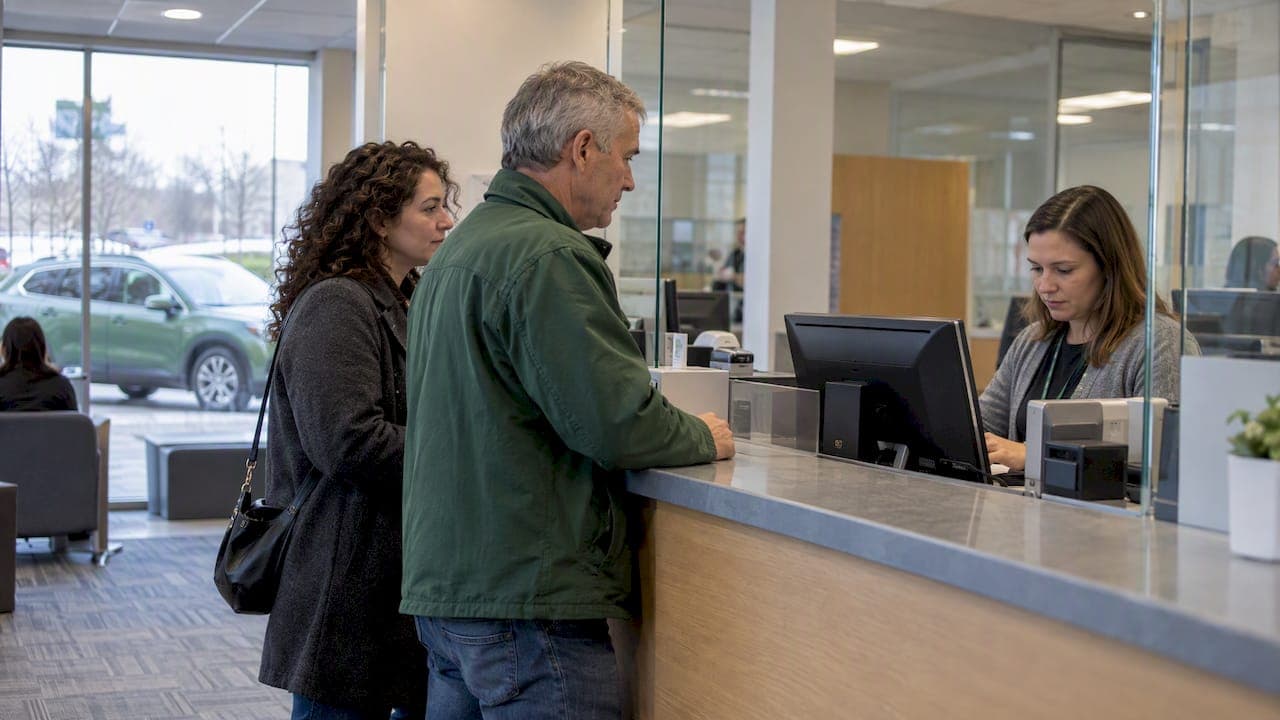
Meet in person and verify funds with a teller at a bank before you sign over the title, or use a regulated escrow service when the sale is remote. Never return "extra" money from an overpayment, never accept gift cards, and never treat a screenshot of a payment as proof. Money that is confirmed by a bank, not one that merely looks sent, is what protects both sides of a private vehicle sale.
TL;DR:
- Banks may make check funds available within 1–2 days, but fraudulent checks can take weeks to detect; never refund an overpayment from a deposit.
- For cash, meet during business hours at the buyer’s bank, ask a teller to inspect and count bills, bring a witness, then deposit immediately.
- For remote deals, research the escrow provider, review its fee schedule and release terms, and reject services routing funds through gift cards or cryptocurrency.
- Buyers should check for liens, match the seller’s name to the title, verify the odometer disclosure and vehicle condition, and get a signed bill of sale before payment.
Table of Contents
- Which payment methods can you trust in a private car sale?
- How do you accept cash safely when selling a vehicle?
- What should you know about bank transfers and cashier's checks?
- When should you use escrow for a remote vehicle sale?
- Are mobile payment apps safe for a vehicle purchase?
- What scams and red flags should you watch for?
- What is the seller's checklist for finishing a sale safely?
- What should buyers check before and after paying?
- Why platform-level verification matters
- Ready to list or browse vehicles with safer payments?
- FAQ
- Sources
- Where can you report scams and find official guidance?
Which payment methods can you trust in a private car sale?
Every private vehicle sale comes down to a handful of routes. Each one can work, and each one can be faked if you skip the check that matches it.
- Cash: avoids the check-clearing problem, but take care when arranging the handoff.
- Bank transfer: reliable once your own bank shows the money as settled, not just pending.
- Cashier's check: looks official, which is exactly why scammers copy it. Verify it with the issuing bank.
- Escrow: a neutral third party holds the money until title and condition checks are done.
- Digital or mobile payments: fast, but a notification on your phone is not the same as funds in your account.
One rule sits underneath all of them: confirm the money through a trusted financial institution or escrow before you transfer the title. Once the title and keys leave your hands, you have very little leverage left.
When the buyer lives nearby, prefer in-person. Meeting at a bank branch lets a teller confirm funds while you stand there. When the buyer is far away, escrow replaces the teller. If a buyer refuses both and pushes you toward a faster or "easier" method, treat that pressure as information about the buyer. Our guide to secure payment methods covers the broader comparison if you want to go deeper.
How do you accept cash safely when selling a vehicle?
Cash removes the check-clearing problem, which is a real advantage. It also brings two new ones: counterfeit bills and the risk of carrying or receiving a large sum in a private place. The fix is to turn a private handoff into a supervised one.
A cautious option is to meet at the buyer's bank branch and ask a teller to verify the money. Avoid driveways, empty parking lots and anywhere isolated.
- Agree on the exact amount and the meeting place in writing before you go.
- Meet during business hours at the buyer's bank branch.
- Have the teller count the cash and check large bills for authenticity.
- Bring a friend or family member as a witness.
- Hand over the title and keys only after the money is verified and in your hands.
- Deposit the cash right away instead of carrying it around.
Pro Tip: Ask the teller to count and inspect the cash in front of both of you, then deposit it into your account on the spot. A deposit receipt is also a record that the sale was paid in full.
What should you know about bank transfers and cashier's checks?
A check that shows up in your balance is not a check that has cleared. According to the FTC, banks often make funds available within 1–2 days, but it can take weeks to identify a check as fraudulent. That lag is the whole trick behind the fake-check overpayment scam.
Here is how it plays out. A "buyer" sends a check for more than your asking price and asks you to wire back the difference. You deposit the check, see the money appear, and send the refund. Weeks later the check bounces, the bank takes the deposit back, and you are out the refund and possibly the vehicle. The FTC also describes this pattern for people selling items online: an overpayment, then a refund request.

The FTC warns that it can take weeks for a bank to identify a check as fraudulent, and during that window the seller is at high risk of losing both the vehicle and any money sent back to the scammer.
Use these steps to protect yourself:
- Complete the sale at the bank that issued the check, so a teller can confirm it in person.
- If you cannot, call the issuing bank using a phone number you found yourself, not one printed on the check or given by the buyer.
- Never use money from a deposited check to send a refund, buy gift cards or wire funds to anyone, a point the FTC repeats in its guidance on how to spot and report fake checks.
- Wait until your bank confirms the check has fully cleared, not just that funds are available.
- Refuse any overpayment. The correct amount is the only amount you accept.
When should you use escrow for a remote vehicle sale?
If you cannot meet the other party in person, you could consider an escrow service. Check its terms carefully to understand how and when the money is held and released.
You could consider escrow if the buyer is out of town or neither side can get to the same bank branch.
Before you pick a provider, check these things:
- Provider: research the service independently before using it.
- Fees: look for a clear fee schedule and who pays what.
- Reviews: read recent, independent reviews, not just testimonials on the provider's own site.
- Payment rails: funds should move through regulated bank channels, not gift cards or crypto.
- Release terms: you should know exactly what triggers the release of money.
Pro Tip: Type the escrow company's web address yourself. Scammers often send a link to a lookalike site, then "pay" into an escrow that does not exist.
If a buyer insists on a specific escrow service that you cannot independently verify, walk away. Choose a service you can independently verify and whose terms you understand.
Are mobile payment apps safe for a vehicle purchase?
Mobile payments are fast, and that speed is both their appeal and their danger. An app notification, or a screenshot that "proves" payment, can be spoofed. The only proof is money that has settled in your own bank account.
- Check your bank account directly, not the buyer's screenshot or an email that looks like it came from the app.
- Be wary of payments from an account that does not match the buyer's name, and confirm the payer name and transaction ID with your bank if anything looks off.
- Be suspicious when a buyer insists on a mobile-only payment or pays first and then asks for a refund.
- Check whether the app's transfer limits and terms suit the sale, and avoid being pressured into a different payment method.
- For remote purchases, consider a payment method you can independently verify. Mastercard describes emerging contextual payments that rely on tokenization and biometrics, but these features do not replace verifying that your money has actually arrived.
A payment app may be convenient, but for a vehicle sale, verify the settlement directly with your bank before handing over the title.
What scams and red flags should you watch for?
Vehicle payment scams repeat the same few moves. Learn them and you can stop most of them with one sentence.
The FTC's consumer guidance advises that banks often make funds available long before a fake check is caught, which is why a "cleared" balance alone is never proof of payment.
- Fake-check overpayment. The buyer pays too much and asks for the difference back. Say: "I only accept the agreed price. Please send a corrected payment."
- Gift cards or wire pressure. Be wary of requests to use these payment methods. The FTC advises sellers to avoid gift cards and wire transfers in its guidance on phony online car sales.
- Sign-and-release loan schemes. Someone asks you to take out an auto loan in your name and promises to make the payments. Chase warns about this scheme: if the payments stop, you are legally responsible for the debt.
- Remote excuses. A buyer who cannot meet, cannot visit a bank and cannot use escrow is often avoiding verification on purpose.
- Rush tactics. "I'm shipping out tomorrow" is a reason for you to slow down, not speed up.
If something feels wrong, pause the sale and verify with your bank. You can also consult the FTC's guidance on reporting scams. Our short guide to local selling scams walks through more examples sellers should spot before releasing an item.
What is the seller's checklist for finishing a sale safely?
Work through this in order, and do not skip a step because the buyer seems friendly.
- Before you meet: confirm the buyer's identity, agree on the payment method in writing, and pick a neutral spot such as a bank branch. Our local pickup safety checklist offers more on choosing a safe location.
- At the meeting: have a teller verify the funds, or confirm the escrow release. Sign and hand over the title only after the money is verified.
- Paperwork: complete a signed bill of sale and keep copies of the buyer's ID and the signed documents.
- After the sale: watch your account until the funds have fully and finally cleared, then notify the DMV and your insurer as local rules require.
For the title-transfer details, see our walkthrough on how to sell your car locally.
What should buyers check before and after paying?
Buyers face a different risk: paying for a vehicle the seller cannot legally sell. Protect yourself before any money moves.
- Run a vehicle history report and check for liens before you pay.
- Make sure the seller's name matches the name on the title, and be cautious if it does not.
- Use a verifiable payment route and, when possible, escrow that holds your money until the title transfers.
- Get a written bill of sale, a copy of the title and the seller's contact information.
- Check the odometer disclosure and compare the vehicle's real condition against what the seller claimed.
- If financing is involved, get the terms in writing. Consumer.gov explains that buyers should insist on a written promise to return their down payment if the dealer's initial financing is not approved.
Why platform-level verification matters
Most payment fraud works because it happens off to the side, in private messages and ad hoc arrangements. Our marketplace offers payment options, seller ratings and direct buyer-seller communication. Choosing a payment or holding option you can verify may help you avoid relying on checks you cannot confirm. For more, read our guide to online classifieds safety.
— Marketplace
Ready to list or browse vehicles with safer payments?
We offer payment options, seller ratings and direct chat to help you communicate while arranging a vehicle sale.
- Browse or list a car, truck or motorcycle in our vehicle category
- Message buyers and sellers directly before you meet
FAQ
What is the general rule for car payments?
Never release the title until the payment is verified by your bank or an escrow service. Confirm funds directly with a teller or your bank, not through a screenshot or notification.
Can I use my car as security for a loan?
Yes, a lender can secure a loan against a car you own, but you should compare offers carefully. The CFPB recommends looking at APR, loan length and total financed amount rather than only the monthly payment.
What is the best security for a car sale payment?
Verify funds directly with your bank before releasing the title. For a remote sale, consider an escrow service only after independently checking its terms and legitimacy.
Is it safe to accept a cashier's check for my vehicle?
Only if the issuing bank confirms it and the funds have fully cleared. Banks may make the money available quickly, but a fake check can take weeks to be caught, so call the bank yourself at a number you looked up independently.
Sources
- Fake check scam targets online car sellers | Consumer Advice
- Consumer
- Fraud and Security | Chase Auto | Chase
- Mastercard US | Future of automotive customer experience: In-car payments
Where can you report scams and find official guidance?
Start with the FTC, which publishes fake-check guidance and takes scam reports. Consumer.gov and the CFPB cover car financing, and your bank's fraud department can freeze or review suspect transactions. Contact local law enforcement if you lose money or feel unsafe.
- FTC guidance on spotting and reporting fake checks
- Consumer
- CFPB guidance on comparing auto loan offers