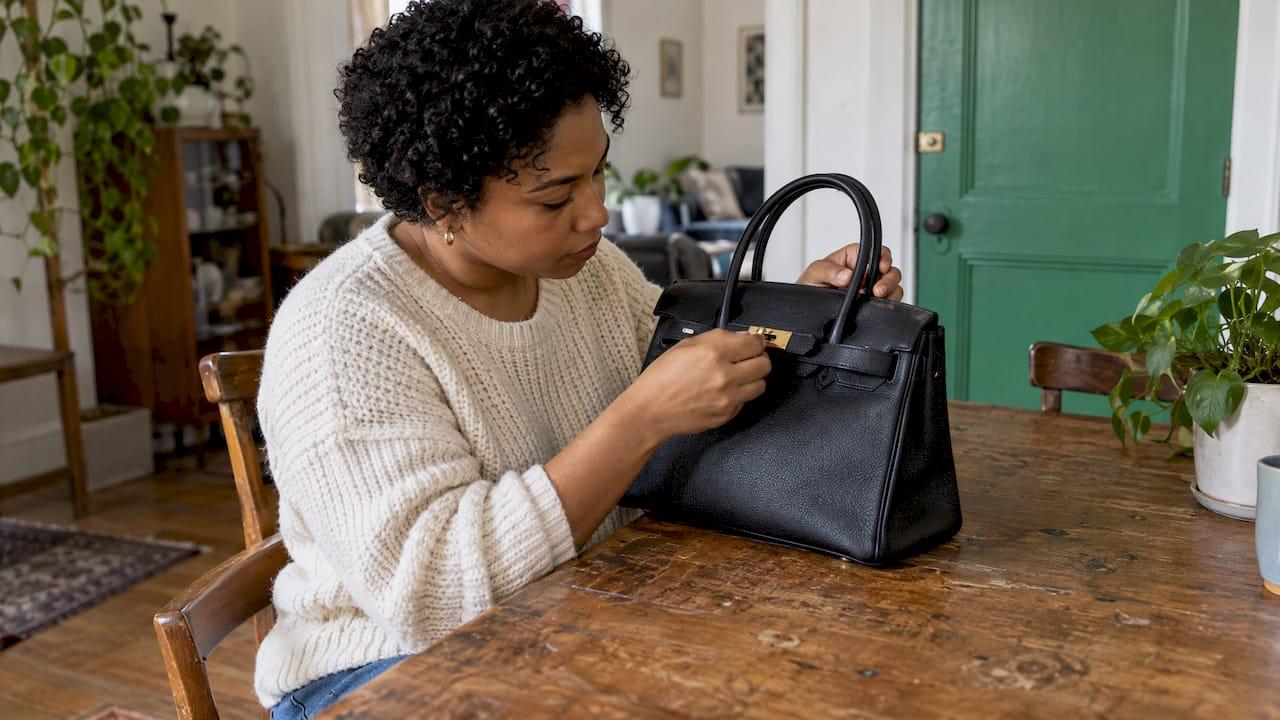
You authenticate a designer bag by identifying the exact model and production period, then checking whether the materials, stitching, hardware, stamps and interior details all agree with that model. No single detail, serial number or paper card settles it. The whole bag has to hold together, and when a high-value bag is at stake, a paid expert opinion is cheap insurance.
This guide walks through the hands-on checks, what a date code can and cannot tell you, when to use a professional service, and how to handle a local sale so you are protected. It also covers selling jewelry locally, because many people clearing out a closet do both.
TL;DR
- Start with the model: size, colour, material and era. Judge every detail against that model, not against a generic idea of "luxury."
- Serial numbers, date codes, boxes, dust bags and authenticity cards are supporting evidence only. Counterfeiters copy them.
- Check materials, stitching, hardware and stamps together. One good detail proves nothing.
- For a high-value bag, pay for a professional opinion before you hand over cash.
- Meet in a busy public place, keep messages and payments on-platform, and compare prices against similar listings.
Table of Contents
- Start by identifying the exact bag
- Materials: how the leather should look and feel
- Stitching and construction
- Hardware: clasps, zippers, feet and plaques
- Stamps, logos and labels
- What serial numbers and date codes can really tell you
- Price and seller: the checks that aren't about the bag
- When to pay for a professional opinion
- We think local buyers have the advantage
- Meeting a local seller safely
- Selling your own designer bag
- Selling jewelry locally
- Sell or buy locally on Marketplace
- FAQ
- Sources
Start by identifying the exact bag
Before you inspect anything, pin down what the bag is supposed to be: brand, model, size, material, colour and the years it was made. Authentication guidance from a 2026 cross-brand guide begins the same way, matching the exact model, size, material, colour and production era before looking at construction, hardware, markings, provenance and price.
This matters because brands change fonts, hardware finishes, stamp wording and lining over the years. A detail that is correct on a 2015 bag can be wrong on a 2023 one. Find clear photos of the same model and era from the brand's own site or reliable catalogues, then compare side by side.
A quick worksheet helps:
- Write down the model name, size and colour the seller claims.
- Note the year or range of years it was sold.
- Save reference photos of the logo, interior label, hardware and stitching on that model.
- Compare each against the bag in front of you or the seller's photos.
Materials: how the leather should look and feel
Leather is where many fakes give themselves away, but also where honest age and wear confuse buyers. Know what the real material should be for that style.
- Texture and grain. Christie's 2026 guides describe, for example, lambskin that should feel buttery and soft, with caviar leather pebbled. Ask whether the leather suits the style and the era.
- Coated canvas. Monogram canvas bags should have a consistent pattern, and the pattern should align at seams and pockets rather than being cut off at random.
- Lining. Interior lining is often where counterfeiters cut corners. For one famous French house, guidance on Hermès bags points to supple leather lining in an official colour that matches the exterior.
- Smell. Treat it as a minor clue. One authentication guide says genuine leather has a subtle scent while fakes may reek of glue or plastic, but adhesives, storage, perfume and cleaning products all change how a bag smells. Never decide on odor alone.
Stitching and construction
Look at the bag the way a repair specialist would. Check stitch size, spacing, thread colour, tension, angle and how corners are turned. Look for loose ends inside.
The standard is brand-specific, not "perfect everywhere." One guide notes that Hermès saddle stitching can look slightly uneven because two needles pass through the same hole, while machine-stitched brands are judged on consistent spacing and tension. On a quilted bag, the diamond pattern should line up and the stitch size should stay consistent across panels.
The RealReal's 2024 guide adds a useful rule of thumb: interior and exterior stitching should be uniform, logos aligned, and sloppy seams or inconsistent fonts are warning signs.
Hardware: clasps, zippers, feet and plaques
Inspect every metal piece: clasps, chains, locks, feet, screws, zipper pulls and logo plaques. Check shape, weight, plating, colour, engraving depth, alignment and how smoothly each part works.
Good signs include hardware that feels substantial, engravings that are crisp, and zippers that glide. But none of these is proof. The same guidance cautions that genuine secondhand bags can have scratches or tarnish, and a heavy feel or a smooth zipper alone cannot prove a bag is real.
Brand-specific details matter here. On many classic Chanel bags, for example, Christie's notes the CC turnlock should have the correct overlap and a rich, consistent colour, and many (not all) classic bags use flathead or star-drive screws rather than Phillips-head screws. If you are not sure what is right for the model, that is a cue to get an expert opinion.
Stamps, logos and labels
Check logo typography, letter spacing, stamp depth and placement, the "Made in" wording, interior labels and pattern alignment. Guidance published in 2026 stresses that a logo or code is not decisive alone: the wording and typography must match the brand's practice at that date.
Also check that interior and exterior stamps match each other. Mismatched stamps, uneven fonts or a stamp pressed too shallow or too deep deserve a closer look.
What serial numbers and date codes can really tell you
People search for how to check the serial number on a bag, and the honest answer is that it narrows things down but never closes the case.
Take Louis Vuitton. A widely used guide explains that date codes identify factory and production timing rather than uniquely identifying a bag. In the 2007-to-present format, a code has two factory letters and four digits, with the first and third digits showing the week and the second and fourth the year. The code may be stamped on an interior leather tab, a D-ring attachment or the lining. The same guide says a correctly formatted code does not prove authenticity, because counterfeiters copy codes.

So use a code for contradictions. If the code says the bag was made in 2012 but the style did not launch until 2019, you have found a red flag. If the code looks right, you have learned very little.
The same goes for everything that comes with the bag. An authenticity checklist for pre-owned luxury says warranty cards, authenticity cards, boxes and dust bags can be bought separately and should be treated as supporting evidence, not proof. It suggests asking for private serial photos, comparing them with paperwork and reading the return policy before you buy. For general serial checks on other goods, see our guide on how to check a serial number before you buy used.
Price and seller: the checks that aren't about the bag
Some of the strongest signals sit outside the leather. The UK government's guidance on spotting fake fashion when shopping second-hand recommends comparing prices with similar listings in similar condition, checking seller feedback and consistency between listing and photos, and looking for detailed original photos of labels, tags and sizes. For high-value fashion, it recommends professional verification. It is a UK source, but the habits apply anywhere.
Practical red flags:
- A price far below comparable listings for the same model and condition.
- Stock photos, or photos that hide the interior label, stamps and hardware.
- A seller who refuses to send extra pictures of the date code, stamps or zipper pulls.
- Pressure to pay off-platform or right now.
- A history of mixed brands or items with no feedback.
Our guide to verifying item authenticity on any marketplace covers the general questions to ask a seller, and the stolen goods warning signs for local buyers is worth a quick read when a deal looks too good.
The habit of matching every detail to a known reference works across collectibles too. If you also hunt for instruments, the steps to authenticate collectible guitars follow the same logic of checking details against the right era.
When to pay for a professional opinion
Your own checks screen out obvious fakes. They do not replace an expert on a bag that costs hundreds or thousands of dollars. Pay for a review when:
- The bag is high value, vintage, or from a brand with many close fakes.
- The seller's photos are incomplete or the paperwork is the main selling point.
- You are not sure whether a detail is correct for the model's era.
- You are buying locally and cannot return the bag easily.
Prices vary by service. As one example, an online service lists handbag authentication at $25 for a 24-hour review, with at least two specialists, a PDF certificate and a refund guarantee if it makes an error. Others require the physical bag in hand, charge by tier and treat photos alone as insufficient, so read how a service works before you pay.
How to judge a service:
- Who reviews? Look for more than one specialist per item. WWD reported in 2023 that one large reseller has every bag examined by at least two people and supervises trainees for at least two years.
- What do you get? A written determination and certificate beats a vague opinion.
- What happens if it is wrong? Look for a stated refund or guarantee policy.
- Does it need the bag in hand? For a local purchase, ask the seller if you can have the bag reviewed before payment, or make the deal conditional on it.
A fair seller with a real bag usually welcomes a reasonable check.
We think local buyers have the advantage
We believe the best way to avoid a fake is to see the bag in person. On Marketplace, buying locally means you can hold the bag, flip it over, run the zipper, read the stamp under good light and ask the seller questions face to face. That is something a shipped package can't offer.
Our platform is built around that: categorized listings, direct buyer and seller chat, verified seller ratings and secure payments, so you can ask for extra photos of labels and hardware before you leave home and keep the conversation in one place. Our guides on verifying authenticity, checking serial numbers and handling returns locally are there to help you set up the deal before you ever meet.
Our advice is simple: use the checklist, ask for the photos, meet in public, and bring your phone with reference images of the model.
Marketplace
Meeting a local seller safely
A safe meetup is part of authentication, because you want time to inspect without feeling rushed. The Better Business Bureau recommends meeting local buyers in a busy public place or police safe-exchange area, bringing a friend, withholding your home address and avoiding having buyers enter your home unless necessary. The same guidance advises keeping messages and payments on-platform, understanding fees, refunds, disputes and chargebacks, and waiting until payment clears.
A simple routine for buyers:
- Ask for photos of the interior label, stamps, date code, hardware and stitching before you travel.
- Meet in daylight in a busy spot, with your reference photos ready.
- Inspect every item on the list above before paying.
- Pay through a protected method, not a code or transfer a stranger asks for.
If you buy secondhand fashion regularly, our guide to buying secondhand clothes that last has more local shopping habits, and handling returns locally explains how to agree terms in advance.
Selling your own designer bag
Authentication works for sellers too. A bag with clear photos of the stamps, date code, hardware and interior builds trust and shortens the time to sale. List the model, size, colour and condition honestly, mention any wear, and price against similar listings. Our guide on pricing used items so they sell shows how.
If your bag is high value, a professional certificate can reassure serious buyers. Keep any receipt or card, but remember buyers will treat them as supporting evidence.
Selling jewelry locally
Many readers clearing out a closet also have jewelry to sell. The principles overlap: get a fair read on value, and complete the sale safely.
The BBB's tips for buying and selling jewelry recommend getting four or five estimates, obtaining a professional appraisal for high-value or vintage pieces, separating pieces by karat before weighing, and checking buyer credentials or reviews. It also reminds sellers that resale value can be lower than retail value. That applies to gold jewelry sold for its metal content and to designer pieces alike.
When choosing an app or platform to sell jewelry, check:
- Fees: what is taken from each sale and when.
- Payment protection: whether you are paid through the platform's own system.
- Dispute policy: how refunds, disputes and chargebacks are handled. The BBB's online-selling guidance lists these as things to understand first.
- Local features: location-based search, instant chat and a way to arrange a public meetup.
For valuable pieces, meet in a safe public spot, avoid verification-code scams and don't release the item until payment clears.
Sell or buy locally on Marketplace
If you have a bag, jewelry or other items to move, or you want to find a deal nearby, Marketplace lets you browse and list across categories including Fashion, Electronics, Home & Garden and more. You get categorized listings, direct chat with buyers and sellers, verified seller ratings, secure payments and a mobile app with push notifications and location-based search. Our fast listing process is designed to make turning unused items into cash simple.
Browse or list items on Marketplace and put the checklist above to work on your next local deal.
FAQ
How do I authenticate a designer bag at home?
Identify the exact model and year, then compare materials, stitching, hardware, stamps and interior labels against reliable reference photos of that model. Judge them together, since no single detail proves authenticity. For high-value bags, add a professional opinion.
Does a serial number or date code prove a bag is real?
No. A code can reveal a contradiction, such as a date before the style existed, but counterfeiters copy correctly formatted codes. Treat it, and any card, box or dust bag, as supporting evidence.
Are authentication apps and services worth it?
For a costly or vintage bag, usually yes. Prices run from about $25 for a quick online review at one service, and some require the physical bag. Check how many specialists review it, what certificate you get and what happens if the service is wrong.
Can I rely on smell and hardware weight?
Only as small clues. Adhesives, storage, perfume and cleaning products change odor, and genuine used bags can have scratched or tarnished hardware. Weight and smoothness alone can't prove a bag is real.
What is the safest way to buy a designer bag locally?
Ask for detailed photos of labels, stamps and hardware before meeting. Meet in a busy public place, inspect the bag in good light and keep payment on-platform. Compare the price with similar listings, because a deal far below market is a warning sign.
Sources
- Luxury Handbag Authentication: Complete Guide
- Chanel handbag authentication guide, Christie's
- Hermès handbag authentication guide, Christie's
- How to Authenticate a Chanel or Hermès Bag
- Luxury Bag Authentication: What Experts Actually Check
- All About Luxury Authentication & Resale
- Authenticating a bag: the real criteria
- A Guide to Analyzing Louis Vuitton Date Codes
- Authenticity Checklist for Pre-Owned Luxury
- How to spot fake fashion when shopping second-hand, GOV.UK
- Luxury Authentication Services
- Fashionphile Teaches How to Authenticate a Louis Vuitton Bag, WWD
- BBB Tip: Decluttering? Tips for selling your used items online
- BBB Tip: Buying and selling jewelry
- Authenticate collectible guitars