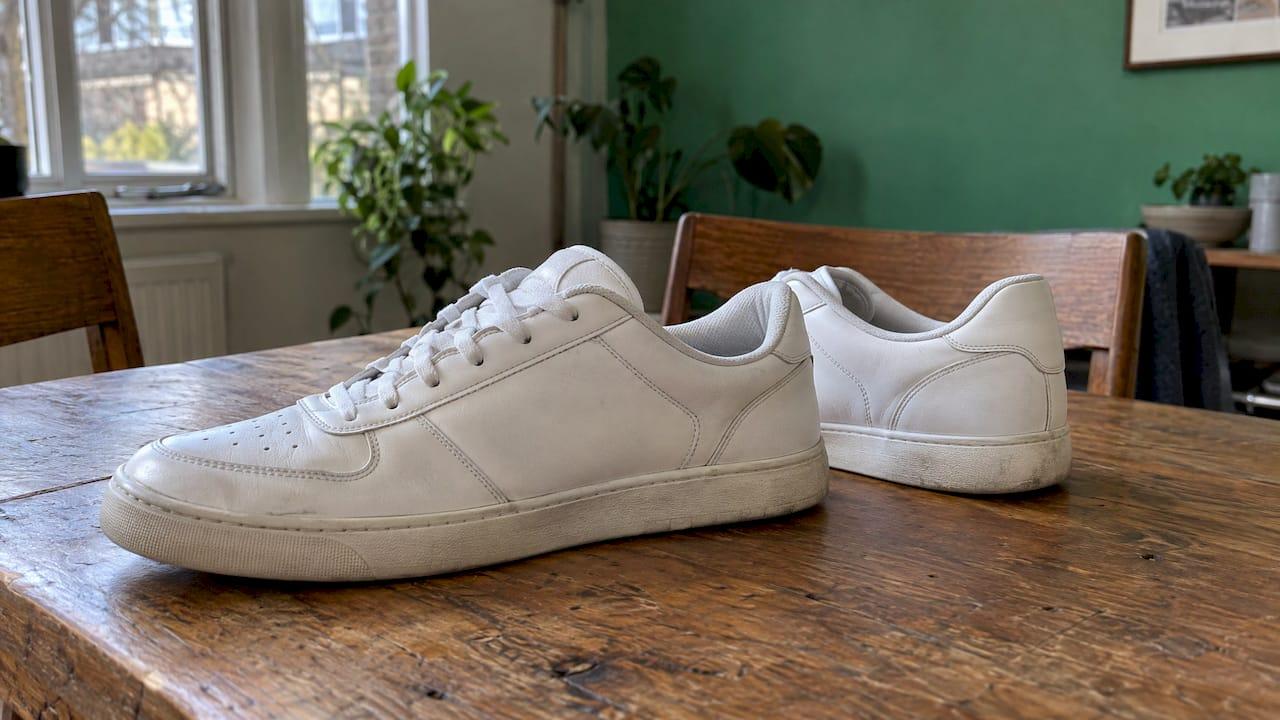
No single detail proves a pair is fake. Real sneakers are checked as a whole: you identify the exact release, compare the pair to a trusted reference, and weigh several details together. Buying locally gives you an edge here, because you can hold the shoes, turn them over and compare them with photos on your phone before any money changes hands. On Marketplaceapp, the in-person meetup is the step where this checklist does the most work.
TL;DR
- Find the style code first, then compare the pair against retail photos of that exact release, never against memory.
- One flaw proves little. Several things off at once (shape, stitching, logo, label) usually mean a fake.
- A QR code, a barcode or a nice box does not prove the shoe inside is real. Boxes and labels get copied and swapped.
- A price far below market, a brand-new account or a seller who dodges photo requests are reasons to ask for more evidence or walk away.
- Meet in person, inspect before you pay, and pay in a way that protects you.
Table of Contents
- Start with the exact release
- Shape, stitching and materials
- Box, labels and codes
- Reading listing photos before you meet
- Seller and price clues
- Inspecting the pair in person
- If you're the seller
- Find sneakers nearby on Marketplaceapp
- Our perspective
- FAQ
- Sources
Start with the exact release
Most mistakes happen because people compare a shoe to the wrong reference. A Jordan 1 High, a Jordan 1 Mid and a Jordan 1 Low differ in many details, and the same model can change between releases. The core method in SneakerIdentifier's legit-check guide is simple: identify the exact release by its style code, get a trusted reference, compare detail by detail, then weigh the evidence.
The style code is the short alphanumeric string on the tongue or inside label. Type it into a search engine and you land on retailer pages and photos of the pair as released. Good references are:
- the brand's or an authorized retailer's product page for that code
- photos from a reputable resale listing of the same code
- a pair you know is genuine, if you own one
Save a few of these images to your phone before you meet the seller. You will use them side by side.
Shape, stitching and materials
Shape and stance
Shape is the hardest thing to copy, because it depends on the brand's own lasts and moulds (the forms a shoe is built around). Verifai's guide lists what to compare: the height and curve of the toe box, the heel profile seen from behind, the height, padding and angle of the collar and tongue, and where the logo sits relative to the panels around it.
Place the shoe on a flat surface and look from the side and from behind. Compare it with the reference photo. A toe box that looks too boxy or too flat, or a heel that leans or curves differently, is a strong signal.
Stitching
Look for even stitch length, straight lines and a consistent distance from the panel edge. Wandering lines, uneven spacing and loose threads are red flags. Keep perspective, though: retail pairs aren't flawless, so one messy stitch is normal. Messy stitching across the whole shoe is not, according to the same SneakerIdentifier guide.
Materials and glue
Compare the leather or suede grain and the weight of the shoe with what you expect for the release. SneakerIdentifier also suggests noticing a harsh solvent smell when you open the box. Check for glue as well. The Shoemakers Academy inspection cheat sheet limits extra glue on the upper to 2 mm and tells inspectors to look for color bleeding between color blocks, paint covering mistakes and rubber blooming, a chalky white film on rubber parts.
Symmetry
The same cheat sheet suggests lining the two shoes up side by side. Toe caps, vamps, overlays, eye stays and eyelets should match, the tongues should be attached straight at the same height, and the upper should not be rotated off-center. Logos that differ noticeably between the left and right shoe are another warning sign.
Soles and logos
Check the outsole for the correct tread pattern and clean edges. Model details help here: SneakerIdentifier points to the toe stars on an Air Force 1 sole as one thing to compare. For logos, look at shape, size, placement and symmetry:
- a Swoosh with the wrong curve or tip position
- a Jumpman with odd proportions
- Three Stripes that are unevenly spaced
- an "N" logo with thin or gappy fill
A UV flashlight can reveal pen guide lines or glowing glue marks on some fakes. Verifai notes that genuine pairs can glow in places too, so only compare the glow against a known-genuine pair and never judge it alone.
Box, labels and codes
The label is where many sellers and buyers get a false sense of security. Treat it as one check among many.
What to check on the labels
Legitcheck.net gives countable checks you can run in a minute:
| Check | What it should show |
|---|---|
| Tongue label | 3 to 4 sizing rows (US, UK, EU, cm) in a fixed order |
| Product code length | Nike nine characters, adidas six, New Balance seven or eight |
| Code consistency | The same code on the size label, the box end label and the brand's product page |
| Retail box label | Model name, style code, a four-system size block, colorway wording and a size-specific barcode |
Inside the shoe, where many fakes cut corners, Verifai says the size label should be printed cleanly in the brand's font, the style code, size and country of manufacture should match the box, the insole logo should be sharp and centered, and production dates on the label should fit the release.
If you have the box, the Shoemakers Academy cheat sheet adds a few more points: the correct inner box for the model, an undamaged box, an end label that matches the shoe's color, model and size, correct hangtags, and a matching left and right shoe.

What a box, barcode or QR code can't prove
SneakerIdentifier warns that a real box proves nothing about the shoe inside, because boxes are swapped and faked separately. It also says a barcode that scans correctly is not proof, since counterfeiters copy real UPCs.
The same goes for QR codes. Legitcheck.net states that a QR code proves only where it points, and a link to a generic homepage is no evidence at all. SneakerLens adds that a scan identifies label data but does not prove authenticity, because copied or switched labels can return plausible information for the wrong item. The useful part of a scan is the comparison: does the returned style code, model, colorway and size match both labels and the shoe in your hands? A mismatch is a reason to recheck everything.

Reading listing photos before you meet
Most deals start with photos, and photos are where you can filter out a lot of bad listings in two minutes. A listing that proves its case shows the details authenticators look at. The FAKEBUSTERS photo guide lists the shots an authenticator needs:
- full views of the sneaker from every side
- a close-up of the heel logo and the outsole logo
- the insole, top and bottom
- midsole stitching, taken as close as the phone will focus
- the label tag inside the shoe and the box size label
- the box lid, any tags or QC stickers, and a receipt if there is one
If a listing has only studio-style or stock images, ask for these. A seller who owns the pair can take them in five minutes. Sellers who refuse, stall or say the pair is already packed are telling you something. One more tip: ask for a short video of the pair being turned in the hand, with a piece of paper showing today's date in frame. Video is harder to fake than a still photo.
Don't lean on receipts. A receipt photo is easy to fake or reuse, so judge the shoes, not the paper.
Our guide to verifying item authenticity on any marketplace covers the same habits for other categories, and the one on authenticating designer bags shows how the method carries over to another product.
Seller and price clues
Price is the loudest signal. StreetIconic's rule of thumb is that the bigger the gap between the asking price and the normal market price, the more evidence you should require. A $300 pair offered at $50 with no credible reason deserves a closer look.
The same page lists seller patterns that call for extra care:
- an expensive item from a very new account with little history
- copied product photos or stock images instead of photos of the actual pair
- a refusal to send detailed photos
- pressure to pay immediately
- positive feedback made up mostly of unrelated, low-cost items
A simple way to use all this is the five-area check: seller, construction, labels, release details, and price. If two or three of those areas disagree with your references, stop. This is also why a seller's rating history matters. On our platform you can look at a seller's ratings and talk through the details in chat before you ever agree to meet.
Inspecting the pair in person
A local deal lets you do what shipped purchases can't. Here is a routine that takes about five minutes.
- Bring references. Have the style code and three or four retail photos saved on your phone.
- Match the code. Read the tongue or inside label and confirm the style code, then match it to the box if there is one.
- Check shape. Set the pair on a table. Look at the toe box, the heel from behind and the collar height against the reference.
- Check symmetry. Compare left and right: logos, stitching, eyelets, tongue height.
- Flip them over. Look at the tread pattern, the sole edges and any chalky film on the rubber.
- Smell and feel. A strong chemical odor, thin or plasticky material or sloppy glue lines are reasons to pause.
- Weigh it up. One small flaw means little. Several together mean walk away.
Meet in a public place with good light. Our online classifieds safety guide covers meetup basics for buyers and sellers, and the piece on local selling scams explains the tricks to watch for before you hand over an item.
Payment matters too. The Federal Trade Commission says to avoid gift cards, cash reload cards and cryptocurrency when buying from an online marketplace, because paying that way is like sending cash and you generally can't get it back. It recommends safer methods such as credit cards, which carry legal protections.
If you're the seller
Selling a real pair? Make it easy to trust. Photograph every detail in the list above, including the label tag, insole, heel and outsole, and show the box label if you kept the box. Say where and when you bought the pair, since evasive answers on this point are what make buyers suspicious. Our guide to listing descriptions that actually sell shows how to write the details buyers look for, and the best shoe selling app guide walks through selling shoes to local buyers.
If you're clearing a closet, only list what you know is genuine. A pair you can't vouch for is a pair that costs you a dispute.
Find sneakers nearby on Marketplaceapp
Marketplaceapp is a peer-to-peer marketplace for buying and selling used and new items locally, with categories including Fashion, Hobbies and Home & Garden. The platform offers verified seller ratings, secure payments, instant chat and location-based search, so you can ask for extra photos, agree a meetup and inspect the pair in person. Browse local listings on Marketplaceapp or list the pairs you no longer wear.
Our perspective
Most fake sneakers get sold to people who skipped a conversation. Buyers rush because the price looks great, and sellers go quiet when asked for a close-up of the label. Local trade fixes much of that. You talk first, you see the pair in daylight, and you hold it next to a reference photo.
That is why we built Marketplaceapp around direct communication between buyers and sellers, verified seller ratings and location-based search. A good deal should survive a few questions and a five-minute inspection. If it does, you both walk away happy, and if it doesn't, you've lost nothing.
Our guides on authenticity, pricing and safe transactions are there for the same reason: a confident buyer and an honest seller make a faster sale.
Marketplace
FAQ
Can I tell if sneakers are fake from photos alone?
You can rule a lot out, but not everything in. Ask for close-ups of the heel, insole, label tag, outsole and box label, and compare them with retail photos of the same style code. If the seller can't or won't provide them, treat that as a warning. Confirm the final answer in person.
Does a QR code or barcode scan prove the shoes are real?
No. A scan only shows what data the label returns, and copied or switched labels can return plausible information for the wrong item. Use it to check that the style code, model, colorway and size match the shoe and box, then judge the shoe itself.
What's the most important thing to check first?
The style code. It tells you which exact release you're looking at, so you can compare shape, stitching, logos and sole with the correct reference. Checking against the wrong model produces both false alarms and missed fakes.
Is a price below retail always a sign of a fake?
Not always, since used pairs legitimately sell below retail. A price far below the going market rate for that release is the signal, and the larger the gap, the more proof you should ask for before paying.
Sources
- How to Authenticate Sneakers: The Complete Legit Check Guide, SneakerIdentifier
- How to Tell If Sneakers Are Fake: Legit Check Guide, Verifai
- Quality and Inspection Cheat Sheet, Shoemakers Academy
- How To Tell If Shoes Are Fake: 8 Measured Checks, Legitcheck.net
- How to Scan a Sneaker Barcode or QR Code, SneakerLens
- Photo instructions, FAKEBUSTERS
- How to Spot Fake Streetwear Before You Buy, StreetIconic
- Buying From an Online Marketplace, Federal Trade Commission