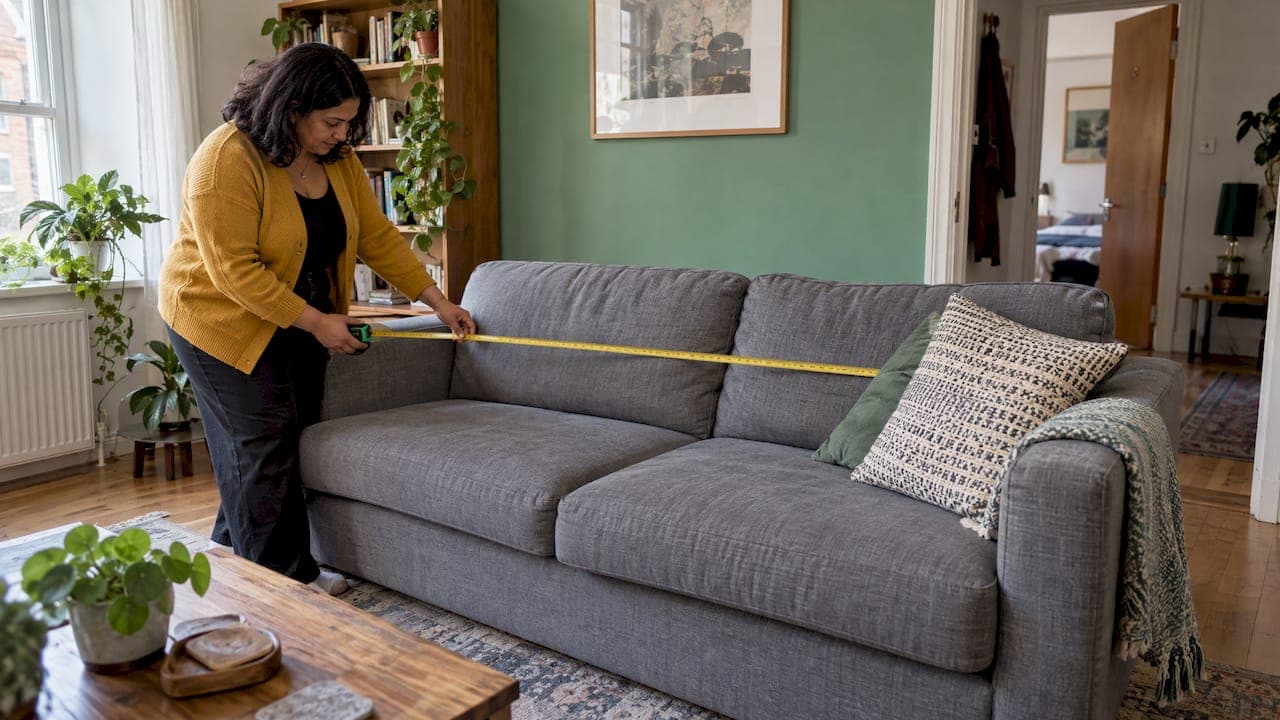
To measure furniture for pickup, you need three sets of numbers: the piece itself (width, depth, height and diagonal depth), every opening it must pass through (doors, hallways, stairs, elevators), and the vehicle that will carry it away. Write them down, compare them with a one-inch safety margin, and put the piece's numbers in your listing. That's the whole method. The rest of this guide shows how to do each part without a second trip, a scratched doorframe or a buyer standing on your porch with a couch that won't leave.
Most guides online are written for people receiving a delivery. Pickup is different. You are often the seller, the buyer is a neighbor with a pickup truck or a borrowed SUV, and nobody from a delivery crew is coming to solve the problem. So the numbers have to be right before the meetup.
TL;DR
- Measure four things on the item: width, depth, height and diagonal depth. Post them in the listing.
- Measure the narrowest point of every opening on the path out, not the nominal door size. Handles, baseboards and light fixtures can take 1 to 2 inches.
- Tape the item's footprint on the floor and test the turns before the buyer arrives.
- Check the vehicle's cargo space, and confirm the buyer's plan for lifting, strapping and a second person.
- If it doesn't fit, take the legs off, remove the doors, or reconsider pickup. Use a tape measure for tight calls, not a phone app.
Table of Contents
- Why pickup measuring goes wrong
- What you need before you start
- Step 1: Measure the piece itself
- Step 2: Measure the path out
- Step 3: Will the sofa fit through the door?
- Step 4: Measure the vehicle
- Step 5: Plan the lift and the handoff
- Can your phone measure it instead?
- Perspective: why accurate numbers sell furniture faster
- Put the numbers in your listing
- When the piece won't fit: your options
- A quick checklist you can screenshot
- FAQ
- Sources
Why pickup measuring goes wrong
The usual failure isn't a bad tape measure. It's a missing step. People measure the sofa, see that it is 84 inches long, and assume the job is done. Then it meets a 30-inch bedroom door, a banister, or a landing where there is no room to pivot.
There are three separate questions, and each one can sink a pickup:
- Does it fit out of your home? This covers the path from the room it sits in to the street.
- Does it fit in the vehicle? This covers bed length, cargo height, tailgate clearance and the way it will be strapped.
- Will it fit where it's going? The buyer needs the same check at the other end, which is why accurate dimensions in your listing save both sides time.
A useful habit from the research: treat measurements as part of being honest about the item. Advice on selling furniture stresses that accurate measurements and clear photos of any wear manage expectations, because local buyers and charity drivers will refuse items that don't match what was described or can't physically be reached.
What you need before you start
You don't need much:
- A metal tape measure, at least 16 feet. Cloth tapes sag and flex.
- Painter's tape or masking tape to mark footprints on the floor.
- A notepad or your phone's notes app.
- A helper for long pieces. Holding the end of a tape across a six-foot sofa alone is how errors creep in.
- A flashlight, if you are checking a dark stairwell or basement exit.
Round every measurement up for the item and down for the openings. That one rule builds in a margin automatically.
Step 1: Measure the piece itself
Start with the item. Don't trust the manufacturer's spec sheet if the piece is secondhand, since cushions settle, legs get swapped and sectionals get rearranged.
The four numbers
| Measurement | How to take it | Why it matters |
|---|---|---|
| Width (W) | Widest point left to right, including arms | Decides the front-on fit through doors |
| Depth (D) | Front to back at the deepest point | Decides whether it can turn on its side |
| Height (H) | Floor to the top of the highest point | Matters for ceilings, stair headroom, vehicle roofs |
| Diagonal depth (DD) | From the back lower corner to the top front of the arm or back, as in the guides below | The limiting number for tight turns |
The diagonal figure is the one people skip. Guidance on moving couches explains that the diagonal depth, measured from the back lower corner to the midpoint of the top back and armrest, is often the limiting factor when an item has to get through a stairwell or around a tight turn. A sofa that is 36 inches deep can still need a good deal more room than that when it is tipped upright.
Note what comes off
Before you move on, check what can be removed to shrink the piece:
- Legs that unscrew from a sofa or bed frame
- Cushions and loose backs
- Drawers from a dresser (this also cuts weight)
- Doors from a wardrobe or hutch
- Table leaves and pedestal bases
- Shelves from a bookcase
Write down the smaller numbers too. "Seat back removed: 31 inches deep" is exactly the kind of detail that makes a buyer say yes.
Step 2: Measure the path out
Now walk the route the item will take, starting at its current spot and ending at the front door, garage or curb. The pages that rank for this topic agree on the principle: measure the height and width of every hallway the item will pass through. Do the same for every doorway, staircase and elevator.
Doorways: measure the clear opening
The number on the door or in your head is nominal. What counts is the clear width: the distance between the open door edge and the opposite frame. Measure the narrowest point of the opening, as the clear opening from frame edge to frame edge, not the nominal door size.
For reference, the standard interior door in most US homes is 32 inches wide by 80 inches tall, with bedrooms often at 30 to 32 inches and bathrooms and closets narrower. Your house may be older or newer than that standard, so measure anyway.
Two tricks help:
- Take the door off its hinges. Pulling the hinge pins typically gives back an inch or so of width, because the open door no longer sits in the opening. It takes five minutes.
- Measure at the handle height and at the floor. Door hardware, trim and thresholds all reduce the opening.
Hidden obstructions
These are the ones that stop a move halfway:
- Door handles and deadbolts
- Baseboards and decorative molding
- Wall sconces and light fixtures
- Thermostats and smoke detectors
- Banisters and newel posts
- Low ceilings in basements and over stairs
One reference suggests these can rob you of 1 to 2 inches of clearance at critical pinch points. Subtract that from your clear width before comparing numbers.
Hallways, corners and landings
A hallway can be wide enough and still be impossible if it has a 90-degree turn. For each corner, measure the hallway width on both sides, then check whether there is room to rotate the piece. Look specifically for the pivot space: the open floor area where the item can swing around.
For stairs, measure:
- Stair width, wall to banister
- Headroom at the lowest ceiling point above the stairs
- Landing size, where the staircase turns
- The number of steps, since it affects how many people you need
A guide to home moves recommends measuring doorways, hallways and staircases to find the best exit and entry route before anyone lifts anything. Moving teams generally can't lift heavy items above chest height safely, which limits tricks like tilting a piece over a railing.
Elevators and apartment buildings
If you live in an apartment, measure the elevator's door opening and interior depth, then call the building manager. Many buildings require reservations for a service elevator, and some limit move times. Mention that to the buyer so they don't show up at the wrong hour.
Step 3: Will the sofa fit through the door?
Here is the question people actually type. The answer depends on rotation.
A rigid 40-inch-wide piece will not go straight through a 32-inch opening, since the width exceeds the gap. But if the sofa's depth or height is smaller than the door's clear width, you can often angle or rotate it through. Think of it this way:
- Tip a sofa up on its end so the height or depth leads through the opening.
- Pivot it through at an angle so the diagonal passes the frame one corner at a time.
- Remove the legs to shave an inch or two off the smallest dimension.
A worked example
Suppose a loveseat measures 58 inches wide, 34 inches deep, 33 inches high, and the front door is 36 inches wide with a 33-inch clear width after the handle and trim.
- Its narrowest dimension is 33 inches (height). Your opening is 33 inches. That is a tie, and a tie is a fail.
- Remove the legs: height drops to 28 inches. Now you have 5 inches of margin.
- Stand it on its side and carry it through with the arm leading.
- Check that the hallway beyond has room to bring it back flat.
Margins matter here. One calculator treats anything within about ¾ inch (2 cm) as tight, and a guide, not a guarantee, since door handles, banisters and the people carrying it all play a part. Aim for at least an inch of spare room at the tightest point.
Tape out the footprint
The simplest test is physical. Lay down painter's tape on the floor to mark the piece's width and depth, then walk the route with that footprint in mind. Mark the turn points too. It takes ten minutes and reveals problems no tape-measure number will.
Step 4: Measure the vehicle
A buyer's vehicle is half of a pickup. Ask what they're driving and compare it with your item's dimensions.
- Pickup truck bed: measure the bed length and the width between the wheel wells. A standard sheet-style piece such as a dresser usually sits fine, but a long sofa may hang over the tailgate and need to be strapped down properly.
- SUV or minivan: check cargo length with the seats folded and the opening height at the rear hatch.
- Sedan: be honest. Most sedans can take small tables, chairs and boxed flat-pack items, and not much else.
- Trailer or rental van: ask for the interior dimensions and loading height.
Give the buyer the numbers in advance. A message like "84 inches long, 36 deep, 33 high, legs unscrew" lets them check their own car before driving over. You can do much of this in advance by chat, which is part of why local pickup works best when the details are settled before the meetup.
Step 5: Plan the lift and the handoff
The fit is only the first half. Before the buyer arrives:
- Clear the path. Move rugs, shoes, plants and anything breakable.
- Prop doors open and remove any that block the opening.
- Wrap or pad the piece with blankets and tape to protect your walls and theirs.
- Agree on who carries. Ask the buyer to bring a second adult for anything heavy.
- Set a time window, especially in apartments with elevator rules.
On safety, keep first meetups simple: have another person at home, keep the item near the exit and finish payment before it leaves. Our guide to safer local meetups walks through the different handoff styles and the checks that go with each.
Can your phone measure it instead?
Apps are fine for a quick look, not for the final call. Augmented-reality tools such as Apple's Measure can estimate dimensions but aren't intended for precision work. The same source reports that LiDAR-equipped iPhones (iPhone 12 Pro and later) get within roughly 1 to 2 cm, while standard camera-based AR is accurate to about 3 to 5 cm, and it notes that Google's own Measure app has been discontinued.
A 5 cm error is about 2 inches, which is more than the margin on most tight doorways. So use the app to size up a room, and use a tape measure to decide whether a piece clears a door.

Perspective: why accurate numbers sell furniture faster
We see the same pattern in local listings again and again. The sofa isn't the problem. The unanswered question is. A buyer who can't tell whether a couch fits their stairwell either skips the listing or asks the question in chat, and a seller who answers late loses the sale to the listing that answered it up front.

That's why we think of measuring as part of the listing, not a chore before pickup. Width, depth, height and diagonal depth belong right under the photos. So does a line like "legs unscrew" or "fits through a standard 32-inch door." Buyers read that as a sign of a careful seller, and careful sellers get messages from serious buyers.
We also think pickup should be treated as a plan, not an event. Measure first, message the buyer the numbers, agree on the vehicle and the time, then meet. When all four are set, the handoff takes ten minutes and nobody gets hurt or annoyed. Our own guides on selling furniture locally and taking better listing photos follow the same idea: remove every reason for a buyer to hesitate.
— Marketplace
Put the numbers in your listing
Once you have measurements, share them where buyers will see them. On Marketplaceapp you can list furniture, home and garden items, electronics and more, chat with nearby buyers directly, and arrange a local handoff without shipping. Add your dimensions to the description, show any wear in the photos, and your pickup questions are answered before they are asked. Browse the categories or start a listing at Marketplaceapp.
Pricing is the other half of a quick sale. If you aren't sure where to start, see how to price used items so they sell.
When the piece won't fit: your options
Sometimes the math says no. You have a handful of choices.
- Disassemble. Remove legs, doors, drawers, shelves and cushions. Bag and label the hardware and tape it to the piece.
- Remove obstacles. Take the door off, unscrew a light fixture, or take down a stair-side handrail if it is removable and safe to do so.
- Change the exit. A patio door, a garage or a window may be wider than the front door.
- Sell it in parts. A sectional can often be separated into modules and sold as a set.
- Pick a different buyer. Some people have the tools and experience to take a piece apart. Say so in the listing.
- Rethink the item. Heavy, damaged or outdated furniture may not be worth the effort.
On that last point, condition changes everything. Visible stains, structural damage or pet hair mean most charities will refuse a piece, which shifts your plan to paid junk removal or municipal bulky-waste pickup. Don't just leave it at the curb either: many cities have strict rules on timing and mattress wrapping, and breaking them can bring fines of $300 to $400 for illegal dumping. Check your city's sanitation page for the current rules before you put anything out.
Is moving it worth it?
If you are relocating rather than selling, weigh the cost. One moving guide gives a rough guide of $0.50 to $1.00 per pound on long-distance moves, and suggests comparing that with the price of replacing the item new. Heavy flat-pack furniture is often cheaper to sell nearby and replace than to haul more than 1,000 miles. If that's your situation, decluttering for cash is a practical route.
A quick checklist you can screenshot
- Measure item: W, D, H and diagonal depth.
- Note which parts come off.
- Measure the clear width and height of every door on the route.
- Subtract 1 to 2 inches for handles, trim and fixtures.
- Measure hallway corners, stairs, landings and the elevator.
- Tape the footprint on the floor and walk the route.
- Share the dimensions with the buyer and ask about the vehicle.
- Clear the path, pad the piece and agree on a time.
- Confirm payment and the handoff plan before anything is lifted.
FAQ
Will a 40-inch-wide sofa fit through a 32-inch door?
Not straight on, because the width is larger than the opening. It may still pass if its depth or height is smaller than the door's clear width, so you can tip or angle it through. Remove the legs and the door, then measure again.
What is the 2/3 rule for furniture?
It's a design guideline, not a law: in a living room, a sofa should be about two-thirds the length of the wall it sits against. It helps with visual balance in the room, not with getting furniture through a door.
Is there an app that can measure furniture?
Yes, AR measuring apps exist, and LiDAR iPhones are noticeably more accurate than camera-only phones. Even so, a physical tape measure remains the better choice for anything that is a tight fit.
How far in advance should I measure before pickup?
Do it when you write the listing. That way the numbers are in the description, buyers can check them against their vehicle and home, and you only need to double-check the path on the day.
What is the cheapest way to get rid of unwanted furniture?
Donation or a free municipal bulky-waste collection is usually cheapest, though costs vary widely by city. Charities typically take only furniture in good, resalable condition, so stained or damaged pieces usually need a paid removal service. Selling locally can even put money in your pocket.
Sources
- Will my sofa fit through the door? Free calculator
- Will It Fit Through the Door? Free Doorway Calculator
- How to Measure Furniture for Delivery: A Guide
- Standard Interior Door Sizes Guide
- How To Move Furniture
- Free measurement apps 2026
- How to Get Rid of Old Furniture in NYC (2026 Guide)
- What to Leave Behind When Moving