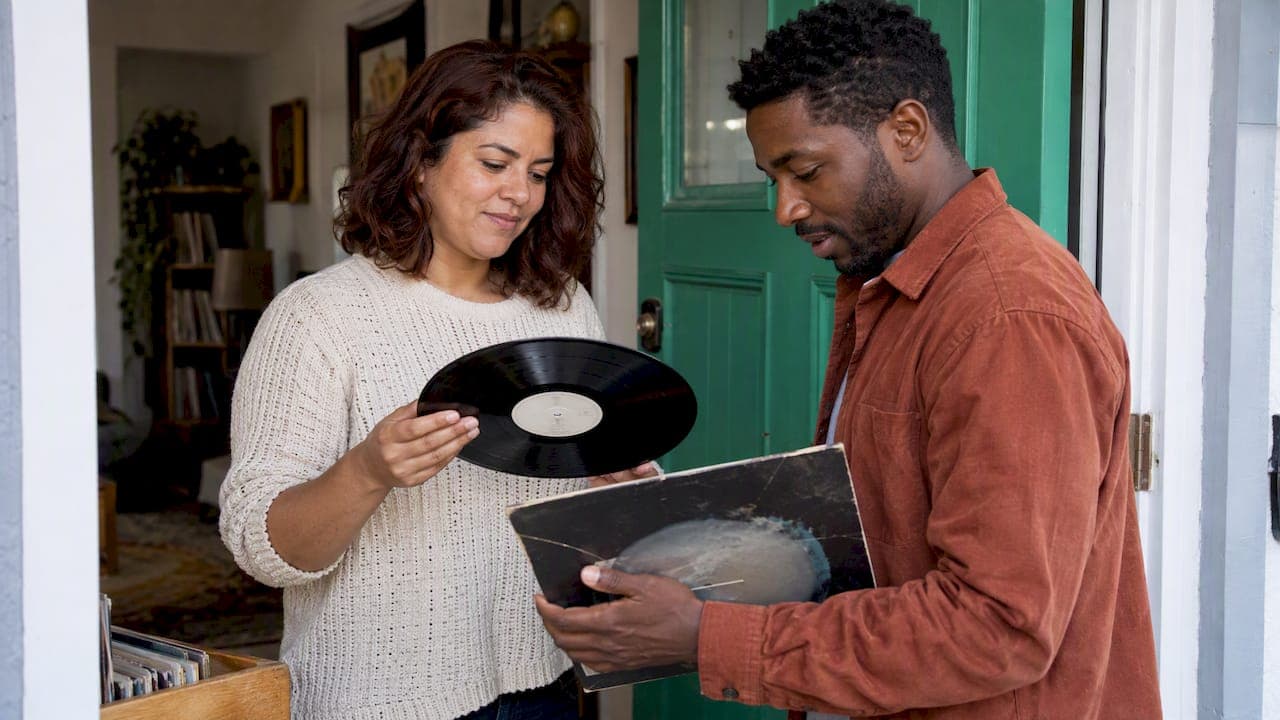
The best way to sell vinyl records locally is to grade them honestly, price them from what similar copies have actually sold for, and match the buyer to the collection: a neighbor or collector for the records you want top dollar on, a local shop for a fast bulk sale. Do those three things and you will beat the typical "I'll take them all for $50" offer by a wide margin. This guide walks through the whole process, from cleaning and grading to pricing, listing, meeting the buyer and getting paid.
TL;DR
- Sort first: pull out the 20 or so records most likely to be worth real money and sell those individually; sell the rest as lots.
- Grade the disc and the sleeve separately, and grade conservatively. Describing a flaw up front prevents a haggle at the door.
- Price from sold listings for the same pressing, not from asking prices. Check the runout etching and catalog number to identify the pressing.
- Local selling means no shipping and no packing, but meet in a public place or a police-designated exchange zone, in daylight.
- Get payment in hand before the records leave, and keep a written list for any large collection.
Table of Contents
- Where local selling beats the alternatives
- Step 1: Sort before you do anything else
- Step 2: Clean and store the records properly
- Step 3: Grade the disc and the sleeve honestly
- Step 4: Identify the exact pressing
- Step 5: Price from sold listings, not asking prices
- Step 6: Single records or a whole collection?
- Step 7: Write a listing that sells
- Perspective: what we see from the local selling side
- List your records where local buyers are already looking
- Step 8: Meet the buyer safely
- Step 9: Get paid properly and close the sale
- Other items that go with records
- Common mistakes that cost sellers money
- FAQ
- Sources
Where local selling beats the alternatives
Vinyl is heavy, fragile and awkward to ship. A single LP in a mailer can arrive with a split seam or a warped disc, and then you are handling a dispute over a $15 record. Selling locally removes that whole category of problem. The buyer inspects the record in person, you skip packaging and postage, and the money changes hands the same day.
The trade-off is a smaller pool of buyers. A national audience will pay more for a rare title; your zip code may not contain anyone who wants it. That is why the smart approach is to split your collection and use more than one route.
There are four realistic local routes:
| Route | Speed | Typical return | Best for |
|---|---|---|---|
| Local record shop | Same day | Lowest per record, since the shop must resell at a margin | Large, mixed collections you want gone |
| Record fair or swap meet | One weekend | Better, since several dealers and collectors see your crates | 100+ records with a few good ones |
| Local marketplace listing | Days to weeks | Highest per record among local options | Individual records and curated lots |
| Neighbors, friends, local buy-sell groups | Variable | Fair, and often easy | Quick one-off sales; see our guide to local buy-sell groups |
Shops usually pay a fraction of what they expect to resell a record for, because they carry the cost of inventory, rent and the records that never sell. That is a fair business model, not a scam, but it means you give up value in exchange for speed. If your collection is a few hundred common records, a shop offer can be a reasonable deal. If you have a handful of sought-after titles, selling those separately is where the money is.
Step 1: Sort before you do anything else
Spread the collection out and sort it into three piles.
- Likely valuable. Original pressings from the 1950s to the 1970s, limited editions, colored vinyl, jazz and soul on well-known labels, early hip-hop and punk, anything signed, and anything you cannot find in a quick online check.
- Solid sellers. Classic rock, pop and soul staples in good shape. They sell steadily but for modest prices.
- Bulk. Scratched, water-stained, club-edition and heavily played records, plus the common titles that turn up in every thrift store (many Christmas albums, easy-listening compilations and mass-produced sets fall here).
Be realistic about pile three. Some of it will not sell at any price. Offer it free in a box on your curb or donate it, and do not let it bog down the sale of the rest.
Step 2: Clean and store the records properly
A clean record sells faster and for more. Dry-brush off surface dust, and wipe the sleeves. Do not use household cleaners on the vinyl itself.
How you store records until the sale matters too. The Library of Congress advises keeping grooved discs upright, with sturdy dividers every 4 to 6 inches so the stack is supported and nothing leans or bends. The same guidance recommends a cool, stable, relatively dry environment of about 35 to 40% relative humidity, away from attics, basements, radiators, vents and vibration. If your records have been sitting in a garage or a damp basement, move them into a living area now and let them settle before you photograph and sell them.

The Library also notes that high-density polyethylene inner sleeves can replace worn record sleeves, with original paper sleeves kept inside them when possible. Fresh poly-lined inner sleeves cost a few cents each and make a record look cared for. Keep any original inner sleeve, since lyric sheets and printed inners matter to collectors.
Step 3: Grade the disc and the sleeve honestly
Most record sellers use a Goldmine-style scale, and buyers expect you to use it. Grade the disc and the sleeve separately: a spotless record in a ring-worn, split cover is a different product from the reverse.
What the common grades mean
| Grade | What it means in practice |
|---|---|
| Mint (M) | Perfect, unplayed. Use it rarely. Being sealed does not by itself prove the record inside is perfect. |
| Near Mint (NM or M-) | Looks and plays like new. No visible wear, no noise beyond a faint pop at most. |
| Very Good Plus (VG+) | Light signs of careful use: a few hairline marks, maybe faint surface noise between tracks. Plays well. |
| Very Good (VG) | Visible wear and audible surface noise, but the music still comes through clearly. |
| Good / Good Plus (G/G+) | Heavy wear and noise, yet it should play through without skipping. |
| Fair / Poor | Badly damaged. Skips, deep scratches or warps. Sell as a bargain or not at all. |
The gaps between grades are steep. As a rule of thumb used across the record market, a VG+ copy sells for noticeably less than a Near Mint copy of the same pressing, and a VG copy for less again. That is why overgrading is the most expensive mistake a seller makes: the buyer shows up, spots the difference, and either walks or knocks the price down.
How to grade in your own living room
- Use a bright, angled light. Hold the record under a single strong lamp and tilt it. Hairlines show as fine lines catching the light; deep scratches show as dark grooves you can feel with a fingernail.
- Play it. Visual grading only goes so far. Play at least a side or two on a clean turntable with a decent stylus. Note surface noise, pops, skips and any distortion on the inner tracks.
- Check the label and edges. Spindle marks, writing, stickers and ring wear all count.
- Inspect the sleeve. Look at the corners, seams, spine, any writing or stamps, and ring wear (the circular fade where the disc pressed against the cover). Look inside too: split seams often hide there.
- Grade the lower of what you see and hear. If it looks VG+ but plays like VG, it is VG.
When in doubt, drop the grade one step and say so. "Plays VG+, a few light scuffs, no skips" is better than a flat "Near Mint" the buyer will contest.
Step 4: Identify the exact pressing
Two copies of the same album can differ in value by tenfold, and the difference is often invisible on the front cover. Collectors care about which pressing they are holding, so you should too.
Look for:
- The catalog number on the spine, back cover and label.
- Runout (deadwax) codes. These are the etched or stamped characters in the smooth ring between the last groove and the label. They identify the matrix, and sometimes the pressing plant.
- Label design and variations. Different label colors, logos and address lines mark different print runs.
- Country of origin. A US first pressing and a UK first pressing are different records.
- Mono or stereo. For many 1960s titles, mono copies are the more sought-after ones.
According to one collector-market guide, sellers should read runout codes, catalog numbers, label variations and pressing-plant marks to separate near-identical pressings. Photograph the runout area and the label up close: serious buyers will ask for exactly those two shots.
Step 5: Price from sold listings, not asking prices
An asking price is a wish. A sold price is evidence. The same guide is blunt that you should use completed or sold listings from recent months, matching country, label variation, matrix code, mono or stereo format and grade, and that an asking price is not proof of market value.
Here is a repeatable method for each record in your "likely valuable" pile:
- Find your exact pressing using the catalog number and runout.
- Pull up the last several sold prices for that pressing at the same grade or one step either side.
- Throw out the highest and lowest outliers.
- Take the middle of what remains as your online benchmark.
- Adjust for local conditions: price a little under the benchmark for a fast sale, or at the benchmark if you can wait for a collector.
A worked example. Say your clean VG+ copy of a 1970s rock LP has recent sold prices of $14, $18, $20, $22 and $45 for comparable grades. The $45 is probably a better pressing or a mislabeled grade, so drop it. The middle of the rest is about $19. List it at $20 to $22 and you leave room for an easy local negotiation down to $18. If you want it gone this week, list it at $17.
For general pricing logic that applies to anything you sell, our guide on how to price used items so they sell covers how to leave negotiating room without scaring buyers off.
Step 6: Single records or a whole collection?
This is the decision that moves the most money.

Sell individually when a record is clearly worth $30 or more, is a sought-after pressing, or sits in near-mint condition with a clean sleeve. A collector will pay for that one record far more readily than a shop will pay for it as part of a pile.
Sell as a lot when the records are common, in mid-grades, or you simply want to be done. Group by genre, artist or era: "25 classic soul LPs, VG+ or better" attracts one buyer who wants them all. Mixed junk lots attract lowballers.
Sell the whole collection to one buyer when it is large (several hundred records or more) and you value time over the last dollar. A good middle path is to pull your top 20 to 40 records first, sell those individually, and offer what is left to a shop or a bulk buyer.
If you do sell a big collection to a shop or an individual, get the offer in writing, ask what they are paying for the key titles, count the cash before you leave and keep a receipt or an itemized list. Local record sellers' guides commonly advise the same, and it protects you if there is a later disagreement.
Step 7: Write a listing that sells
Buyers search by artist, title and pressing detail, so put those words first.
Title formula: Artist, Album Title, Year or Pressing, Format, Grade Example: Miles Davis, Kind of Blue, Columbia 6-eye label, mono, VG+
In the description:
- State the disc grade and the sleeve grade separately.
- List every flaw: ring wear, seam split, writing, light scuffs, a skip on a specific track.
- Say whether you played it and what you heard.
- Include catalog number and runout codes.
- Name your pickup area and your available times.
Photos matter more than words. Take at least four clear shots: the front cover, the back cover, the label, and the disc itself angled under light. Add the runout area for anything you are pricing above $25. Our short guide on shooting four photos and picking the right app walks through lighting and angles that work with a phone camera.
Respond quickly to messages. Local buyers often message several sellers at once and buy from whoever answers first.
Perspective: what we see from the local selling side
We built Marketplace around a simple idea: the best sale is the one that happens within a short drive of your front door, with no shipping box in the middle. Records are a perfect example of why that works.
The sellers who do well follow a pattern. They list fewer records, but describe them better. They say what a record sounds like, not just what it is called. They respond fast, they hold firm on price for the good titles and they bundle the rest. They also use in-app chat to settle the details (grade, price, meeting spot) before anyone leaves the house, so the meetup is a quick handoff rather than a negotiation in a parking lot.
The buyers who come back are the ones who were never surprised. A seller who says "light ring wear, one scuff on side B, plays clean" earns trust that a seller who writes "great condition!" does not. Verified seller ratings on the platform reward exactly that habit, and the rating you build selling ten records helps you sell the next fifty.
One more thing we tell every seller: do not let an urgent buyer rush you. If someone wants to pay in an unusual way, pick up at an odd hour or skip the in-person inspection, walk away. Another buyer will come.
— Marketplace
List your records where local buyers are already looking
If you want the price of an individual sale without the work of shipping, list your better records on Marketplace. Buyers browse by category and by distance, so your listings show up for people nearby who are already hunting for entertainment and hobby items. Instant chat lets you answer grading questions in minutes, push notifications tell you the moment someone messages, and secure payments and seller ratings help both sides feel comfortable about a sale between strangers.
Start by listing your top ten records with clear photos and honest grades, then add lots for the rest. Browse the categories and post your first listing at Marketplace.
Step 8: Meet the buyer safely
Records are not high-risk items, but a collection can be worth hundreds of dollars and buyers know you may carry cash home. Plan the handoff the way you would for any local sale.
- Choose a public, well-lit place. Many US police departments now offer a designated spot for online sales. For example, the San Mateo Police Department offers a Safe Exchange Zone for private-party transactions, and other departments run similar programs. Check your own city or county police website for one near you.
- Go in daylight and bring a friend or family member. Police guidance elsewhere, such as Victoria Police in Australia, recommends daylight meetups, bringing someone with you and using a safer exchange site where available. The advice applies anywhere.
- Keep your home address private unless the buyer needs to come to you for a very large collection, in which case have another adult at home.
- Bring a turntable or a portable player if a buyer asks to test. Offer to play the one track they care about on a clean stylus. Do not let a stranger run a stylus of unknown condition across a valuable record.
- Carry records in a sturdy box and keep them upright, as with any storage.
For a fuller plan, including message templates for setting the time and place, see our guide to meeting safely with a 7-step scheduling plan. If you are the one coordinating several pickups, our local pickup tips explain how to keep each handoff short and predictable.
Step 9: Get paid properly and close the sale
Agree on the price and the payment method before you meet. For a small sale, cash is simplest: count it in front of the buyer, and for larger bills, check them. For a bigger deal, use the platform's secure payment option, which keeps a record of the transaction and avoids the risk of counterfeit cash or a reversed transfer.
Be wary of overpayment offers, requests to ship "just this once," checks that arrive for more than the asking price, and anyone who wants to move the conversation off the platform right away. Those are standard scam patterns and a real local buyer has no reason to use them.
For a large collection, write a short bill of sale listing the records or the count, the agreed price and the date. Both of you sign it. It takes two minutes and prevents most disagreements later.
Other items that go with records
A record collection rarely arrives alone. If you are clearing out a music room, you probably also have a turntable, a receiver or speakers worth selling, and our guide on selling electronics locally covers testing, pricing and safe handoff for gear. Selling a few CDs or a game console? The principles in our guide to selling video games locally carry over: grade honestly, price from recent sales and keep the full price by avoiding the first lowball offer.
Common mistakes that cost sellers money
- Overgrading. One step too high and you lose either the sale or your credibility.
- Pricing from asking prices. Active listings include hopeful, unsold prices. Use sold data.
- Ignoring the sleeve. A great record in a wrecked cover loses much of its value to collectors.
- Bundling your best records with junk. The good ones subsidize the rest. Pull them out.
- Skipping the runout check. The valuable pressing of a common album can look identical to the cheap one.
- Storing in a hot garage or damp basement before the sale, which can warp discs and mildew sleeves.
- Meeting at your door by default. Pick a public place first.
FAQ
How can I get the most money for my vinyl records?
Identify the exact pressing, grade the disc and sleeve honestly, and price from recent sold listings rather than asking prices. Sell your best records individually to collectors, and sell the common titles as themed lots. Patience pays too: a record listed at a fair price for a few weeks usually beats a rushed sale to the first lowball offer.
Should I sell vinyl records to a shop or list them myself?
A shop is fastest and easiest, but its offer has to leave room for the shop's own resale margin, so it will pay less per record. Listing yourself takes more effort and returns more, particularly for records worth $20 or more. Many sellers do both: list the best records, then offer the remainder to a shop.
What should I do with old vinyl records that are not worth much?
Try bundling them into a themed lot at a low price, or put them in a free box on your curb. Records in poor shape can be donated or reused as craft material. Before giving anything away, check the titles and runouts of your older records in case one turns out to be a better pressing.
How do I grade a record if I do not have a turntable?
Inspect the disc under a strong angled light for scratches, scuffs and warping, and judge the sleeve carefully, then grade one step lower than it looks and say in the listing that you could not play it. Buyers appreciate the honesty. If the record might be valuable, ask a friend with a turntable to play it or have a local shop give you a quick opinion before you set a price.
Sources
- Care, Handling, and Storage of Audio Visual Materials, Library of Congress
- Are Vinyl Records Worth Anything? How to Check Value (2026)
- Safe Exchange Zone, San Mateo Police Department
- Online marketplace safe exchange sites, Victoria Police