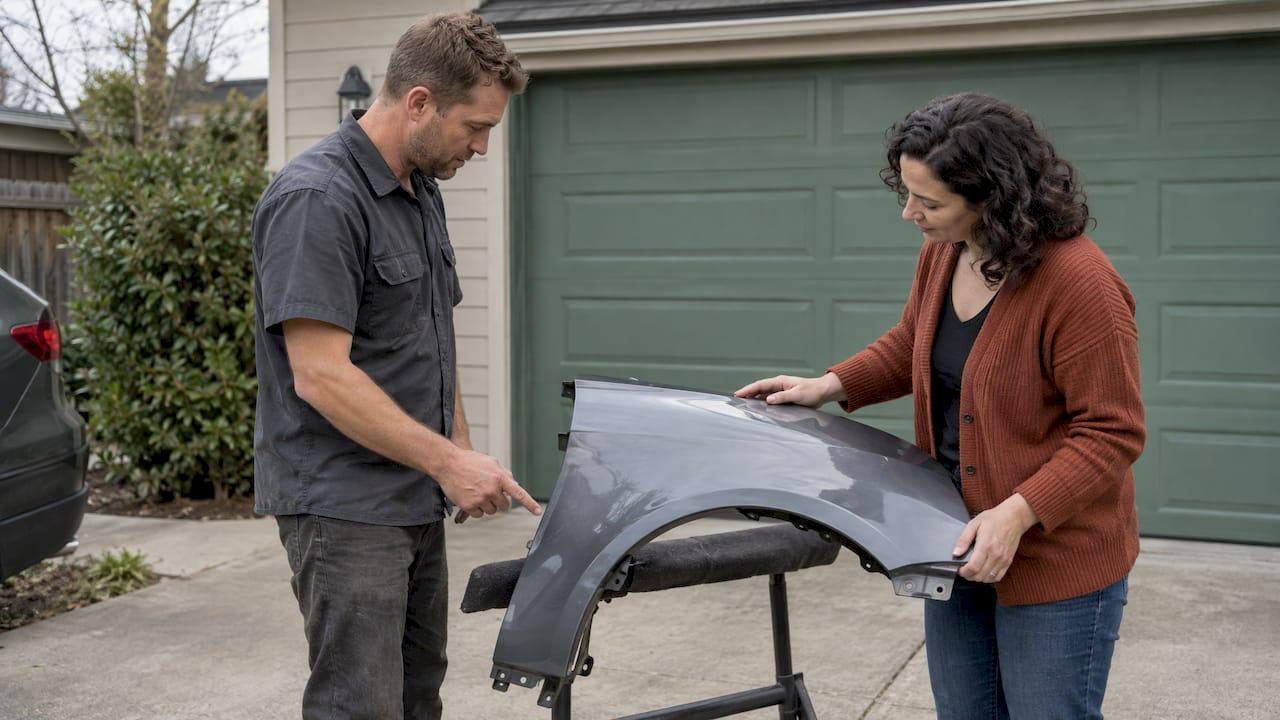
The fastest way to sell car parts locally is to list each part on a local marketplace with its exact part number, an honest condition grade, a price built from comparable sales, and clear photos, then hand it off in person in a public place. Bulky, heavy parts like bumpers, wheels, seats and alternators are exactly what local selling suits: no crating, no freight quote, and the buyer can see the part before paying. On MarketplaceAnywhere, you list in the Vehicle category, buyers nearby find you with location-based search, and you talk through instant chat.
TL;DR
- Identify the part first: the part number, the donor vehicle's year, model and mileage, and what is included. Buyers search by these.
- Price from sold comparables for the same part number, not from asking prices, then adjust for condition and for local pickup.
- Photograph every defect and every label or connector. If a buyer would have to ask about it, a photo should already answer it.
- Meet in a public place, let the buyer inspect the part, and settle payment through secure checkout where you can.
- List where nearby buyers already search, so a heavy part never needs shipping.
Table of Contents
- Why local is the right way to sell car parts
- Step 1: Identify exactly what you are selling
- Step 2: Price used car parts from comparables
- Step 3: Photograph the part so buyers can decide
- Step 4: Write a listing buyers can trust
- Step 5: Handle questions and offers
- Step 6: Hand it off safely
- What to expect when selling parts versus the whole car
- A seller's view from MarketplaceAnywhere
- List your parts where local buyers look
- FAQ
- Sources
Why local is the right way to sell car parts
Car parts are awkward to ship. A fender, a hood or a transmission costs a lot to pack and send, and a buyer who can't hold the part before paying hesitates. Local pickup removes both problems. If you want to weigh the trade-off in numbers, our guide to shipping versus local pickup covers fees against reach for sellers in general.
The buyers you want are close by: people repairing a daily driver this weekend, hobbyists restoring a project car, and neighbors who would rather pay a fair price for a used part than a full price for a new one. They are searching by location, and they want to pick up soon. That is the buyer MarketplaceAnywhere puts in front of you, with push notifications that alert them to new listings and instant chat to settle questions in minutes instead of days.
This is also an easy way to clear out the garage. If you have a shelf of parts left from a repair, a wheel set from an upgrade or a trunk full of spares from a car you sold, each piece can become cash. Our garage sale versus online comparison explains why listing online reaches more of the right buyers than a driveway table does.
Step 1: Identify exactly what you are selling
Before you write a word of the listing, find out what the part is. A used part sells when the buyer is sure it fits. A vague listing makes them ask, wait or move on.
Collect these details:
- The part number. Look for a stamped or printed number on the part itself, often on a label or casting. Wipe off grease and take a clear photo. Keep any suffix letters or digits, because they can separate versions that look identical.
- The donor vehicle. Write down the year, make, model, trim and approximate mileage of the car the part came from. The Automotive Recyclers Association's standards and codes say a description should include the part's condition, the donor vehicle's year and model, and its mileage so the right part reaches the repair. Professional recyclers describe parts this way for a reason, and a casual seller who does the same stands out.
- What is included. Say whether the brackets, bolts, wiring pigtails, sensors or trim pieces come with it. A buyer values a part that arrives with its mounting hardware.
- Whether it works. If you removed it from a running car, say so and say how you know. If you never tested it, say that too.
If you are not sure the part number matches other models, search the number in the listing text. Many parts are shared across several vehicles, so naming the part number lets people with a different car recognize it as a match. A buyer who searches for "alternator" plus their model will find you if you list the models you know it fits, and only those.
Step 2: Price used car parts from comparables
This is where most sellers go wrong. They either guess low and lose money, or look at what others are asking and price into a crowd of listings that never sold.
The method that holds up is simple:
- Search for sales, not listings. Use a national auction site's completed or sold listings and search the exact part number. An asking price only shows what someone hopes for.
- Match the comparable carefully. The same part number, the same vehicle generation, a similar condition, and similar contents (with or without hardware, tested or untested). Sales from the last one to three months are the most useful.
- Drop the extremes. Ignore the highest and lowest sale, and use the middle of what remains.
- Adjust for local pickup. A local sale has no shipping to pay and no online selling fees on the buyer's side, so buyers expect a lower number than the shipped price. Many sellers price noticeably under the shipped sold price for that reason, which also helps the part move quickly.
- Check the local competition. Search your own area for the same part. If two others are listed, price to be the clearest and best-described offer, not simply the cheapest.
Grade your condition honestly
A simple four-step scale keeps your listing clear and your price consistent:
| Grade | What it means | Pricing against a typical sold price |
|---|---|---|
| A | Removed from a working car, tested or known good, clean | Full comparable price |
| B | Very good, minor cosmetic marks | Slightly below the comparable |
| C | Good, visible wear but functional | Noticeably lower, often by a quarter |
| D | Fair, heavy wear or cosmetic damage | About half the comparable or less |
The percentages are rules of thumb, not fixed law. A cracked tab on a headlight housing that is hidden once installed matters less than a scratch on a visible door panel, and buyers think in those terms. An untested electronic module should sit clearly below a tested one, because the buyer takes on the risk.
A worked example
Suppose you are selling a headlight assembly from a car you sold. This is an illustration, not a market quote. You search sold listings for the exact part number and find several recent sales around $200, one at $90 that was cracked and one at $350 for a new-in-box unit. You ignore those two. Your part is clean, with no cracks, and was working when removed, so it is Grade A. You are selling locally with no shipping, so you list it somewhat under $200 and keep a little room for the buyer to negotiate. If the lens were hazed, you would drop one grade and price accordingly, and say so in the title.

For general pricing habits that apply to anything you sell, our guide on how to price used items so they actually sell is a good companion. If you sell parts regularly in smaller amounts, check how selling app fees affect $25 to $100 sales before you set your floor price, since fees take a larger share of small sales.
Seasonal demand matters a little too. Parts tied to the weather, such as air-conditioning components in hot months and heating components in cold ones, tend to move faster when the weather turns, so time your listing for when buyers are looking.
Step 3: Photograph the part so buyers can decide

Photos do most of the selling. A buyer scrolling a local feed decides in seconds, and a part with a single dark photo looks like a risk.
Clean the part first. Wash and degrease it, but do not hide the wear. The rule is to clean the part, never to clean up the part. A buyer who finds a scratch you did not show them will argue about the price at the handoff, or walk away.
Take these shots:
- A full view of the part on a plain, well-lit surface, such as a clean garage floor or a sheet of cardboard.
- Every label or stamped number, close enough to read, so a buyer can check it against their own.
- Every electrical connector, square-on, so they can see pins and clips are intact.
- Mounting points, holes, threads and tabs, because these decide whether the part fits and whether it has been repaired.
- Each defect, one clear frame each: cracks, corrosion, chips, bent brackets, stripped threads. A crack that is photographed plainly and described in the listing sells to the buyer who can weld it or live with it.
- Everything included, laid out together, so the buyer sees the hardware and wiring you are offering.
Eight to twelve photos is a reasonable target for most parts. A smaller bolt-on part needs fewer, an engine or transmission needs more. The principle of showing wear and details openly is the same for any used item, as this guide to showing wear and details in photos shows for instruments.
Step 4: Write a listing buyers can trust
Use a title that carries the facts buyers search for: the part name, the year range it fits, the make and model, and the part number if it fits. Then write a short description in this order:
- What it is, and the vehicles it fits.
- The donor vehicle's year, model and mileage.
- Condition grade, and any defects in plain words.
- Whether it has been tested, and how.
- What is included.
- Pickup area and when you are available.
Do not claim a fit you have not confirmed. If you are not sure whether the part fits a certain trim, say "fits the models listed, check your part number before buying." Everything the buyer would otherwise ask in chat is a question you can answer once in the listing, which saves you a dozen messages.
Put the listing in the right place. Parts of the kind this article covers belong with the vehicle listings; if you are selling accessories like a car stereo or dash camera, Electronics is also a reasonable home. You can browse the categories on MarketplaceAnywhere.
Step 5: Handle questions and offers
Expect three kinds of messages: "is it still available?", "will it fit my car?" and "what is your lowest price?"
- Fitment questions. Ask the buyer for their year, model and, if they are willing, the part number on the old part. Compare it with yours. If you cannot confirm a match, say so rather than guess. If you can't supply what someone needs, helping them figure out what else might work is good practice, and it is what professional recyclers' standards expect of them.
- Price questions. Decide your lowest price before you list. Because you priced from real sales, you can hold firm politely and explain: "That is in line with recent sales for this part number." A fair counteroffer is fine, a lowball is not worth chasing.
- Availability. Mark the listing sold as soon as it is gone, so you stop getting messages.
If you have a lot of parts and want a steady flow of local buyers, read how to turn local sourcing into sales, which covers building a repeat routine for small sellers.
Step 6: Hand it off safely
A local sale is simple when both sides follow a few habits.
- Meet in a public, well-lit place. A busy parking lot in daylight works for most parts, and many police departments offer designated exchange spots. For a heavy part that must be carried to a car, bring it to the meeting place yourself.
- Let the buyer inspect it. A buyer should be able to look at the part, check the number against their old one, and confirm that mounting points and connectors look right. A seller who has photographed honestly welcomes this.
- Agree on testing before you meet. If a part can only be tested on a car, say whether the buyer may bring it for a bench test or whether it is sold as-is, and write it in the chat so both of you have it on record.
- Be clear on returns. Say plainly whether the sale is final. Making this clear before the meeting prevents disputes after.
- Take payment in a way that protects you. Use the platform's secure payment where possible, and be careful with checks, overpayment offers and requests to move the chat elsewhere.
- Bring a friend or tell someone where you are going for larger meetups.
Our breakdown of local delivery versus pickup and the safety checks for each handoff goes through the options in more detail. If what you are selling is the whole car rather than its parts, see how to sell your car locally.
What to expect when selling parts versus the whole car
Sellers sometimes ask whether it is better to part out a car or sell it whole. The answer depends on the car's condition, your time and your garage space. Parting out takes more work: removing, cleaning, photographing, listing and handling many small sales and many messages. Selling whole is a single transaction. If you have the time and the space, selling the individual parts that hold value, such as wheels, seats, electronics, lighting and body panels, often brings more in total. Scrap value for what is left is a separate question, usually decided by the weight and the local rate, so call local scrap buyers for the current figure rather than relying on a number from the web.
For a few spare parts after a repair, there is no question: list them. Each one is cash, and each one clears space.
A seller's view from MarketplaceAnywhere
We built MarketplaceAnywhere around one idea: the best buyer for a bulky, used item is usually a few miles away, and the best sale is one that does not need a shipping label.
Car parts are a perfect fit. They are heavy, specific and easier to judge in person. A buyer who can hold the part and read the number on it feels confident, and a seller who has described it honestly rarely has to haggle at the curb.
That is why our platform is built around location-based search, instant chat, push notifications, secure payments and verified seller ratings. Nearby buyers find your listing, ask what they need to know, and pay with protection on both sides. A seller with a record of honest descriptions builds a reputation that makes the next sale quicker.
Our advice is simple: identify the part, grade it honestly, show everything, price from real sales, and meet safely. Do that, and a shelf of leftovers becomes cash.
Marketplace
List your parts where local buyers look
If you have parts ready to go, MarketplaceAnywhere lets you list them in minutes under Vehicle, Electronics or another fitting category. Buyers nearby find them through location-based search, message you in instant chat and pay through secure checkout, and ratings from verified sellers help the next buyer trust you. Start at MarketplaceAnywhere and post your first part today.
To compare where else casual sellers list, our guides on the best marketplace apps for sellers and local selling options in the U.S. lay out the choices by use case.
FAQ
How much can I get for selling used car parts?
It depends on the part, its condition and demand. Use sold listings for the exact part number as your base, adjust for condition grade, and expect local buyers to pay somewhat less than a shipped price. Electronics and sought-after body panels usually hold more of their new price than commodity items.
What is the best way to price used car parts?
Start with recent sales of the same part number on the same vehicle generation, ignore the highest and lowest, and use the middle. Then adjust for condition, whether it was tested, and what is included. Check local listings to see what you are up against.
Where is the best place to sell car parts locally?
A local marketplace with location-based search puts your part in front of nearby buyers without shipping. MarketplaceAnywhere has a Vehicle category and instant chat for questions, so buyers can confirm fitment before they meet you.
Do I need the part number to sell a car part?
It is not required, but it helps a great deal. The number lets buyers confirm the fit, and it lets you find comparable sales to price from. If you cannot find it, describe the donor vehicle's year, model and mileage and photograph the part closely.