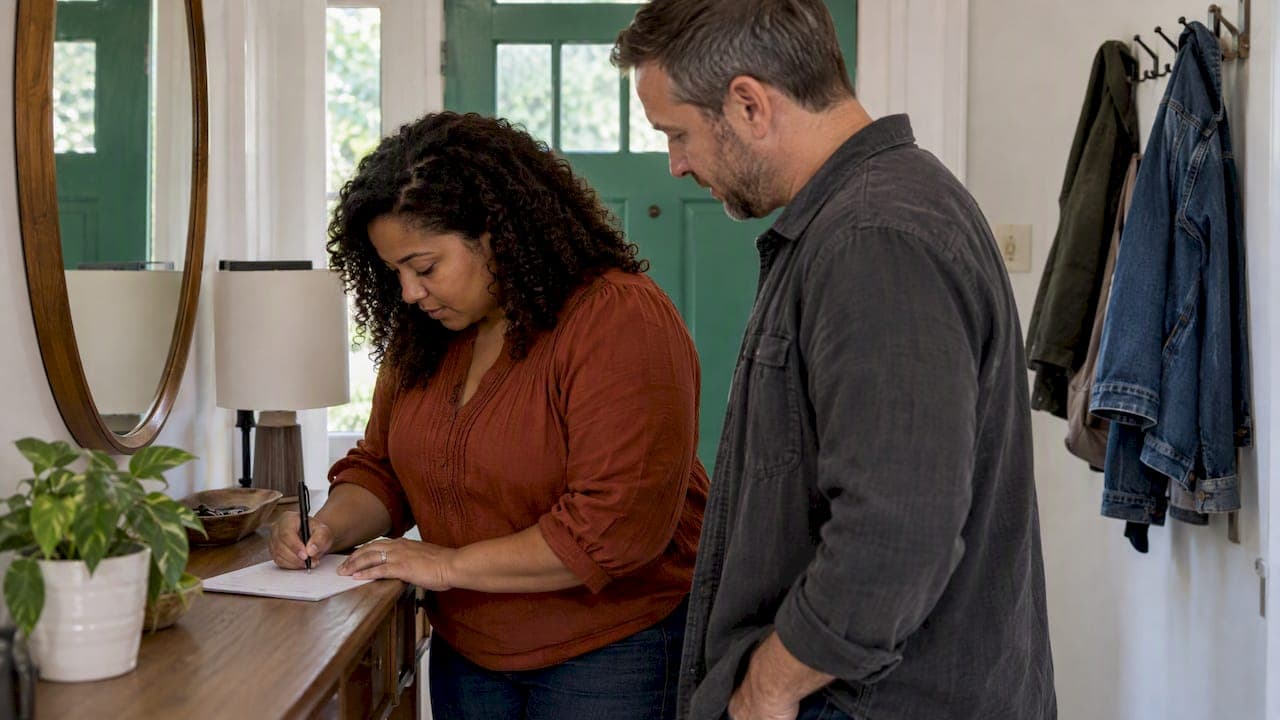
A good receipt for a private sale takes five minutes and fits on one page. Write the date, the seller's and buyer's names, a clear description of the item, the price and payment method, an "as-is" line, and get both signatures. Make two copies, one for each person. That covers almost every garage-sale, local-pickup and online-marketplace deal.
Below you'll find exactly what to put on the page, a handwritten template you can copy, how to list several items at once, when you need a bill of sale instead, and when selling isn't worth the effort at all.
TL;DR
- A private-sale receipt needs the date, both parties' names, an item description, the price, the payment method and signatures.
- Handwritten is fine for everyday items, as long as it is legible and both people keep a copy.
- For vehicles and other high-stakes items, use a bill of sale, which records the terms as well as the payment.
- Add an "as-is" line so the buyer knows no warranty is promised.
- Selling multiple items? List each one on its own line with its own price.
Table of Contents
- What a private-sale receipt should include
- A handwritten receipt template you can copy
- Receipt vs. bill of sale: which do you need?
- Add an as-is line, and know what it does
- How to show multiple items or quantities on one receipt
- When the law asks for a receipt
- Safe handling: signing, paying and keeping records
- Should you sell it or donate it?
- Perspective
- Sell locally on MarketplaceAnywhere
- FAQ
- Sources
What a private-sale receipt should include
A receipt is proof that money changed hands for a specific item on a specific day. According to one guide to receipts for personal items, a solid one lists the seller's full legal name, address (at least city and state) and a phone number or email, plus the sale date. It also names the buyer, describes the item, gives the price and payment method, states any terms, and carries both signatures. The buyer's address and contact details are optional.
Here is how to turn that into a checklist:
- Date of sale. Write the full date, not just "Tuesday."
- Seller details. Full legal name, city and state at minimum, and a phone number or email.
- Buyer details. Full legal name. Address and phone are a bonus, not a must.
- Item description. Brand, model, color, size and condition. Add a serial number for electronics, or the VIN for a vehicle.
- What's included. Charger, case, remote, extra keys, original box. If it isn't on the list, it wasn't part of the deal.
- Price and payment method. Cash, a payment app or a check. Write the amount in numerals, and in words if the amount is large.
- Terms. For example, "sold as-is, no warranty expressed or implied."
- Signatures. Both of you sign and date.
None of this is complicated. The point is that if a dispute comes up in a week or a year, the page answers the questions: who, what, how much, when, and under what terms.
A handwritten receipt template you can copy
Yes, a receipt can be handwritten. Government guidance for businesses in Australia, for example, lists handwritten receipts alongside digital ones as a normal format. For a private sale, what matters is that the information is complete and readable, not how it was produced.
Copy this onto paper, a notes app or a Word or Google Docs file:
RECEIPT OF SALE
Date: ____________
Seller: ____________ (full name) Seller address: ____________ (city, state at minimum) Seller phone or email: ____________
Buyer: ____________ (full name)
Item sold: ____________ (brand, model, color, condition) Serial number or VIN (if any): ____________ Included with item: ____________
Sale price: $________ Payment method: ____________
Terms: Item sold as-is. No warranties, expressed or implied.
Seller signature: ____________ Date: ________ Buyer signature: ____________ Date: ________
Tips for a handwritten copy:
- Use a pen, not a pencil, and don't cross out amounts. If you make a mistake, start a fresh sheet.
- Write two identical copies, or snap a photo of the signed page on both phones before you part.
- Print a stack of blank templates and keep one in your car or your bag on selling days.
You can also save the template as a reusable document or run it through a receipt generator that exports a PDF. The result is the same as long as the fields above are filled in.
Receipt vs. bill of sale: which do you need?
The two overlap. A bill of sale records a private sale and works as proof of purchase like a receipt, but it can also carry extra terms, such as a purchase agreement. A receipt for personal items is, in practice, a simple bill of sale.
The difference shows up when the stakes rise. One legal-forms publisher puts it this way: a receipt proves payment, while a bill of sale proves the terms of the transaction. Those are not interchangeable for items such as vehicles or firearms.
| Situation | Receipt enough? | Better choice |
|---|---|---|
| Sofa, lamp, kids' clothes, books | Yes | Simple receipt |
| Phone, laptop, game console | Yes, with serial number | Receipt with serial number and as-is line |
| Bike, appliance, furniture over a few hundred dollars | Usually | Receipt with detailed terms |
| Car, motorcycle, boat, trailer | No | Bill of sale, plus whatever your state requires |
| Anything where a buyer needs paperwork to register it | No | Bill of sale |
For vehicles, the same publisher notes that a receipt is not a substitute for a bill of sale. Some state DMVs ask for one, and a bill of sale supports a title transfer but is not proof of ownership by itself. Before you sell a car, check your state DMV's website for its exact requirements and forms.
Add an as-is line, and know what it does
When you write a homemade bill of sale or receipt, it is recommended to include an as-is disclaimer stating that no warranties are expressed or implied. It tells the buyer you are not promising future performance.
Two habits make that line work for you:
- Describe the condition honestly. "Works, minor scratch on the back, battery holds about four hours" is better than "good condition."
- Don't treat the line as a shield for misrepresentation. Our guide on how an "as is" sale doesn't block fraud claims explains why accurate listings matter even when you sell as-is.
If you also want to spell out whether returns are possible (most local private sales say no), the same thinking applies as for any shop. This overview of what goes into a return policy for an online store shows how clear wording prevents arguments, and a single sentence on your receipt does the same job on a small scale. For local deals specifically, see handling returns locally.
How to show multiple items or quantities on one receipt

If a buyer takes a bundle, say a desk, a chair and a monitor, list each item separately with its own price, as receipt guidance for personal sales recommends. Then add a total at the bottom.
A simple layout:
| Item | Description | Qty | Price each | Line total |
|---|---|---|---|---|
| Desk | Oak, 48 in., two drawers, light wear on top | 1 | $80 | $80 |
| Office chair | Black mesh, adjustable arms | 1 | $40 | $40 |
| Monitor | 24 in., serial no. on file, power cable included | 1 | $60 | $60 |
| Total | $180 |
The prices above are only an example of the format.
A few rules for multi-item receipts:
- If you sell identical goods, such as six matching dining chairs, one line with a quantity and a per-unit price is fine.
- Items with serial numbers (phones, laptops, cameras) each get their own line so the number is attached to the right device.
- If you gave a bundle discount, show it as its own line so the total adds up for anyone checking the math.
When you list several items on a marketplace, put the same breakdown in your listing. The buyer then sees on the receipt exactly what they saw in the ad. For help with the numbers, see how to price used items so they actually sell.
When the law asks for a receipt
For most casual sales, a receipt is good practice and nothing more. But some states regulate certain secondhand transactions. Virginia is one example: under Code of Virginia § 59.1-126, buyers of certain secondhand articles at private sales must take a dated written receipt signed by the seller. The statute spells out the seller information it must carry and requires a detailed description of the article.
That law applies to specific categories and situations, not every yard sale, so read the statute itself if you trade in used goods regularly. The takeaway for everyone else: rules differ by state and by item type. Vehicles, firearms, boats and similar goods often come with their own paperwork, so look at your state's official pages before you sell something regulated. If you sell often enough to count as a business, check what your state expects of sellers.
Safe handling: signing, paying and keeping records
The receipt is one piece of a safe local sale. A few habits go with it:
- Meet in a public place and bring the receipt already filled in, leaving only the signatures.
- Confirm payment before you sign. Check that cash is real and that a payment-app transfer has landed in your account before you hand over the item.
- Keep your copy. A photo in a dedicated folder on your phone is enough. Keep it as long as you might need it, for example for your own tax records if you sell at a gain or regularly.
- Don't write down more personal data than you need. A full legal name and city and state are enough for the seller's side. Don't put your home address if you're meeting in a public place and the form doesn't call for it.
Our local marketplace etiquette guide covers meeting spots, communication and how to keep the exchange polite and safe.
Should you sell it or donate it?
Before you write any receipt, decide whether the item is worth selling. One practical rule of thumb: sell it if it works and is likely worth $25 or more, and donate it if the time spent selling would outweigh what you'd earn. Items that are broken, stained or unusable belong in recycling or the trash, not in a donation bin.
A few details on the donation side:
- Some items are generally not accepted, such as mattresses, stained furniture and recalled children's equipment. Donation centers often can't sell them, and the nonprofit may end up paying to dispose of them.
- Usable goods can go either way. Well-worn, cracked or torn items should be set aside for trash or recycling.
As a quick test: if it works, looks decent, and local buyers search for it, list it. If it needs a repair, you may still find a buyer, as we show in how to sell broken electronics. If you have a pile of mid-value things, our guide on decluttering for cash walks through what to list first.
Perspective
Most of the disputes we hear about in local sales have the same root: nobody wrote down what was agreed. The buyer remembers a working charger, the seller remembers selling the phone alone. A one-page receipt settles that before it starts.
We built MarketplaceAnywhere around the idea that a local deal should be quick and still feel safe: clear listings, direct chat between buyer and seller, verified seller ratings and secure payments. A receipt fits right into that. The listing says what is for sale, the chat confirms the details, and the receipt records the final agreement at handoff.
Our advice to casual sellers is simple. Describe the item honestly in the listing, repeat that description on the receipt, and keep your copy. You will look trustworthy to buyers, and buyers who trust you come back and recommend you to neighbors.
Marketplace
Sell locally on MarketplaceAnywhere
Once your receipt template is ready, you need buyers nearby. MarketplaceAnywhere lets you list electronics, fashion, vehicles, pets, home and garden items, hobby gear, health and beauty products and entertainment items for people in your area. You get location-based search, instant chat and push notifications in the app, so you can agree on details and set up pickup without shipping anything.
Wondering what fees apply to small sales? Read about selling app fees for local sellers, and see where used electronics fetch the most cash before you set your price.
FAQ
Can a receipt be handwritten?
Yes. Handwritten receipts are accepted as a normal format, as in official business guidance from Australia that lists handwritten and digital options. Make it legible, complete and signed, and keep a copy. A typed version is easier to read and helps you avoid leaving something out.
Can I create my own receipt?
Yes. You can write one by hand, build a reusable template in Word or Google Docs, or use a generator that exports a PDF. Include the parties, the item, the price and both signatures. The template in this article is a good starting point.
What is the difference between a bill of sale and a receipt?
A receipt proves that payment happened. A bill of sale records the sale and its terms, and it can double as a receipt. For cars, motorcycles, boats and similar items, use a bill of sale and check your state's rules for title and registration.
Do I need a receipt if the buyer paid in cash?
It is a good idea, because cash leaves no payment trail on its own. A signed receipt shows the amount, the date and what was sold, which helps both of you if a question comes up later.
Sources
- How to Make a Receipt for Selling Personal Items
- Bill of Sale Template
- Bill of Sale vs. Receipt: Are They the Same Thing?
- Receipts and proof of purchase, business.gov.au
- 2023 Code of Virginia § 59.1-126
- What to Do With Unwanted Items: Donate, Sell, Gift, Recycle or Trash
- How to Donate vs. Dispose: A Decision Framework
- Should I Donate Used Items or Try to Sell Them?